

























































The “God Squad” is Subject to a Lot of Limits. But I’m still worried.
Getting an exemption from the Endangered Species Act is normally difficult. But there’s a scary exception.
It’s understandable that many people freaked out when a Federal Register notice appeared announcing a meeting of the Endangered Species Committee relating to offshore drilling in the Gulf of Mexico. (Actually, the notice said “Gulf of America,” but I don’t think anyone beyond Trump & Co. uses that term.) The Committee is nicknamed the God Squad, on the theory that it holds the power of life and death over endangered species. By exempting a project from the strictures of the Endangered Species Act (ESA), the Committee can leave a species to face extinction. The normal process for considering exemptions has some important safeguards to protect against abuses. However, there is a major and very worrisome exception, which I’ll discuss later in this post.
The Normal Process
An exemption request must satisfy several requirements under § 7(h)(1) of the ESA:
- There must be no reasonable and prudent alternatives to the proposed agency action. (In this case, one alternative might be increasing drilling on land somewhere else or in less sensitive waters.)
- The benefits of the proposed action must clearly outweigh those of alternatives that don’t increase the risk of extinction. (One obvious alternative in this case is for the industry to obey the limited restrictions that have already been imposed under the ESA.)
- The proposed action must have national or regional significance and be in the public interest.
- There must be no irreversible commitment of resources pending the committee’s decision that would present a fait accomplis.
- The order granting the exemption must contain mitigation measures that are “necessary and appropriate to minimize the adverse effects of the agency action upon the endangered species, threatened species, or critical habitat concerned.”
Besides the need to provide a sufficient justification, there is also a complex procedure to navigate. The Congressional Research Service has put together this flow chart of the process, which shows just how complicated it is.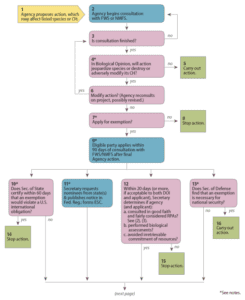
The top few steps require the agency to go through the full ESA process and get turned down before it can apply for an exemption. Since we don’t know what specific actions and which species the Committee might be currently considering, we don’t know if those steps are complete. If they are, the most onerous of the remaining steps is a requirement for a formal hearing. Unlike the procedure used for rule making, which involves only filing papers, a formal hearing is much like a trial, with witnesses and cross-examination. This process is neither slow nor easy. Also, there may need to be an environmental impact statement.
Finally, the statute provides for judicial review. Because there was a formal hearing rather than a rule making process, the government would have to show that the decision was supported by substantial evidence, that it was in accordance with law, and that the proper procedures were followed. Since an endangered species is by definition going to be exposed to an enhanced risk of extinction if the action is carried out, there may be a strong case for a judicial stay pending the final decision.
The Scary Exception
I was feeling very reassured by all this and had some snarky things to say about the Trump Administration’s effort to use this provision. But then I noticed subsection (j). It reads as follows:
” Notwithstanding any other provision of this Act, the Committee shall grant an exemption for any agency action if the Secretary of Defense finds that such exemption is necessary for reasons of national security.”
So while the Committee may not have godlike powers, the Secretary of Defense may. Invoking this provision seems totally on-brand for Trump. Do we trust Pete Hegseth to exercise that power responsibly? I’m sure he considers the Endangered Species Act unacceptably woke.
There are, however, a couple of fallback arguments if Hegseth does give the oil industry a “license to kill” entire species. First, it’s possible that Hegseth’s determination might have to pass some kind of judicial scrutiny, though there would undoubtedly be a lot of deference. Second, while the Committee may have to issue an exemption, it would seem that the Committee still has to consider mitigation measures and arguably needs to conduct a hearing to do so.
The oil industry is dutifully supporting the possible use of the exemption process. Maybe they’re really pushing it, but maybe not. They can still drill without it, and killing off an entire species of whales or sea turtles isn’t really a good look for them. Nor is being more tightly associated with an unpopular war.


About Dan

Dan Farber has written and taught on environmental and constitutional law as well as about contracts, jurisprudence and legislation. Currently at Berkeley Law, he has al…
READ more
Reader Comments