

























































Can We Avoid Another Day Zero?
From Texas to the Global South, Local Governments Need New Tools To Protect Their Water
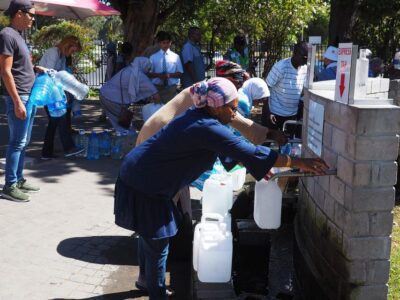
You might recall “Day Zero,” when in 2018, the City of Cape Town came perilously close to running out of water entirely. Only severe rationing and a good rainy season saved the Mother City. Now it looks like Corpus Christi Texas might be the next victim.
Two years ago, I received a Fulbright Scholarship to study how Cape Town was changing its water policies in order to avoid a new Day Zero. The Palisades Fire and the Trump Administration meant that I was unable to go (long story short: the fire burned my house down, and the Trump Administration’s new Fulbright oversight meant that it killed projects that mentioned “climate”), but I remained interested, and just completed a paper in the Law and Development Review that seeks to connect Day Zero problems with the legal weakness of local governments. Here’s the abstract:
The 21st is the Urban Century. The world’s population reached 8 billion in November 2022, with over half (55 per cent) living in urban areas, a figure projected to rise to 70 per cent by 2050, and 85 % by 2100. And urban areas are the drivers of growth: according to the World Bank, cities account for more than 80 % of global GDP and nearly 90 % of private sector job creation. If economic, social, and human development throughout the world, and especially throughout the Global South, will occur, it will do so in cities and metropolitan areas. Yet cities are also legally and politically weak. They generally lack fiscal capacity and often the authority to regulate many of the most quintessential municipal affairs. Such legal fragility poses an enormous problem for development, for cities also face massive challenges: they are often cites of inequality and environmental destruction and lack both the power and accountability mechanisms to facilitate democracy. This Article considers the extent to which cities can contest their legal and political disempowerment through resort to the courts. Local governments often possess some sort of constitutional status, comprising both rights and (more often) responsibilities. What they often lack is leverage: national and state/provincial governments often have little incentive to cooperate with local governments in satisfying those obligations. But courts can change those incentives. This essay will consider the potential for litigation-driven local empowerment in two of the most important nations in the Global South: South Africa and India. In particular, this Article will focus on one policy area traditionally (although not exclusively) handled by local governments: water provision. The development of modern urban form required the provision of clean and sanitary water, and urban jurisdictions throughout the world early on assumed some responsibility for this service, whether through public ownership or public regulation of private ownership. Yet at the same time, water is crucial for agriculture, and indeed obviously for human life no matter where people live. Water law and policy thus clearly implicates the very heart of national economic and social development strategy. Excavating the fraught politics and technical issues surrounding water, therefore, serves as a prime area to demonstrate the power of local governments in development – or lack thereof.
In India and South Africa, the problem stems to a large degree on local disempowerment: cities have no control over how and from where they get their water. That’s why in the piece, I advocate for cities to challenge retrograde national and state-level policies through the courts: they need the leverage to get higher levels of government to move.
In Corpus Christi, the problem is more subtle: as this report from Inside Climate News makes clear, the difficult is that the locals believed the state’s assessment of Texas’ water supplies — but the state had systematically excised all mention of climate impacts on water from its appraisal. The city aggressively pursued water-sucking businesses like plastics manufacturing — only to discover in 2019 that the water it was counting on wasn’t available. Now Corpus Christi is counting the days until its own Day Zero. Policy solutions might be as prosaic as cities just developing their own capacity for water assessments. The much-maligned Los Angeles Department of Water and Power has had this capacity since around 1900, and it’s a good thing that it does. DWP engineers might have been blinkered about the external environmental impacts of their actions (although as I have argued this is vastly overstated and in key places just plain wrong), but its engineers have always been laser-focused on what they needed to do to keep water coming out of the taps.
Water supply and sanitation is a key function — one might say the key function — of urban government. It stands to reason that urban governments must have the practical, institutional, and legal tools to deliver. Other levels of governments simply will not do it. As I argue in the article, South Africa and India show this to be true. And we might very well learn it from Corpus Christi within a matter of weeks.


About Jonathan

Jonathan Zasloff teaches Torts, Land Use, Environmental Law, Comparative Urban Planning Law, Legal History, and Public Policy Clinic – Land Use, the Environment and Loc…
READ more
Reader Comments