
















































Ban The Palm?
Streets For All Wants To — But Is it More About Attention Than The Environment?
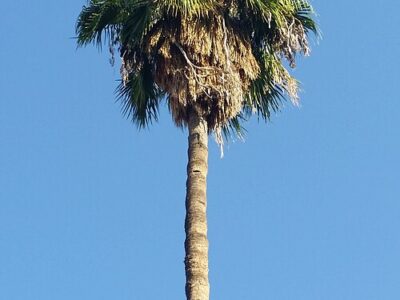
Nine times out of 10, when you see a graphic about Los Angeles, somewhere in it you will see a palm tree. It’s the iconic image of this city. When Walter O’Malley built Dodger Stadium, he made sure to include towering palm trees at the Stadium.
The problem is that that’s mostly a lie.
Palm trees are not native to Los Angeles. They are tropical plants, and this region is very much not tropical (at least not yet). Only one species derives from southern California, and it is not the most common one on the city’s streets and boulevards. So why are there so many palms here? Unsurprisingly, it’s from civic boosterism: thousands of palms were planted in preparation for the first time Los Angeles hosted the Summer Olympics, in 1932.
Now, an advocacy group, Streets For All, has decided to make a splash about it.
Streets For All has launched a social media campaign “Palm trees are a scam”, blasting the trees for guzzling water, providing little shade and being dangerous during fires and high winds.
“Time for LA to replace Palm Trees with trees that provide actual shade and cool down our city,” the group declared.
“Palm trees suck at doing the one thing trees need to do in cities: provide actual shade,” the group argued.
They want the city to plant more broad-canopy trees, such as sycamores, which the group says provide more shade and help cool city streets.
On one level, SFA’s argument makes sense: if you are trying to create shade – and in the realm of climate adaptation, we will very much need to – taking out palm trees makes sense.
But the rest? Not so much.
Consider the notion that palm trees are water-guzzlers. Some are, but many – including my personal favorite species, the Canary Island Date Palm – are not, once they are mature. It would make no sense to plant palms to start with, but once they are fully grown, they are actually drought tolerant.
Indeed, between the water required to grow new trees – even drought-tolerant ones – and the energy required to plant and care for new saplings as well as disposing of the old ones, it might cost more in water and carbon emissions than it would save.
And even when it comes to shade, SFA is assuming that it is a zero-sum game. It’s not like Los Angeles is stuffed full of palm street canopies. Sure, there are a lot of them, but there are also hundreds of streets with no trees at all – many of them in low-income communities of color. It makes no sense to whine about tearing down the trees: just plant new ones!
So why is SFA insisting on this? There are two possible overlapping reasons:
My own sense is that this is a rhetorical tick that has become prevalent on the Left, especially in recent years. Don’t like something? Think it is suboptimal? Don’t improve it: scrap it. Police are too brutal? Defund the police. Private health insurance is bureaucratic and unresponsive? Ban it under a single-payer system (which among developed nations, only Canada does). Sometimes this impetus has a lot of force: ICE is so thoroughly corrupt and brutal that it cannot be reformed. But that is a last resort, because institutional transitions are really complicated and hard. (Which Revolution would you prefer: Glorious or French? Gandhi or Mao?)
The real cynic in me, however, thinks that this might have more to do with the Attention Economy.
After all, a campaign to plant trees is nothing new: Tree People has been around for decades, and when he was mayor, Antonio Villaraigosa promised to plant a million trees (so much for that). One more campaign to plant trees is unquestionably valuable and unquestionably old news.
A campaign to tear down palms? Now that attracts attention. It gets people talking (or even blogging). It seems edgy and radical. It builds an organization’s brand. And that, I think, is really what’s driving this. Put another way, as with so much “radicalism” nowadays, it is just about building market share.
That’s not the most appetizing politics in the world, but it is the world we live in, and we will probably just have to get used to it.
Reader Comments
One Reply to “Ban The Palm?”
Leave a Reply


About Jonathan

Jonathan Zasloff teaches Torts, Land Use, Environmental Law, Comparative Urban Planning Law, Legal History, and Public Policy Clinic – Land Use, the Environment and Loc…
READ more
Hmm. No, I think we should *actively work* against the growing tide of stupidity.
I think the youngs don’t know what they are missing (in terms of newspapers and fact-based discourse, flawed though it always was and is). And we should be telling them at every opportunity. If we don’t tell them, how *could* they know?
Yes, they may tune us out to a certain extent. But some of the message might get through.
As for this new campaign, it is probably mostly an online, X type of thing. Mostly astroturf, in other words. The sad part is the low-information voters who fall for this garbage.
I am with you on the need for more trees though. (In fact, love of trees is a decent chunk of why I so despise the yimbies. However, not to obsess over that.) I also tend to not like people who go on and on about “native” this and that. It’s too late for that, no?
Thank you, though, for applying at least this much scrutiny to the ceaseless onslaught of New Left propaganda. it is sickening and I can see why you are kind of throwing up your hands. This kind of sh*t is why we got stuck with voldemort again. I mean, it’s on a lower level, but it is the same, imo.