





















































Sharing Our Advice with California’s Next Governor
Climate and Environmental Policy, Process, and Governance: Advice for California’s Next Governor
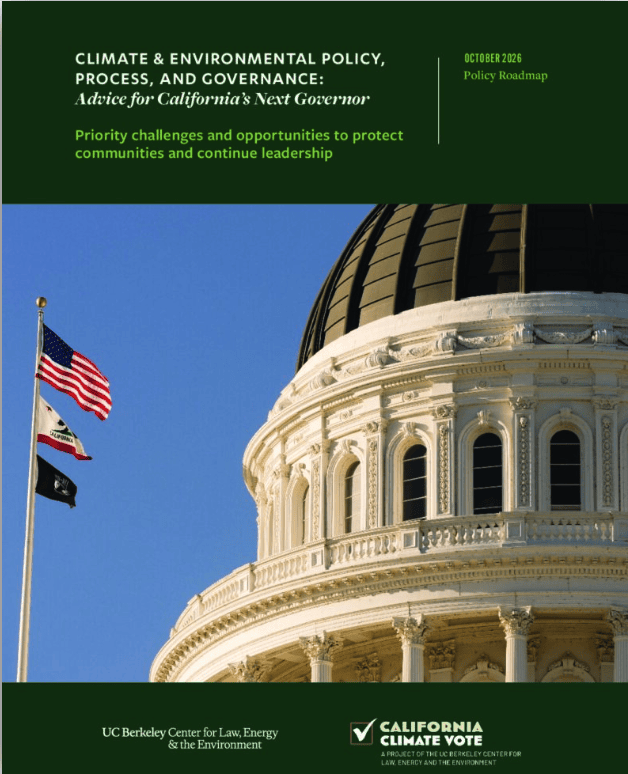 Over the past year, CLEE partnered with dozens of organizations and individuals to develop and share information on key energy, environmental, and climate change topics in California’s gubernatorial election. This work included co-hosting a forum with candidates in January focused on energy, environmental, and climate change topics; development of a series of policy briefs that we shared with the campaigns and the public; and other outreach and engagement activities. We have now integrated and built on that work in a new report that provides advice for California’s next governor.
California is at a critical moment for climate and environmental issues. As the Fifth California Climate Change Assessment shows, the state is already experiencing severe impacts from climate change and these are expected to worsen. Issues of affordability, access to insurance, growing worries about jobs and the economy, and other issues have surfaced tensions in decisions on environmental actions. And, on top of those pressures, hostility from the federal government toward California, the State’s authority, clean energy, and environmental protection threatens to undermine environmental progress, harm public health, and disrupt economic and industry development.
We developed this roadmap in this context. We share our recommendations with humility, knowing that the path forward will require difficult decisions, trade-offs, and, critically, strong leadership, passion, and commitment by the State’s next leader. We believe that this is not only possible, but necessary, in order to protect the State’s people, natural resources, infrastructure, and economy.
In this post, I am sharing our five cross-cutting recommendations for the next governor. These are actions that we believe will make a large impact and enable many of the other recommendations in the report.
- Establish Collaborative Action Teams: Many of the most pressing climate, environmental, and energy challenges require coordinated action by multiple state agencies and, in some cases, local and federal government and other institutions. This includes electricity affordability, accelerating clean energy development, and reducing transportation emissions. Collaborative teams, led by the Governor’s Office and empowered by the Governor, can provide fertile ground to more rapidly tackle these issues.
- Support and Expand State Environmental Sovereignty: The next Governor will need to continue to defend the State in the face of ongoing attacks on State authority, which will be critical for continuing to make progress on clean air and water. At the same time, the Governor can lean into areas of State’s authority to continue making progress – for example using state authority over clean electricity and transmission to develop integrated approaches to achieving clean transportation and energy goals or to exercise State leadership in Western water negotiations.
- Launch a Comprehensive State Climate Financing Strategy: Navigating the energy transition and building resilience will require significant investment. The Governor can establish a vision and direct development of a comprehensive and integrated finance strategy that includes expanded use of revolving loans and first loss positions, strategic use of limited grant funds, and insurance innovations to maximize investment and, critically, attract more private sector investment in these activities.
- Protect Communities and Promote Environmental Justice: Equity and environmental justice have been a cornerstone of California’s climate policy for the past two decades. The Governor can extend this legacy by leading in several key areas, including spearheading an energy transition plan for workers and communities, accelerating transportation electrification to meet clean air goals, and using innovative community benefits tools to deliver meaningful benefits and wealth-building opportunities in communities.
- Maintain and Strengthen Collaboration and Leadership: California’s strength derives, in part, from its partnerships that have helped scale and replicate policies and to deliver on shared commitments to emission reductions and policy innovation. Maintaining and expanding these domestic and international partnerships, especially on methane emission reductions, transportation decarbonization, and other emerging topics will be critical.
Building on these cross-cutting recommendations, the remainder of the report shares advice on breaking down government silos, maintaining California leadership, and recommendations in eight specific sectors. Over the next few weeks, we will share more on the sector-specific recommendations in the report.
California’s next governor has an opportunity to extend the State’s environmental leadership by demonstrating that achieving environmental goals while growing the State’s economy and protecting consumers, workers, and communities is possible.

About Louise

Louise Bedsworth is Executive Director at the Center for Law, Energy, and the Environment where she also serves as a Senior Advisor to the California-China Climate Instit…
READ more
Reader Comments