




























































UCLA Report Offers Framework for Resolving Coastal Conflicts
Guest contributors Maeve Anderson and Mackay Peltzer write that regulatory updates are needed to ensure California’s coastal planning remains consistent with the intent of the Coastal Act.
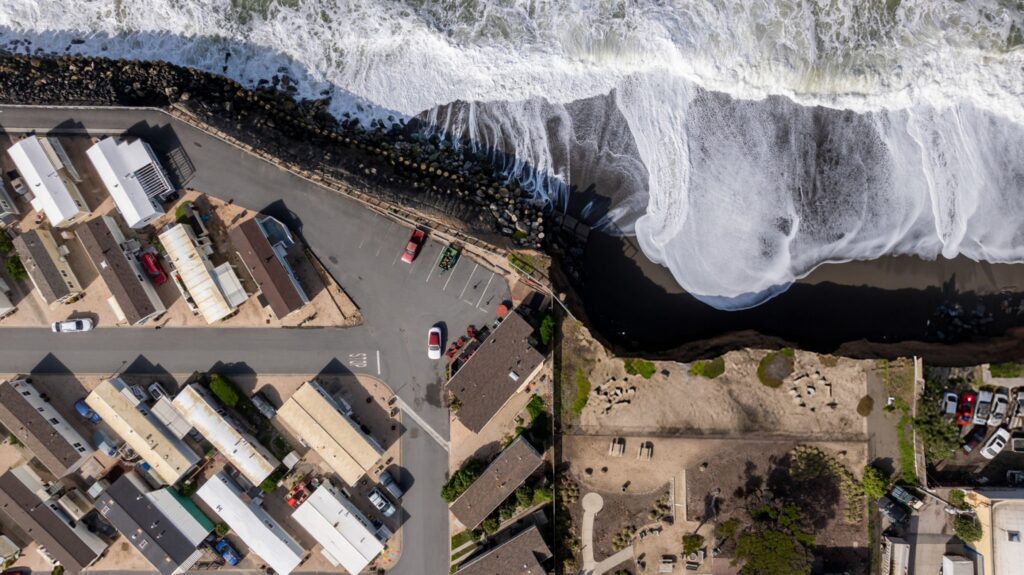
California’s iconic coastline is simultaneously a source of pride and tension for the state. As increasingly severe storms, intensified by climate change, accelerate the erosion of beaches and bluffs, the conflict around land use at the coast has also intensified. Nowhere exemplifies this reality better than the City of Pacifica, a popular surfing destination located between San Francisco and Half Moon Bay, where battles over land use planning in the wake of sea level rise have sparked vigorous debate. In a new paper titled “Conflict at the Coast” we explain why the Coastal Commission’s response to Pacifica’s land use plans sets a dangerous precedent for the many other coastal jurisdictions across the state facing similar challenges and choices.
Last May, in the culmination of a yearslong process, the City summitted an updated Local Coastal Plan (LCP)—the primary coastal land use planning document developed by California’s local governments under the state’s Coastal Act—to the California Coastal Commission. Per state law, a wave of jurisdictions must update their LCPs in the coming decade; the City of Pacifica is one of the first to present an updated LCP to the California Coastal Commission for approval. Under significant political pressure to replace the City’s 1980s-era LCP with an updated one, the Commission approved Pacifica’s submission. What makes this local land use planning document so controversial? The updated plan would permit shoreline armoring — using harmful seawalls — inconsistent with the letter of the Coastal Act. As students in the Frank G. Wells Environmental Law Clinic, we worked last year on behalf of the Surfrider Foundation to research and analyze Pacifica’s proposal and we testified at the Commission.
To arrive at this decision, the Commission relied heavily on the Coastal Act’s rarely invoked conflict resolution provisions (Coastal Act Sections 30007.5 and 30200), which require that conflicts between the Act’s provisions be resolved in a manner that, on balance, is the most protective of significant coastal resources. Because there is no set process to conduct this balancing, the Commission used a highly discretionary approach that centered shorter-term considerations and speculative harms and allowed “temporary” armoring that may become permanent and worsen sea level rise impacts on Pacifica’s coastline. Now there’s a risk that other LCP update processes will follow the same path. The issues at stake extend far beyond Pacifica, implicating how multiple California municipalities will respond to sea level rise, the seriousness with which they will approach climate adaptation, and the tradeoffs they are willing to make to protect coastal property and infrastructure.
In other cases where a Commission decision will necessarily result in a conflict between two Coastal Act provisions — for example, when ecological conservation activities could result in a reduction of public recreation opportunities — the Commission has taken different approaches, none of them with a clear process for determining how the conflict should be resolved, Our report illustrates how the Commission’s inconsistent application of the Coastal Act’s conflict resolution provisions could lead to more decisions that undermine forward-thinking sea level rise planning and create uncertainty for local governments as they navigate the LCP update process. We suggest that the Coastal Commission adopt a uniform, transparent conflict resolution process to ensure that decisions affecting the California coast meaningfully advance the Coastal Act’s fundamental goals.
The limited statutory and legislative history and case law interpreting the conflict resolution provisions largely leave the task of operationalizing the provisions to the Commission and localities. Without clear statutory or legislative guidance, a review of past Commission decisions reveals an inconsistent application of the Coastal Act’s conflict resolution provisions. Across staff reports, there is significant variability in how conflicts are identified and a general lack of rigorous assessment once a conflict is determined to exist. The Commission has no defined factors or criteria for how to actually weigh the competing policies and considerations to determine which resolution to the conflict is “most protective” of coastal resources. As a result, the existing process leaves the Commission with broad discretion to elevate certain policy considerations over others without a transparent or consistent rationale.
The Commission’s lack of a uniform conflict resolution process and use of substantial discretion leads to inconsistent, unpredictable results for important land use planning decisions. This adversely affects communities by threatening the coastal resources that the Commission is directed by the Coastal Act to protect. In Pacifica, the Commission weighed speculative future harms to water quality and marine resources more heavily than the ongoing harm to coastal resources and public access caused by beach erosion accelerated by armoring and accordingly approved the City’s LCP. Without rigorous protocols in place for conflict resolution assessment, the Commission was able to sidestep the required protection of coastal resources mandated by the Coastal Act and delay meaningful coastal land use planning in Pacifica.
To ensure California’s coastal planning actually remains consistent with the intent of the Coastal Act, regulatory updates are needed to replace today’s ad hoc and opaque conflict resolution practices with a uniform and transparent framework. The process should mandate an explicit evaluation of factors, including benefits and downsides for each decision path. Further, clearer protocols must be established for distinguishing between long-term and short-term effects and between hypothetical or speculative harms as opposed to tangible, evidence-based impacts. With over thirty other local governments in the process of updating LCPs or awaiting Commission review, a regulatory update is urgently needed. We must ensure future decisions comply with the Coastal Act and do not set a dangerous precedent by favoring temporary armoring solutions over thoughtful land-use planning that protects coastal resources for all Californians, now and for future generations.
Download the paper here.
Guest contributors Maeve Anderson and Mackay Peltzer are UCLA School of Law students (J.D. ’26)
Reader Comments
One Reply to “UCLA Report Offers Framework for Resolving Coastal Conflicts ”
Leave a Reply

About Guest

Legal Planet welcomes contributions from policy partners and professors from other environmental law programs.…
READ more
Query whether it’s a bad thing for members of the Coastal Commission to retain discretion to exercise their personal judgment and apply their personal values in resolving conflicts among provisions of the Coastal Act. Setting regulations that seek to eliminate such discretion may elevate a vague desire for consistency over fact-based resolution of such cases on their particular merits.