




























































Honoring Dolores Huerta
Huerta has received the Eleanor Roosevelt Human Rights Award, the Presidential Medal of Freedom, and four honorary degrees–so why is her name rarely mentioned without Chávez’s?
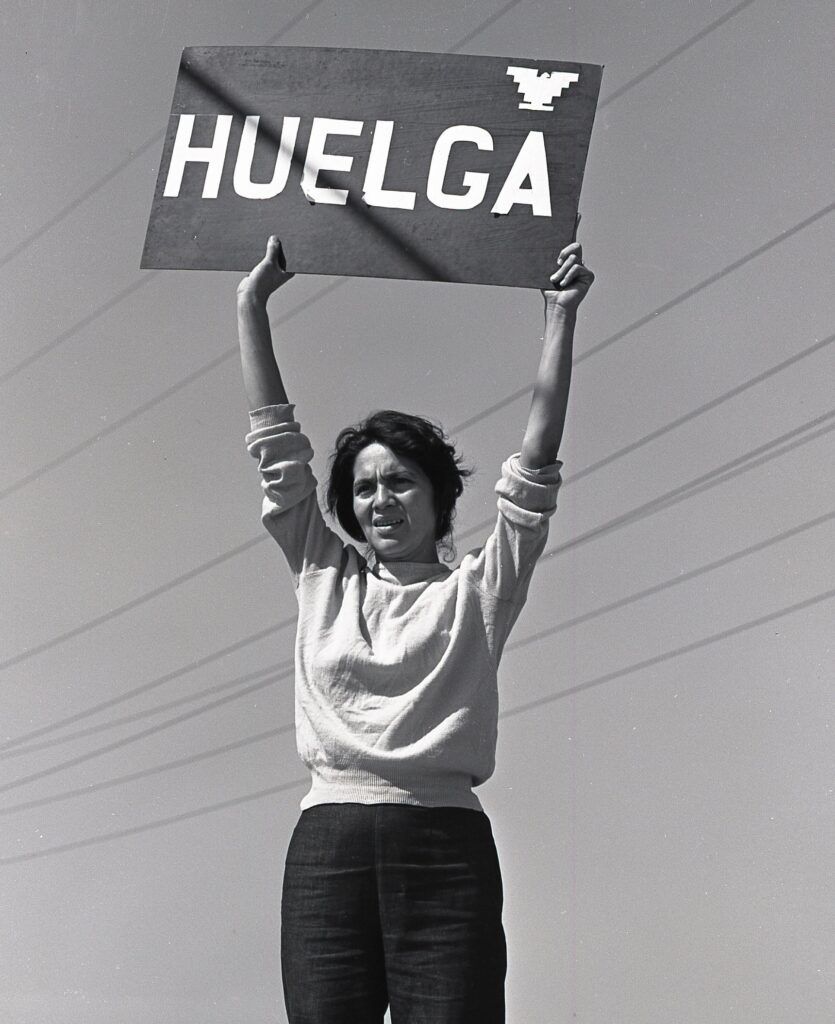
Content Warning: Sexual Assault.
Over the next week, as we draw nearer to California’s first “Farmworkers Day,” we’re undoubtedly going to see Dolores Huerta’s name in the news a lot. But unfortunately, I fear that the focus will be more about the recent New York Times investigation revealing that César Chávez sexually abused numerous women and girls—including Huerta, Ana Murguia, and Debra Rojas—for years during the height of the Farm Worker Movement—and less about Huerta’s incredibly impressive decades-long career organizing and advocating for farmworkers, consumers, women, and the environment.
Although we absolutely should continue to share survivors’ stories and shed light on Chávez’s abhorrent actions, we must not forget to showcase Huerta’s, and other survivors’, strength and resilience in ways unrelated to their abusers. Thus, while I encourage everyone, if they are able to do so, to educate themselves on the full history of the farmworker movement—the good and the bad—this is the last time this post will mention Chávez. Instead, I want to take this opportunity to honor Dolores Huerta and the ways she has shaped, and continues to shape, the environmental justice movement.
As someone building a career at the intersection of the environmental justice and labor movements, Dolores Huerta has been a personal heroine of mine for as long as I can remember. Indeed, Huerta’s life is one of the best examples of what intersectional movement work should look like, and why it is so important. Although Huerta’s activism predates Kimberlé Crenshaw’s introduction of the term “intersectionality” by at least a couple of decades, she has always advocated for issues connecting labor rights, racial and economic justice, and women’s rights. This is, at least in part, why Huerta’s work has been so impactful—regardless of whether she is advocating for farmworker health, equal access to public lands, and water justice, or speaking out against corporate greenwashing or mass incarceration, she remains steadfast in her commitment to the ultimate goal of building a world where people are treated as more important than profit.
The issue of pesticides is most often viewed as an environmental issue, or even a consumer issue, but the campaign to ban spraying DDT and other dangerous pesticides was born out of the labor movement. As I wrote about in a previous post, under Huerta’s leadership in the 1960s and ‘70s, the United Farm Workers (UFW) organized and demanded regulation of the use of harmful pesticides because exposure to these chemicals was causing disproportionate rates of cancer, birth defects, and other severe health issues in farmworker communities. Huerta actually led two consumer boycotts of grapes—the first in the late 1960s and the second in 1973—to pressure growers and lawmakers to provide better wages and protections for farmworkers. The second boycott led to the creation of the California Agricultural Labor Relations Act of 1975, a first-of-its-kind law that still protects farmworkers’ right to organize for better working conditions to this day.
In the decades since, Huerta has continued to critique corporations, such as Driscoll’s, for their use of pesticides and call on consumers to boycott their products. But Huerta’s advocacy is not limited to the issue of pesticides. For example, she has also engaged in advocacy surrounding the transition from fossil fuels to clean energy. Huerta has been a longstanding and vocal advocate not just for the clean energy transition in general, but also for building solidarity between the labor and environmental movements on all fronts. There is a perceived division between the movements, but in reality, this “division” is nothing more than corporations and people in power pitting the movements against each other in an effort to weaken them both. As Huerta has previously explained,
“I wouldn’t call it a division. What you have are people who work in the oil fields all over the United States. We know that we have to transition those oil jobs to green jobs. But people need to get paid a living wage, a wage to support their families regardless of where they work. It’s not that they’re loyal to oil. I think the vast majority of oil workers or coal miners would be happy working in another industry as long as they’re paid adequately.”
This is why Huerta also works to ensure that any federal or state funds committed to clean energy do not end up back in the pockets of oil and gas executives. Although the energy transition will benefit both the environment and the health of workers everywhere, any benefit will be short-lived if we allow clean energy funds to simply make the rich richer. There is no environmental justice without a safe, healthy, and well-paid workforce, and vice versa. This is the type of lesson that Huerta has always kept at the forefront of her advocacy, and that we should as well.



About Tiffany

Tiffany Deguzman (she/her) is the 2025-2027 Shapiro Fellow in Environmental Law and Policy at UCLA School of Law, where her work will focus on sustainable agriculture, wa…
READ more
Reader Comments