













































Does Taking Oil Money Disqualify You from Being Governor?
The Drain is a weekly roundup of environmental and climate news from Legal Planet.
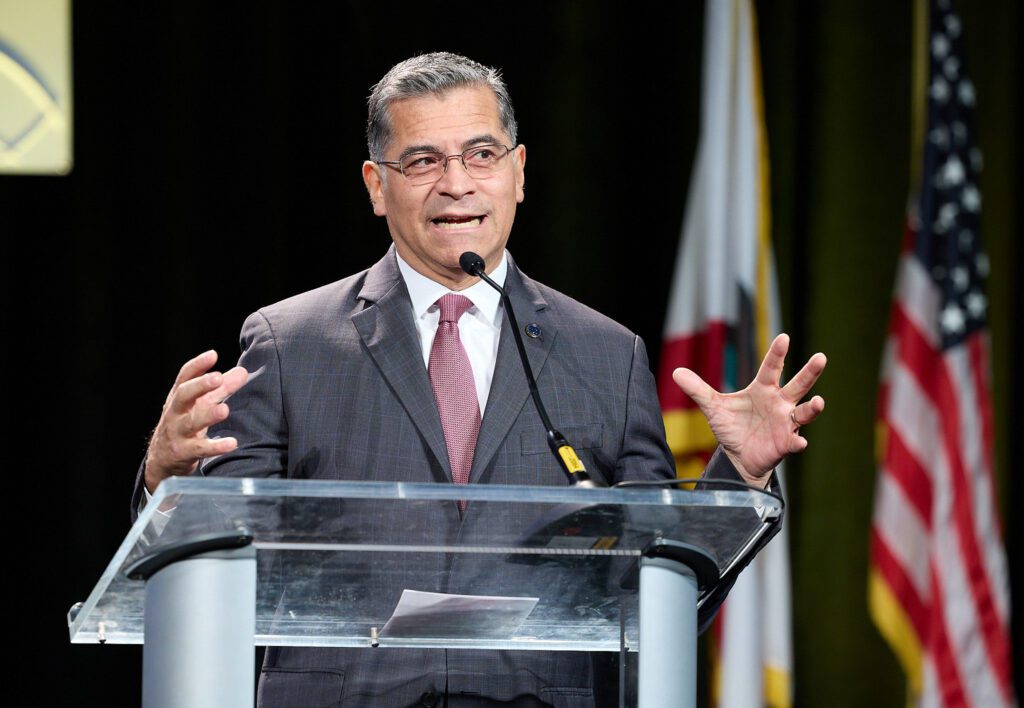
UPDATE: At the time I published this article, Xavier Becerra had received the max contribution from Chevron of $39,200. Since publishing, Becerra has received much more support in the form of independent expenditures. As of May 21, Chevron had given $500,000 to an independent campaign committee supporting Becerra for governor. As of May 12, California Resources Corporation — one of the state’s largest oil drillers — had given $500,000 to the independent committee supporting Becerra.
The race to be California’s next governor has managed to be both wild and underwhelming, with a wide field of candidates who are competent but not exactly captivating. Exciting or not, voters are starting to tune in.
If the environment and climate change rank among your top concerns, who should you vote for? My Legal Planet colleagues from UC Berkeley have an ongoing series examining the climate issues in the race and while we don’t do endorsements, I have some observations.
Tom Steyer and Katie Porter received a dual endorsement from the California Environmental Voters and the endorsement of The Climate Center Action Fund. Why? Because according to The Climate Center they are the two candidates who won’t take oil money, will stand up to corporate power, will invest in nature, and won’t prolong the fossil fuel era.
Tom Steyer of course is a longtime climate activist and anti-billionaire billionaire. After building a hedge fund empire and making a fortune (off fossil fuels among other industries), you could say he’s seen the light. He’s credited his religious faith for bringing him to a spiritual form of environmentalism. Observant reporters have noticed that Steyer draws a Jerusalem cross on his hand to remind himself to be truthful. He has supported candidates as a donor, backed several successful ballot measures taking aim at corporate power, and unsuccessfully run for president. He says California is “uniquely positioned to continue to lead, further cementing itself at the forefront of clean energy, innovation, climate mitigation, and adaptation.”
Katie Porter is the consumer lawyer and former whiteboard warrior in Congress representing Orange County. She has taught at UC Irvine School of Law. She was appointed by then-Attorney General Kamala Harris to be California’s independent monitor of banks in a nationwide $25 billion mortgage settlement. She famously flipped her congressional seat from red to blue and wielded said whiteboard to take on corporate interests—and polluters—during congressional hearings. She says that “preparing for and responding to disasters that strike California will be one of the most important roles of our next Governor.” She lost a previous run for a U.S. senate seat but had an eight-point plan for fighting polluters and climate change.
A few weeks ago, I started thinking about Xavier Becerra. He’s one of the only candidates who has actually held statewide office or run a big government agency. As state Attorney General, he has a record of taking on polluters and protecting the environment. He sued the Trump administration more than 100 times. More recently as the head of the U.S. Department of Health and Human Services, Becerra connected public health and the environment by launching a new government office to address the health threats of climate change. Becerra has climbed in the polls this month, and snuck into the feeds of Instagram influencers, but he’s not high on any environmental voter guides.
Earlier this month I posed a question on social media: Why isn’t Becerra scoring more points with climate activists? I quickly got my answer on Bluesky. “Problem is he’s still taking money from the fossil fuels industry, so I don’t feel like I can trust him,” replied David Sacerdote. “Lots of other candidates refuse that money.” Although I’d seen California Environmental Voters cheer Steyer and Porter for saying “no” to Big Oil contributions, I hadn’t yet noticed Becerra failing to do so. “Chevron maxed out to Becerra,” RL Miller, the Political Director of Climate Hawks Vote, pointed out. “He’s a non-starter among climate folks.” (Search the campaign finance records at CalAccess.) By Monday of this week, the issue had fully entered the discourse.

So, should taking Big Oil contributions disqualify you from being governor of California?
Becerra supporters might argue that it’s easy to reject Big Oil money when you’re a self-funded billionaire like Steyer, while their guy had to fight for every donation at the start of the campaign. Fair enough, but Katie Porter also swore off oil money, and she’s done alright. Becerra backers might also argue that he has a track record as Attorney General and HHS Secretary of holding corporations accountable even if they donate to his campaigns. Twenty years ago, you might be able to make that argument with a straight face. But knowing what we know now about the fossil fuel industry’s decades-long campaign to undermine the consensus on climate change, it’s hard to take that argument seriously. Each legislative session, we witness the oil industry’s continued stranglehold on political power in Sacramento. Chevron is not just the second-largest oil company in the U.S., it is a firm with California history that recently moved its headquarters from Northern California to Texas and that is constantly threatening to leave the state entirely if it doesn’t get what it wants (fewer taxes and emissions rules). Chevron and its lawyers are in many ways leading the charge against climate lawsuits, which includes the lawsuit by the state of California against Chevron. All of this points toward the benefits of a governor not having any fresh financial ties to Chevron, even if political litmus tests are less than ideal. Part of me wondered if Becerra, seeing his new surge in the polls, regretted having taken oil money.
At a recent candidate forum, Becerra got that question. KQED’s Scott Shafer asked Becerra why he took money from Chevron and Southern California Edison. “Why do they support you?” Shafer asked.
“It’s a free country,” Becerra replied. “Chevron — that’s the problem with politics — they’re not the bad guy. Does everybody here drive an electric vehicle? You need Chevron, I need Chevron, my people of the state of California need Chevron,” Becerra said. “It’s unfortunate that we use these tags and paint with these broad brushes. Chevron wants to give me a check, that’s their prerogative… Some of these candidates are saying ‘He took a check from Chevron, so he’s gotta be bad on the environment.’ I say look at my record and compare to their record.”
Luckily, someone has done just that. Last week, the Center for Biological Diversity Action Fund evaluated the five highest-polling candidates for governor of California) and gave them an overall environmental grade. Here’s how the democrats in the race did:
Tom Steyer: A
Katie Porter: B+
Xavier Becerra: C+
Steyer is the most climate forward. He’s airing a new ad touting his experience taking on Big Oil. He designated himself a “climate advocate” on the ballot and describes himself as the “#1 climate candidate” in mailers. He’s endorsed by Our Revolution. He has sat for multiple longform interviews with climate journalists, like Dave Roberts and Emily Atkin, demonstrating that he can go deep on electricity, grid utilization, retail competition and answer tough questions. In last night’s debate, Steyer tried to drive home that Big Tech, Big Oil, and investor-owned utilities are spending big bucks to defeat him. “If you want change, there is only one person on this stage they are afraid of,” he said.
Given his place in the polls, other candidates (Porter included) have slammed him for profiting off past investments in polluting industries. But when it comes to the subject of making polluters pay now? The Center for Biological Diversity Action Fund gave Steyer, and him alone, an A+.
Welcome to The Drain, a weekly roundup of environmental and climate news. Our song this week is “Throwing Stones” by the Grateful Dead. It’s one of the 70 songs on my Climate Playlist.
Fossil Fuel Phaseout and Science
Some 57 governments gathered this week in Santa Marta, Colombia to discuss how to speed up a global phase-out of coal, oil and gas. They’re joined by 400 academics and 1,500 delegates from Indigenous peoples, businesses, cities and other sectors, Inside Climate News reports.
“Let this conference be the moment when ambition becomes action,” Colombia’s environment minister, Irene Vélez Torres, said during the opening plenary. “Let’s make this a turning point in history.”
My UCLA Emmett Institute colleague Ted Parson has a new essay at Legal Planet, arguing that the phaseout of ozone-depleting chemicals under the Montreal Protocol offers a model for how the Santa Marta conference participants could think about a fossil fuel phaseout.
Chinese government leaders published a policy document on Earth Day – that calls for stricter controls on fossil-fuels and greater oversight of heavy emitters. Carbon Brief says this is the first high-level document to explicitly link decarbonisation efforts with energy security and industrial development.
Republican allies of Big Oil are unfairly smearing the objectivity of an independent climate report from the National Academies of Sciences, Engineering and Medicine on the harms of human-caused climate change, Liza Gross reports for Inside Climate News.
The Trump administration on Friday afternoon via email dismissed members of an independent board that oversees the National Science Foundation, which finances much of the public scientific research in the United States, Adam Sella reports for NYT. “National Science Board members worry that their firing, along with the threat of funding cuts, could have wide-ranging national consequences.”
The EPA’s prestigious research office spent decades doing scientific work insulated from political pressure. Now it’s being dismantled and Lisa Friedman has the inside story of how.
“Can the EPA survive Lee Zeldin?” asks Elizabeth Kolbert in a profile of the administrator for The New Yorker that paints him as someone trying to “move fast and break things.” Kolbert is on WHYY’s “Fresh Air” with Teri Gross this week.
Energy

Electricity is “the most underrated issue of our time,” writes Robinson Meyer in an interactive Op Ed for the New York Times, “and if we don’t meet this moment, we will face an impoverished future of more expensive, less reliable energy, and slower economic growth.”
Maine’s governor on Friday vetoed a bill that I’m mentioned here before that would have made Maine the first state in the country to enact a temporary ban on new data center development. A handful of projects that emerged in the past year appear ready to move forward, according to the Press Herald.
Boston Mayor Michelle Wu has laid out her roadmap to help the city slash greenhouse gas emissions by 2050, WBUR reports.
U.S. District Judge Denise Casper ordered the Trump administration to stop stalling renewables permitting, Jael Holzman reports. “The ruling is a potentially fatal blow to five key methods the Trump administration has used to stymie federal renewable energy permitting.”
The cost of building new gas plants in the U.S. has risen 66 percent from 2023 to 2025, and the time needed to bring a facility online has also increased by 23 percent, according to Bloomberg.
Battery project developers are increasingly encountering communities afraid that large lithium-ion storage farms could spontaneously burst into flames, Todd Woody reports for Bloomberg.
New data from Ember show that China’s solar exports reached a record 68 gigawatts in March — double the previous month. It’s more proof that the global energy shock is pushing countries to rapidly pivot away from fossil fuels, according to Electrek.
The French utility giant Engie is reportedly in talks with the federal government about getting a payout for its U.S. offshore wind leases, following the lead of TotalEnergies, which was given $1 billion to not produce energy.
Tandem PV has built an automated factory line in California to pump out large panels of glass treated with a photovoltaic perovskite coating that it says can improve solar panel efficiency by one-third, Julian Spector reports for Canary Media.
And gasoline prices in the United States rose yesterday to their highest level in four years.
Los Angeles
Feeling miserable? UCLA’s Luskin School of Public Affairs released its annual Quality of Life in L.A. County index and our qualify of life dropped to 52 percent, the lowest level ever recorded. “More than half of respondents said they were unsatisfied with wildfire recovery efforts, while many worried about how they might respond to the next disaster or crisis,” the LA Times writes.
Los Angeles remains the most ozone-polluted metro area nationally for the 26th time in 27 years, according to the 2026 State of the Air report. Across California, 82 percent of residents live in counties affected by unhealthy air.
Data collected by UCLA, UC Davis, University of Florida and the U.S. Forest Service will be some of the most extensive ever gathered to understand how the urban tree canopy fares in the face of increasingly catastrophic fires in an era of human-caused climate change. It includes “data on more than 2,000 trees — about 600 in the Palisades and 1,500 in Altadena — to analyze how they may recover after the fires and their role in the fires’ spread,” Erin Stone reports for LAist.
California

I recently wrote about a state bill that would have empowered California’s attorney general to sue fossil fuel companies to recover insurance losses from wildfires and other climate-fueled disasters. That bill, SB 982, died last week. It was killed in a key committee even after Sen. Scott Wiener got it through the Judiciary Committee by making some big changes to it, Stephen Hobbs reports for the Sac Bee. The measure, which had the backing of Extreme Weather Survivors and several other groups, continued to develop a novel approach to help cover the costs suffered by the California FAIR Plan.
California’s Energy Commission voted to approve the massive 300-MW Soda Mountain solar-plus-storage project in the Mojave Desert at the urging of climate advocates and over some local opposition.
The California Chamber of Commerce collected more than 945,000 signatures — twice what’s required — to qualify a measure on the November statewide ballot to overhaul CEQA, Paul Rogers reports for the Mercury News.
Attorney General Rob Bonta filed a lawsuit against Trump accusing EPA of failing to enforce Biden-era standards for soot pollution.
Four state lawmakers wrote a letter to California Energy Commission Vice Chair Siva Gunda demanding a plan to address “a supply chain already in crisis” and criticizing California’s “overreliance on global markets.”
State lawmakers should focus on “smart policies that lower costs for consumers, dampen price volatility and protect our environment” and not listen to the oil industry, Ryan Cummings and a co-author opine in the LA Times. “More drilling in California would not insulate the state from price spikes, because the price of oil is determined on the global market.”
Tai Milder, appointed by Newsom in 2023 to lead the newly-created Division of Petroleum Market Oversight within the CEC, sat down with Noah Baustin for POLITICO.
The offshore wind scam has reached California: One of three companies has canceled its plans to deploy turbines off Morro Bay in a deal with the Trump administration. Ocean Winds, which owns the Golden State Wind project, agreed to end its lease in the Morro Bay Wind Energy Area, reports the SLO Tribune.
CalMatters’ Levi Sumagaysay spoke with the five leading candidates for Insurance Commissioner to learn what they would do if chosen to lead the California Insurance Department.
A new UC Santa Cruz study finds that many of the state’s valuable and most recognizable trees could decline sooner than expected because current risk calculations don’t incorporate climate change
Meanwhile, new UCLA research has found ecosystems can recover in mere decades. Timo Metz, the UCLA postdoctoral researcher and first author of the study, published in the journal Nature told the NYT that “none of us expected it to be so impressive and so quick.”
Now in its fourth year, SF Climate Week reportedly doubled in size from 2025, with roughly 60,000 people choosing from more than 700 events.
On Earth Day, Gov. Newsom announced plans for three new state parks in the Central Valley: one along the Feather River in Yuba County, another along the San Joaquin River near Fresno, and one in Bakersfield.
Climate Interventions & Extreme Weather
The critical Atlantic current system appears significantly more likely to collapse than previously thought after new research found that climate models predicting the biggest slowdown are the most realistic. Scientists called the new finding “very concerning” as a collapse would have catastrophic consequences for Europe, Africa and the Americas.
In a study published in the journal Science Advances, Dutch researchers show that building a 50-mile-long dam across the Bering Strait could, maybe, prevent a collapse of the AMOC.
A new nonprofit called the Arctic Stabilization Initiative launched to “evaluate whether targeted interventions can slow dangerous” warming near the Earth’s northern pole. So far, ASI has raised $6.5 million in philanthropic funding toward a five-year budget goal of $55 million to study whether MCT, as mixed-phase cloud thinning is known, could help save the Arctic.
Erin Sikorsky and Shuchi Talati have an essay at Lawfare about how two new reports exemplify how focusing on SRM through an extreme security lens alone can undermine productive research and governance.
A new United Nations report maps how extreme heat is tearing through every layer of the global food system but as Grist reports it mostly overlooks the people at the heart of it.
Here’s a new communication challenge: A 2026-2027 El Niño event might actually make Americans care less about climate change, Jeva Lange writes at Heatmap News. “If an El Niño mellows out some extreme weather trends in the U.S. this year and next, it could also mellow some of the sense of urgency to act.”
Media News
Satellite images have long helped investigative journalists gather intelligence on conflict zones and track changes in remote landscapes. Now, reporters are leaning on AI machine learning models to automate parts of this work and scale up their analysis to an unprecedented degree, Andrew Deck reports at Nieman Labs.
Spreading hate about heat pumps? A string of scammy accounts compare heat pumps and clean heating technology to a “lawn mower that never stops” and depict installers as “environmental fraudsters” and “swindlers”. Desmog connects the campaign to a French PR executive with links to the gas industry.
Reader Comments
8 Replies to “Does Taking Oil Money Disqualify You from Being Governor?”
Comments are closed.

About Evan
Evan George is Director of Communications for the UCLA Emmett Institute, a leading environmental law center. He also writes The Drain, a weekly roundup of environmental a…
READ more
Thank you for this! I see the governor race piece exactly the same way. I really want to like Becerra, especially with his environmental justice history, but everything I’ve seen from him in this race has been a little disappointing? And saying chevron isn’t the bad guy, when they have around half a century of climate deception history, is wild to me. What about those EJ communities suffering because of Chevron? In my opinion, history is only relevant if it’s consistent with their current views—and it doesn’t seem consistent currently?
My concern about Steyer is that he has no record in the legislative process. Yes he passed an initiative, but that’s not what a governor does. Steyer has relied on political consultants to send his message but we already have an example of a billionaire with no governing experience–he has bypassed the legislative process entirely and his legacy will be short-lived if he lets the electoral process run its course. Steyer doesn’t seem to have the charisma and warmth of Schwarzenegger that enabled the latter to have legislative success. If Steyer had been at least a city councilmember I’d be much more comfortable supporting him. I think he will instead try to steamroll the Legislature without the deeper public support that Trump has been able use. That means that Steyer won’t be effective at enacting his agenda, as attractive as it sounds. Instead, I’m left searching for the most viable Democrat in a primary field that the party failed to winnow down.
Since I do not accept California’s approach to land use planning – shoving more and more people into “infill” areas, with absolutely no regard for their quality of life or mental health, or, well, anything about them as human beings at all – it doesn’t concern me much what the “environmental groups” have to say about the goob race. To me they are all just going along with Big Real Estate. Like the CDP as a whole and the entire Leg. So, whatever, is what I say to them.
But I still don’t know who I’m voting for. Boy would it have been nice to have ranked choice voting.
Unfortunately, the two GOP candidates are both Trompy. So, I don’t think I can go there. Bc, we should otherwise really be trying to pick which one of them makes the runoff. That would be the smart thing to do, no? I am not sure being precious about oil is wise. We all burn it, even today. Where’s the purity?
What a mess.
Fair point, Richard. But Tom Steyer does have legislative endorsements, and I might argue that having served in Congress years ago is not as helpful for being CA Governor in 2026 as running several ballot measures. Here’s a few of Tom’s endrosements:
Damon Connolly
Assemblymember
California State Assembly, District 12
Dr. LaShae Sharp-Collins
Assemblymember
California State Assembly, District 79
Nancy Skinner
Former State Senator and now on CEC
Tina McKinnor
Assemblymember
California State Assembly, District 61
Liz Ortega
Assemblymember
California State Assembly, District 20
Here’s more:
Henry Stern
California State Senator
Nick Schultz
Assemblymember
California State Assembly, District 44
Steve Bennett
Assemblymember
California State Assembly, District 38
Corey Jackson
Assemblymember
California State Assembly, District 60
Tasha Boerner
Assemblymember
California State Assembly, District 77
Lola Smallwood-Cuevas
State Senator
California State Senate, District 28
Caroline Menjivar
State Senator
California State Senate, District 20
Mia Bonta
Assemblymember
CA State Assembly, District 18
Toni Atkins
Senate President pro Tempore Emeritus
CA State Stenate
I’m not sure”…measure on the November statewide ballot to overhaul CEQA…” is a good description of the CoC’s initiative. “measure…to gut CEQA” is probably closer to the truth.
Giving a candidate who has never held office of any kind, never had to draft or negotiate on legislation, or balance competing political interests any kind of ‘grade’ against others who have had to represent real constituents across political ideologies is an insult to our intelligence. Color me unimpressed with these kind of endorsements.
Steyer has worked on several ballot measures:
Voters approved Question 6—an initiative backed by Steyer’s group NextGen America to increase renewable portfolio standards—for the second time on November 3, 2020.
Steyer’s group NextGen America was involved in the campaigns for three ballot initiatives to increase renewable portfolio standards in three states in 2018.
Steyer campaigned on California ballot measures during the 2016 election cycle, with the majority going to support the statewide tobacco tax increase measure Proposition 56.
Steyer “all but single-handedly sponsored Proposition 39, spending nearly $29 million” according to Reuters. Proposition 39 passed, requiring out-of-state businesses to calculate their California income tax liability based on the percentage of their sales in California.