
























































The Supreme Court Rules in Favor of Bayer
Bayer gets the litigation relief it was looking for in the Monsanto Roundup case.
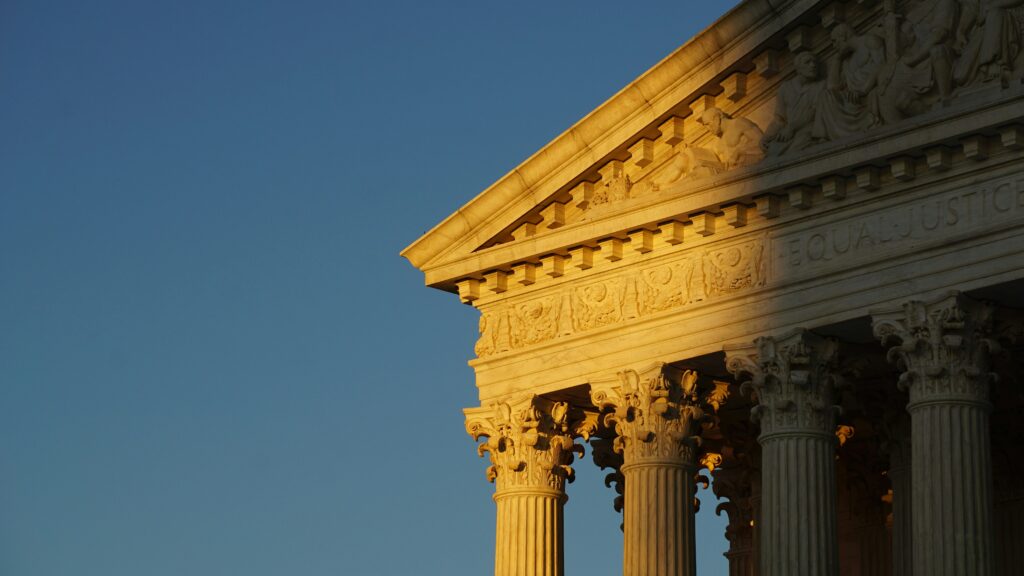
The Supreme Court has ruled in favor of Monsanto in its ongoing effort to contain its vast and growing litigation exposure stemming from its best-selling product, Roundup—the most popular weed killer in the world. In a decision by Justice Kavanaugh (joined by six other justices), the Court held that FIFRA expressly preempts the state law failure-to-warn claims that have been brought against Monsanto for failing to warn Roundup users that glyphosate (the active ingredient in Roundup) causes cancer.
These state failure-to-warn claims stemmed largely from a 2015 conclusion by the World Health Organization’s International Agency for Research on Cancer (IARC) that glyphosate is “probably carcinogenic to humans” – in contrast to EPA’s continued claim that glyphosate is not carcinogenic.
Since the IARC finding, Roundup has been the subject of many thousands of lawsuits over its links to cancer, leading to more than $11 billion in settlements with Monsanto, which the German multinational chemical company Bayer purchased in 2018. Bayer’s litigation exposure has grown to such levels, in fact, that the company has threatened to stop producing the chemical altogether. This case thus represents part of a multi-pronged effort by Bayer, together with its allies in Congress and the Trump administration, which urged the Supreme Court to take the case, to contain that exposure. And today, it got the relief it was looking for from the Supreme Court.
As discussed in two previous blog posts (see here and here) as well as a recent podcast on Bloomberg, the 7-2 decision is not surprising. In my view, there was always a relatively clear path for a majority of the justices to find express preemption. What was somewhat surprising was the fact that Justice Gorsuch joined Justice Jackson in dissent (more on that below) and that Justice Thomas issued a concurring opinion that joined the majority decision in full while making several broader points about what he called the “underlying constitutional infirmities” of FIFRA, including that various provisions of FIFRA, such as those regulating individual use of a pesticide, likely exceeded Congress’s commerce clause authority and that the broad delegation of authority to EPA was an unconstitutional delegation.
The majority’s holding basically adopted Bayer’s main argument: FIFRA includes an express preemption provision that prohibits states from imposing labeling requirements on pesticides that are “in addition to or different from” those required by EPA under its registration of the pesticide. In this case, John Durnell’s claim in Missouri state court that Monsanto had failed to warn him that glyphosate could cause cancer was thus expressly preempted by FIFRA because it would impose a pesticide labeling requirement that was “in addition to or different from” the EPA required label, which has never included a cancer warning given that EPA has repeatedly concluded that glyphosate does not cause cancer.
Justice Jackson offered a spirited dissent, arguing that the majority effectively ignored FIFRA’s ongoing prohibition against misbranding of pesticides. In her view, FIFRA’s fundamental requirement is that all pesticides must carry warnings that are “necessary and adequate” to protect the public from unreasonable risks and that these warnings must be adjusted as new information becomes available. Here, the state law failure-to-warn claims operated in parallel to the federal labeling requirements (rather than in addition to them) because they simply required only what FIFRA also requires: that all pesticide labels continue to be “necessary and adequate” to protect public health. Thus, when new scientific information becomes available that renders an existing label inadequate, the pesticide is misbranded and the states are free to impose new labeling requirements to ensure that the label once again meets the “necessary and adequate” threshold as required under FIFRA.
In my view, this is a plausible and more health-protective reading of the statute, but it was always hard to imagine four other justices signing on. While one might generally expect Justice Gorsuch to vote with his conservative colleagues on a case like this given the text of the express preemption provision under FIFRA, his strong commitments to state sovereignty likely carried the day.
In essence, the majority took a straightforward, formalist approach to the statute and read the express preemption language as precluding anything that is not part of the EPA approved label. The dissent, on the other hand, looked to the broader substantive goal of the statute to protect against misbranded pesticides—a goal that, Justice Jackson maintained, allows states to play a parallel role in ensuring that labels meet the ongoing requirement that they contain information that is necessary and adequate to protect against unreasonable risks.
Not surprisingly, all of the decisions ignored the long, sordid history of corporate malfeasance and agency failures on glyphosate—all of which has serious implications for the whole question of whether the existing label for Roundup is in fact adequate to protect the public from unreasonable risks. These concerns have been well documented and are covered in some detail here and here. And while it is true that these issues were not before the Court and can be addressed in part through other channels of administrative law, they do raise the question of whether corporate deception and agency failures could ever render a pesticide misbranded. After today, the answer seems to be no.
As for Bayer, the decision goes a long way towards containing its litigation exposure. The company’s stock price has been rising over the last several months in anticipation of a victory in the Supreme Court and jumped significantly on Thursday after the decision was issued.
Going forward, plaintiffs like John Durnell will have fewer options, forced to rely upon alternative theories of liability. Bayer’s leverage in the ongoing settlement discussions will clearly grow. Plaintiff’s lawyers will likely look to cut a deal and move on to the next opportunity. And the MAHA faithful will have yet another reason to doubt the Trump administration’s commitments to their agenda.
Meanwhile, public health research indicating links between glyphosate exposure and cancer and other harms continues to accumulate. As noted in a previous post, the recent consensus statement by leading public health experts on glyphosate adopted at the Seattle Glyphosate Symposium (March 25-26, 2026) concluded that glyphosate can cause cancer and a range of other harms. All of which means that this saga is far from over and that, perhaps one day under a future administration, EPA will take a hard look at glyphosate safety as it discharges its ongoing obligations under FIFRA to ensure that pesticides do not pose unreasonable risks to public health and the environment.
Reader Comments
One Reply to “The Supreme Court Rules in Favor of Bayer”
Comments are closed.

About William

William Boyd is Professor of Law at UCLA School of Law and Professor at the Institute of the Environment and Sustainability. He is the founding Director of the Labora…
READ more
infuriating