








































By Our Powers Combined, We Are Captain Planet
Facing climate disasters, the GCF Task Force is putting the network theory of governance into practice.
I don’t need to tell you that the last several months have seen an increasing number of climate-related disasters, including severe heatwaves throughout Europe and droughts that are impacting water supply and reducing ship passages through the Panama Canal. This year’s super El Niño has exacerbated the ongoing fires across Indonesian Borneo. It is projected to result in significant impacts globally (drought, fire, floods, extreme storms and heat, impacted food systems, etc.). Coupled with natural disasters like the earthquake in western Colombia and a host of volcanic eruptions in Indonesia, this has been a difficult summer for the world.
But the last several months have also seen a great number of convenings, on-the-ground action, public-private sector partnerships, and capacity building exchanges that seek to confront the impacts of global warming. These efforts highlight the fact that climate change is a “global collective-action problem” that requires efforts at every level. That’s where the Governors’ Climate and Forests Task Force comes in. The GCF Task Force is a project of the Emmett Institute at the UCLA School of Law, in partnership with the Institute of Behavioral Science of the University of Colorado Boulder.
Last week, national governments gathered in New York for the 81st session of the United Nations General Assembly (UNGA), alongside a full line-up of events for New York Climate Week. While some discussions at the UNGA focused on climate change (thank you, Secretary-General Guterres!), Climate Week brought together a diverse set of actors seeking to address this global problem. These actors included governments, civil society groups, Indigenous Peoples and local community leaders, corporates and consultants, and networks such as the GCF Task Force.
Ensuring that diverse voices, experiences, and efforts integrate into collective action (combining our powers to call forth our favorite ’90s cartoon hero, so to speak) has become increasingly essential for driving climate results. The GCF Task Force demonstrates this in practice and the value this type of global initiative provides in the tropical forest and climate space. Fostering technical exchanges, capacity building, and better relationships within and across the network has also highlighted the network’s ability to undertake decentralized actions based on specific jurisdictions’ or regions’ immediate priorities, all under the framework of the network’s New Forest Economy vision. To uplift this vision, I want to share some of the activities of the GCF Task Force in September 2026:
Sept. 7-10: Manaus, Brazil. Latimpacto organized an investment-focused conference entitled Impact Minds: Connecting Us. The GCF Task Force Global Secretariat and partners in Manaus participated on behalf of the network in discussions focused on investments in the transition to a bioeconomy.
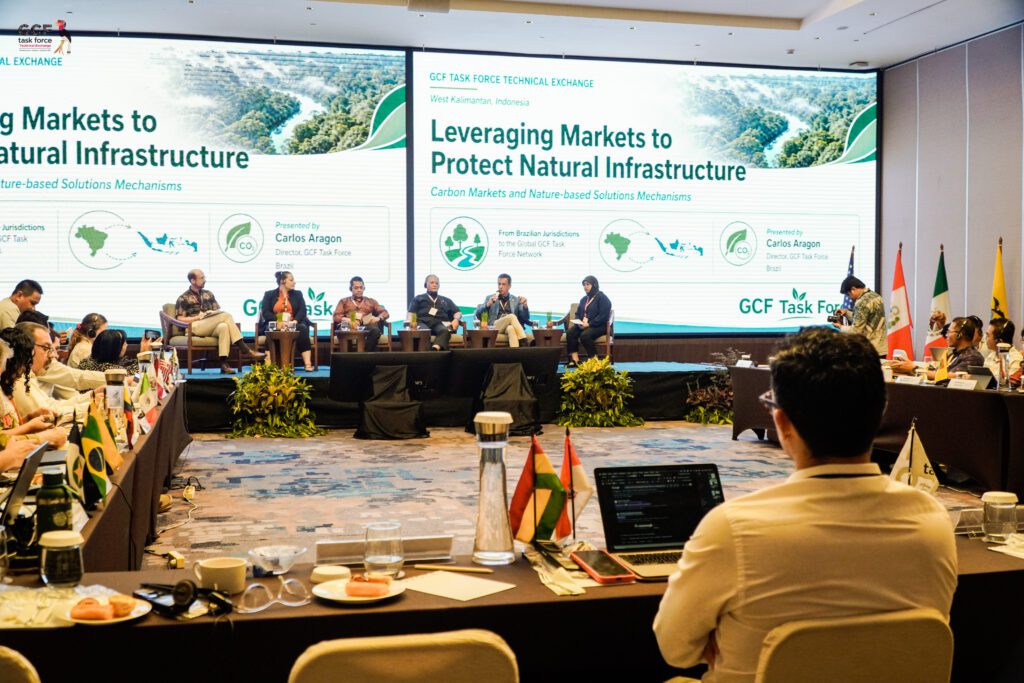
Sept. 8-10: Bogor, Indonesia. The GCF Task Force held a Technical Exchange hosted by the Government of West Kalimantan, Indonesia, focused on increasing public-private collaboration in conservation and restoration. It involved GCF Task Force members from across Indonesia, Bolivia, Brazil, Colombia, Ecuador, Mexico, Peru, and the United States, as well as private sector actors from across Indonesia and beyond. (This exchange was originally scheduled to take place in Pontianak, West Kalimantan, but had to be moved to Bogor due to fires (mentioned above). The eruption of Arak Krakatau volcano also disrupted travel and air quality for several days.)
Sept. 17-19: Piura, Peru. 10th Annual Congreso Regional Forestal from the Northern Forests of Peru. In this event, hosted by the Regional Government of Piura, the GCF Task Force and local partners engaged on topics of bioeconomy development, mangrove restoration, new remote sensing technologies, biodiversity financing mechanisms, and the need to factor in socio-environmental conflicts into forest governance efforts.
Sept. 18: Mexico. Long-time GCF Task Force partner, CTrees, supported a virtual training workshop on their new Land Use Change Alerts tool for 28 remote sensing staff from six GCF Task Force member states in Mexico and the national government.
Sept. 21-22: Santa Cruz, Bolivia. Fundacion Natura Bolivia, which serves as the GCF Task Force Secretariat partner in Bolivia, organized a two-day Climate Change and Carbon School for the Government of Santa Cruz. This is an ongoing capacity building program that will extend to national legislators.
Sept. 21-24: New York. As mentioned above, the GCF Task Force had a delegation including Governors, environment secretaries, and Global Secretariat representatives participating in New York Climate Week.
In October, the GCF Task Force will launch a webinars series around impacts of the Super El Niño and how member jurisdictions and partners are working together to address them.
If you’re not familiar with out history, the GCF Task Force arose out of an initial convening of 10 founding Governors in 2008 to respond to the fundamental problems of tropical deforestation and climate change—and the corresponding complexities of ecological disruption, biodiversity loss, food, energy, and water insecurity, and rural poverty. Since that time, the GCF Task Force has evolved into a global network of 54 states and provinces from 11 countries that includes more than one-third of the world’s tropical forest. For more than 17 years, the GCF Task Force has played a key role in supporting state and provincial governments as they work to build jurisdictional programs to reduce emissions from deforestation and land use and advance new forest economies.

Theory of Change
The founding governors and subsequent newer members understood that one state or province (or country) could not address the scope of the climate crisis alone. Rather, coordinated, collective action is the only way to confront such a global challenge. These members adopted a theory of change starting from the premise that the key obstacles facing efforts to protect forests and reduce greenhouse gas emissions at scale are:
- Political and legal fragmentation across multiple levels of governance;
- Limited incentives and support for political leaders and civil servants to focus on the climate agenda; and
- Lack of funding and institutional capacity.
To address these challenges, the Task Force believes that bottom-up, subnational approaches to protecting forests, reducing emissions, and enhancing livelihoods continue to offer important complements to more traditional top-down approaches.
Governance Structure
GCF Task Force members chose early on to organize themselves as a network with a governance structure that prioritizes knowledge exchange across its membership, builds capacity for civil servants and partners, and works toward a common vision to reduce deforestation and improve economic opportunities within their territories. The members also decided to create an Executive Committee (elected from within the GCF Task Force membership) and a global secretariat to help manage the work of the GCF Task Force and ensure its continuity. This type of governance structure follows the line of organizational research into the “network theory of governance,” which is essentially a framework for understanding how interdependent actors – in this case government agencies, their individual networks within their territories, and their broader partnerships – can best coordinate to achieve shared goals.
Understanding the type of network and how it functions is important to ensuring it is able to continue to operate and achieve its goals. In the case of the GCF Task Force, this structure allows the network to reflect that there are different legal, policy, environmental, financial, and cultural differences across its many member states and provinces, while also aligning around the shared vision of protecting forests and attracting more sustainable forms of investment for communities and businesses. This vision was most recently expressed in the GCF Task Force’s Blueprint for the New Forest Economy.
This structure helps demonstrate key elements of the network theory of governance in practice, by fostering trust and capacity building through information sharing and knowledge exchanges; enabling decentralization of actions, policies, and laws in member jurisdictions/countries (as described above); while also promoting centralized efforts to achieve common goals.
Building Trust and Capacity
Each member jurisdiction brings with it a unique set of experiences and relationships when it joins the GCF Task Force. Once a Governor designates his or her official delegates to engage within the network (typically Secretaries of the Environment and/or technical, civil servants), those individuals are introduced to peers from their own countries and across the globe.
Over the years, the GCF Task Force has organized technical exchanges (see here and here for a few examples) and larger General Assembly Meetings (see here). One intention of these is to enable the delegates to share their experiences, form closer relationships with their peers, and start to build trust within the network. This is essential to encourage members to more openly share and learn from their individual challenges, successes, and best practices; and to determine if any of those lessons can be replicated and/or scaled in other member jurisdictions. These exchanges also serve to build technical, policy, and legal capacity within member jurisdictions.
This work takes time, careful planning, and relationship maintenance, especially as new members join and during election years (for example, in 2026, 24 of our 54 members are undergoing gubernatorial elections!). Over time, through consistent organization and engagement from the Global Secretariat (along with ongoing political will and technical interest from member jurisdictions), the GCF Task Force has built a unique community of practice and trust across its delegates and Governors.
Another benefit of the years of effort to foster this community of practice is that the GCF Task Force network is better positioned to interact with other actors (e.g., Indigenous Peoples and local communities, civil society actors, the private sector, investors, academia, and other networks like Regions4 and the Under2Coaliton) within individual member jurisdictions, regionally, and globally. This is because the trust and capacity built amongst the delegates act as enabling conditions for more informed, open, and productive partnerships with these other actors, including with the important networks that each GCF Task Force member has within its own territory.
Progress toward the New Forest Economy Vision
Each of the actions described above aims to improve the enabling conditions with GCF Task Force member jurisdictions to advance with on-the-ground policies and programs that implement the shared New Forest Economy vision. Assessing progress under the network theory of governance is not as straight forward as simply reviewing changes in deforestation rates, although that is certainly one important metric, and one where members have shown progress over the years as I wrote about previously here.
In addition, the creation of a lasting network that has grown from 10 initial governmental members to 54 states and provinces, that has continued through political transitions in each of its countries, and that can quickly mobilize technical and policy experts from within and outside government to engage in exchanges, webinars, and on-the-ground implementation activities demonstrates the importance of this type of network initiative. Long-term progress toward the economic transition to a New Forest Economy requires a network approach that can identify and engage key actors within each member jurisdiction, build trust and capacity over the long run, leverage the network’s interdependencies, increase funding support, and encourage the hard move to implementation, investment, and transformation. This is the model that we’re trying to advance with the GCF Task Force.
About Jason
Jason Gray is Project Director, Governors' Climate and Forests Task Force, at the UCLA Emmett Institute on Climate Change and the Environment.…
READ more
Reader Comments