




















































The Attack on California’s Coast Puts Us in Uncharted Waters
The Drain is a roundup of environmental and climate news from Legal Planet.

California’s coast faces danger from which of these threats:
a) Increasingly likely Super El Niño
b) Super king tides
c) Rising sea levels
d) The Trump Administration
e) All of the above
If you answered “e,” congratulations. California is staring down a rare convergence of El Niño, climate-fueled sea level rise, and big waves that could bring record flooding and erosion. But the fourth, and most detestable, threat comes from Trump attacking coastal states’ long-recognized ability to protect their own coastline from the dangers of industrial uses like expanded offshore drilling and unregulated rocket launches.
The National Oceanic and Atmospheric Administration recently held public hearings to reconsider, or strip, some of the California Coastal Commission’s long-standing powers.
The Coastal Zone Management Act (CZMA) of 1972 is a federal law that outlines how to manage the nation’s coastal resources, balancing development with preservation and restoration. The CZMA establishes a voluntary partnership between the federal government and coastal states. It grants coastal states like California the right to review and object to any project in federal jurisdiction (federal projects as well as federally permitted or licensed projects) that might clash with state policy. Since then, hundreds of federal projects in California have undergone state review under the CZMA to address impacts to coastal resources.
The California Coastal Commission must follow and implement the California Coastal Management Program. To that end, NOAA conducts a formal review every 5 to 10 years — basically to ensure that the state is protecting its coast in line with the CCMP — and in fact just completed a review in California in 2024. These are called Section 312 reviews (as in Section 312 of the CZMA).
It is not hyperbole to say that California now finds itself in uncharted waters. Not only has the federal government reopened and expanded an off-cycle 312 review of California, but its justification is essentially that the state is robustly complying with its CCMP to the detriment of other administration goals. Given that no coastal state has ever faced such a process, there is some real legal ambiguity as to whether this can even be grounds for review.

There’s been great coverage of this federal attack on California’s coast from Rosanna Xia, Erin Stone, and KALW. The Santa Monica Daily Press sent a reporter to the hearing in Santa Monica to capture the backlash. “The brand of California is not offshore oil and gas,” said Grant Bixby, a real estate broker in Newport Beach who has organized business groups to protect the coast.
In the New York Times, Maxine Joselow used this unprecedented move by NOAA as Exhibit A in a trend piece about how The Trump administration has enlisted “at least a half-dozen federal agencies” to undermine California’s environmental policies. “It’s completely against a traditional Republican doctrine of respecting states’ rights,” Jerry Brown told Joselow.
The truth is California officials routinely approve all sorts of projects, from desalination plants to pipeline repair and maintenance projects. According to a fact sheet put together by California, only one desalination project of dozens has ever gone through the CZMA review process and at least 135 aerospace and space launch-related projects have been reviewed, with just two of these projects receiving objections.
So, why is this happening? The administration wants to unleash oil drilling off our coast. Look no further than the continued legal saga over offshore oil drilling near Santa Barbara and a newer proposal to resume underwater fracking on an aging offshore platform in the Santa Barbara Channel. My UCLA Law colleague Allan Marks is quoted in a Los Angeles Times story helping to explain the recent federal judge’s ruling that Sable Offshore Corp. can indeed continue pumping oil off Santa Barbara County’s coast under a Trump administration emergency order, over the objections of California officials and regulators. More of that — risky oil drilling, brash SpaceX launches — could be in our future.
What happens next is anyone’s guess because no one’s ever been here before. (Alaska is the first and only state to opt out of the CZMA but it decertified itself rather than face any federal review.) In theory, NOAA is now expected to respond to the 20,000 comment letters it received and issue findings within 120 days from the last public hearing. The CZMA authorizes the U.S. Secretary of Commerce to suspend financial assistance to a state coastal program if the state fails to adhere to any portion of its approved program or the terms of its grant or cooperative agreement funded under the law. According to that fact sheet prepared by California, if financial assistance is suspended, the commerce secretary must then provide the governor with specific actions that can be taken by the state in order to resume payments. “The suspension of financial assistance may not last for less than six months or more than 36 months after the date of suspension.” But of course, such a suspension would be challenged.
For better or worse, the coming Super El Niño, super king tides, and rising sea levels may be more predictable than whatever the Trump administration is cooking up.
Welcome to The Drain, a roundup of environmental and climate news from Legal Planet. Our song of the week is “Don’t Go Near the Water” by the Beach Boys. My climate playlist is now 500+ songs (on Spotify and Apple Music). Also, RIP to a real one, Dolly Parton. If you haven’t heard her cover of “After the Gold Rush” with Linda Ronstadt & Emmylou Harris, let it rip.
HOT HOT HEAT
Temps are hovering at 90 degrees all week where I am in Los Angeles — the hottest heat wave in a hot year. On Monday, UCLA building operations sent out an email warning that there would be “a campus-wide reduction in HVAC cooling in non-critical areas to protect patient care and research spaces.”
My 10-year-old came home from his L.A. Unified school on Monday having spent a couple hours with no AC and 100-degree temps in his classroom. Luckily, it got fixed. But it’s the kind of aging infrastructure that needs to be replaced with cleaner, safer electric systems. As Leah Stokes notes at her Substack, California’s school electrification program could be on the chopping block during this record heat wave. “If the legislature does not act by this Friday, it will sunset at the end of this year.”
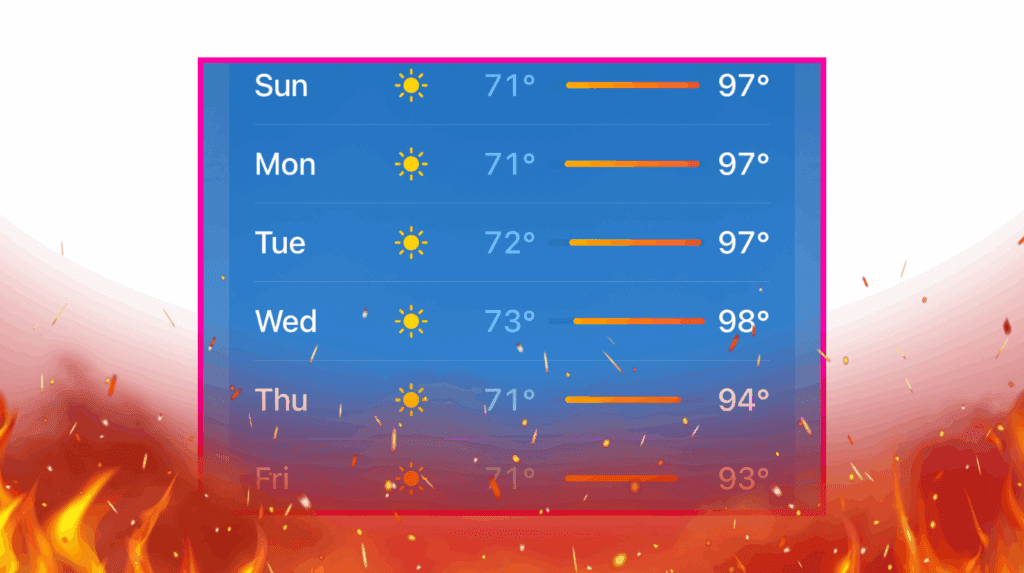
As I wrote about last week, the need to cool our buildings is rising, partly due to climate change.
One problem with this heat is that nighttime temps are not dipping and we’ve been broiling with Miami-level humidity, Alex Wigglesworth and Karen Garcia report for LAT.
And yet, LA, Orange and San Bernardino counties just recorded their driest July since record-keeping began 132 years ago, and more than half of California is currently classified as “abnormally dry.”
A July study in the journal Nature finds that cooling without relying solely on AC will be critical for adapting to climate change. Mat Santamouris, the study’s lead author, tells Axios that “we really have to avoid the solar radiation [entering] the building.” Letting that heat in and then spending electricity to remove it, he adds, “is not so intelligent.”
That growing need for air conditioning “is evidence of how badly the world has failed to decarbonize,” writes Chelsea Kirk, of Strategic Actions for a Just Economy, for Dissent Magazine. The obstacle is not technology. “It is that the buildings and energy systems on which everyone depends are controlled by private owners whose interest in protecting the value of their property and profits override our social interest in protecting the planet and ourselves.”
MEDIA NEWS
Something brand new in marketing and climate communications is hitting the shelves! The company Oatly has long promoted the sustainability of its own product, but now it’s trying an entirely different idea for a carton — one that amplifies the voice of real voters, extreme weather survivors, and climate storytellers while calling out the climate silence of politicians. The side of the box indicates 11% with the words “Politicians! These eleven words represent people not interested in climate action.” Read for yourself the much-longer passage describing the 89 percent. The move is part of the 89 Percent Project launched by Covering Climate Now. CCN’s Kyle Pope wrote about it on LinkedIn.
As senior climate editor at NPR, Sadie Babits often sends out guidance to the NPR newsroom during extreme weather to help other editors and reporters understand the role of climate change. Now Sadie is explaining the connection to readers and seeking audience questions. Good idea! “What questions do you have about climate change and its influence on extreme weather?”
ProPublica announced that Bernice Yeung will serve as editor of its new reporting hub in California. She was a member of the national Emmy-nominated “Rape in the Fields” reporting team, which investigated the sexual assault of immigrant farmworkers. The California newsroom will be ProPublica’s sixth regional investigative hub.
Dream gig: Wanna be Climate Correspondent for the New York Times? The NYT Climate Desk is looking for a “high-energy and collaborative journalist to join the team of reporters covering climate and environmental policy and politics.”
A climate reporter walks into a bar. That’s the premise of Sammy Roth‘s latest at Climate-Colored Goggles, highlighting some of the best in climate comedy. He jokes with Max Boycoff, a University of Colorado Boulder environmental studies professor who teaches a class called Creative Climate Communication, where students learn different ways of thinking and talking about global warming — including through comedy.
The Yale Program on Climate Change Communication announced that Jono Anzalone is the organization’s new Managing Director, with a background in humanitarian response, climate and nonprofit leadership, the private sector, philanthropy, and higher education.
A group of OnlyFans creators and adult film stars are trying a new approach at capturing attention to the climate crisis, Channel 4 News reports. “OnlyFans models like Lily Phillips might be the unlikeliest of climate influencers, but we meet the content creators using this platform to educate clients about global warming.”
LITIGATION
Nevada has filed the first lawsuit challenging the Trump administration’s Colorado River plan, which was released as a decision of record last Friday. The Interior Department’s Bureau of Reclamation ordered Nevada, Arizona and California to cut water use by about 20% over the next two years and it allows for much larger cuts in future years. Nevada filed the lawsuit in federal district court and Arizona has said it could also file a challenge, Ian James reports.
METHANE
The New Mexico Environment Department just proposed beefed up rules for monitoring methane leaks in order to help reduce both air pollution and natural gas waste. It would create a new statewide program to identify large methane leaks through satellite and aircraft imagery and then notify oil and gas operators in the area and require them to investigate, Source NM reports. Carbon Mapper says it’s an example of “how methane data can support smart methane policy.”
Too hot to ignore: Waste regulators across the country are letting landfills operate gas wells at temperatures far above federal limits, approving requests over and over with almost no investigation into why the landfill is overheating in the first place, a new report by Full Circle Future finds. “Warning signs are flashing at America’s overheating landfills,” is how a Bloomberg story puts it.
LEGISLATION
Introduced by Rep. Mark Messmer (R-Ind.), the Heat Workforce Standards Act, H.R. 6213 aims to kill worker heat protections proposed by the Biden administration two years ago. Those protections would require employers to provide workers with water and a cool place to rest when heat and humidity reach 80 degrees. It passed 18-15 along party lines, POLITICO’s Ariel Wittenberg reports.
California legislators are considering SB 1159, which would forbid the knowing use of AI to falsely represent that a real person engaged with or submitted information to an agency, following the scandals involving loads of fake or problematic comments being submitted at SCAQMD.
As Canary Media reports, fake comments submitted to try to kill renewable energy projects is a phenomenon roiling Ohio politics as well.
LOS ANGELES + CALIFORNIA
Last week, the California Energy Commission unanimously approved a rule that would phase in the nation’s first standards for tire efficiency. Grist reports that the rule is “designed to ensure that replacement tires sold in the state are at least as energy efficient, on average, as tires sold in the state as original equipment.” The nation’s first efficiency standard for replacement tires could save drivers roughly $1 billion in fuel costs each year.
California wildfire regulators (finally) adopted a final “Zone Zero” rule for the area around homes in fire-prone regions. The rules will go into effect for new construction as soon as they are finalized at the Office of Administrative Law, POLITICO reports.
Meanwhile, California water officials have released a new proposed water plan for the Sacramento-San Joaquin River Delta, backing an approach supported by Gov. Gavin Newsom, LAT’s Ian James writes.
Is Becerra being careful or non-committal? Unlike Republican candidate Steve Hilton who is campaigning on promises like a $3-a-gallon gas and halving electricity bills, Democratic candidate Xavier Becerra “has avoided tying himself to lofty goals in his bid to lead California,” reports CalMatters’ Jeanne Kuang.
Two dozen Democrats in the state legislature are pushing to delay fees under SB 54, the state’s landmark plastic reduction law, for two years citing cost, CalMatters’ Alejandra Reyes-Velarde reports. “This 11th-hour Hail Mary (by plastic producers) is only trying to maintain status quo and avoid due responsibility, throwing years of good-faith negotiations, and affordability and sustainability improvements out the window,” says State Sen. Ben Allen, the law’s author.
And the LA Times has a nice newsletter feature on the Angelenos who get by without a car. As someone who uses an E-bike to get to work, I love hearing people’s different approaches to driving less in Los Angeles.
DATA CENTERS + POLLUTION
Data centers could increase U.S. greenhouse gas emissions by more than 20%.
U.S. data center developers are proposing 99 natural gas plants to power their operations, and while many are unlikely to be built, a BloombergNEF analysis finds their construction could significantly raise the country’s carbon emissions. They would emit about 318 million metric tons of carbon dioxide annually if run at industry-standard rates, according to this analysis. “The entire US electric power industry emitted about 1,485 million metric tons of carbon last year, according to Energy Information Administration data, meaning one slice of data center infrastructure has the potential to lift US power sector emissions by 20%, and as much as a third should the new plants run flat out.”
A new analysis by Global Energy Monitor finds that U.S. gas-fired power capacity in development jumped 50% in the first half of 2026, with Texas leading the push.
Microsoft, Google and Amazon have all promised both to fight climate change and to develop AI responsibly so “why are they making custom AI tools to help the fossil fuel industry produce more oil and gas?” asks Emily Atkin at HEATED. She’s also asked the tech companies and is hoping to hear back.
The Trump administration wants to fast-track permitting of data centers and utility infrastructure along federal highway and railway corridors. The Transportation Department posted a public notice to that effect.
In fact, the U.S. EPA wants to kill a federal requirement that states seek public input on applications for air pollution permits for industrial facilities — data centers most notably. A coalition of nearly 200 environmental, health, and community groups filed comments late Friday urging them to think again.
Trump is also planning to permit the largest-ever gas project — a facility that will power OpenAI’s 10-gigawatt data center in Pike County, Ohio — in just 7 months, according to reporting by Jael Holzman at Heatnap News.
Heatmap also reports exclusively that a whopping 75% of Americans now say they oppose local data center development.
In Pennsylvania, Gov. Josh Shapiro vowed to slow down their development after negative ads from his Republican opponent. In Michigan, the GOP Senate candidate Mike Rogers endorsed a statewide moratorium, Heatmap News reports.
Ohio is worth paying attention to also because the National Republican Senatorial Committee has warned in a private memo to top AI companies that the massive unpopularity of data centers is killing the party’s chances of holding a vital senate seat in Ohio, Axios reports.
And on the Democratic side, a climate group called Climate Power that backs Dems is giving the party’s 2028 hopefuls and campaign committees advice on how to capitalize on waning public support for data centers, according to a new memo.
El Paso City officials and a congresswoman for the area are asking questions about recent incidents and flaring at Marathon Petroleum’s El Paso Refinery, Inside Climate News reports. “During the night of Aug. 4 into the early morning hours of Aug. 5, Marathon released 13 compounds into the air that were in excess of allowable amounts in its air permits, according to reports the company filed with TCEQ. Residents reported experiencing nausea and headaches that night.”
This year, Arizona has built more battery capacity than any state besides Texas. “But political shifts could complicate the long-term growth trajectory,” Julian Spector writes for Canary Media.
Reader Comments
One Reply to “The Attack on California’s Coast Puts Us in Uncharted Waters”
Leave a Reply

About Evan

Evan George is Director of Communications for the UCLA Emmett Institute, a leading environmental law center. He also writes The Drain, a weekly roundup of environmental a…
READ more
I can’t thank you enough for this story. It brought back the anti-government anger I felt in 1969. The Santa Barbara Oil Spill was just the first, then the Third World Strike (I don’t think that was the name, but I’m 76 now), and by the time I had turned 19, People’s Park. I have been a bird watcher since I was eight (1958) so the oil spill was very important to me. If you wonder why those of us at Berkeley in the late Sixties were so angry, just look at those things. And as for Becerra, you outlined why I voted for Steyer. He’d better man up and become a strong environmentalist fast. Anything I can do, I will. Just contact me–ellenfranzen@duck.com, still in Berkeley. And the music list, fabulous!