















































Our Information Ecosystem is Toxic. But We Can Clean It Up
The Drain is a roundup of environmental and climate news from Legal Planet.

Amy Westervelt’s new book “Brought To You By” is not about the climate crisis so much as it is about our overarching, inextricable information crisis that makes climate change that much harder to address.
The book lays out in great detail how our information ecosystem has become as devastatingly polluted as any toxic sewer or superfund site on Earth. She examines how public knowledge is first created through research and then shaped by “public relations” and then disseminated by media, and now social media, as well as the corporate money behind it all.
A reporter who has long covered Big Tech, Big Oil and climate change as a freelancer and for her own independent media company “Drilled,” Westervelt approaches this story like a crime board upon which investigators pin up photos of suspects, pieces of evidence, and timelines all connected with red string in their pursuit to solve a crime. The end of every chapter leads her to yet another clue. The muder board is a metaphor she employs herself at some point during the book, acknowledging that she is not an impartial fact-finder any more than the detective hell-bent on taking down a perp. “I love to protect an underdog,” she writes about why she became a journalist. The victim in this case is a well-informed populace.
So, who are the perps? If the (largely discredited) “Great Man Theory of History” was a lens for seeing the history of civilization through the actions of a few exceptional individuals, “Brought To You By” uses a lens for understanding the rise of modern corporate propaganda through the actions of a few specific individuals that might be called the “Greedy Man Theory of History.” We’re talking about some actors (and they are mostly men) who are slightly lesser known than the Koch Brothers and who kept their personal records and correspondence allowing a reporter like Westervelt to spend days and weeks combing through their archives to unearth this story.
She introduces us first to Antony Fisher, a World War II veteran and British businessman from a mining family who goes on to found Atlas Economic Research Foundation whom she describes as the “environmentalist-hating” father of the modern think tank. Next we meet Herb Schmertz, the public relations pioneer who made Mobil Oil “the thinking man’s oil company” and whom Westervelt has profiled previously for her Drilled podcast. There’s also Richard Edelman, the PR guru who has helped boost the credibility of several unpopular industries and entities. Former Energy Secretary Ernest Moniz has a cameo. So does David Petraeus, whom the book describes as “the disgraced spy chief using counter- insurgency tactics to discredit climate science.” And law firm Gibson Dunn, in service of their corporate clients, plays a fairly major role in the book.
The thesis here is that decades of corporate-funded research, PR disinformation, and lawfare have created a dishonest and uneven playing field for climate scientists and others to compete with corporations. “It’s very hard to evaluate the merits of two competing ideas when one is being amplified with the sort of megaphone that only a giant multinational can afford and the other is being distributed by an academic press while also being constantly criticized and ridiculed by the folks with the giant megaphone,” she writes.
Fittingly, I read this book just before the Supreme Court heard oral arguments in the big climate case, Suncor v. Boulder, which could determine whether local governments can bring state tort cases against major polluters for false claims and false advertising about the impacts of their products. So, I perked up at her mention of one such case in San Francisco — where crab fisherman have seen their industry in decline due to climate change and an algae that blooms in warmer waters. As Westervelt reports some of these plaintiffs in the fishing association do not even necessarily believe “Big Oil” is to blame for climate change but these crabbers were shown documentation and patent applications that made clear oil companies were outfitting their own equipment and drilling operations for a warming world while apparently suppressing that same information about climate change from public view. The crabbers, whatever their personal politics, felt it was unfair that they’d been denied access to such information that would allow them to prepare too. This sounds a lot like the position of Colorado cattle ranchers who filed a brief in the Suncor case. At its heart, climate deception is unfair (and undemocratic) as a matter of disclosure.
Speaking of the courts, “Brought To You By” zeroes in on a case that preceded Citizens United: a constitutional law case in the late 1970s called First National Bank of Boston v. Bellotti, which dealt with whether the bank had had its First Amendment Rights infringed upon. She notes that decades later Justice Anthony Kennedy in his Citizens United opinion referenced the Belotti decision 24 times. “If Belotti gave corporations a megaphone to shout over citizens in the metaphorical public square, Citizens United gave them a high-end speaker system to amplify their messages even further,” she writes. “And almost as importantly the courts did not couple these free speech rights on steroids with any new responsibilities or obligations… lying about one’s product, or the dangers associated with it, was still prohibited under commercial fraud laws, but political speech was completely unfettered. What could go wrong?”
Things go from bad to worse after Citizens United in that traditional media gatekeepers (which had their own problems, of course) start losing market share to tech elites’ own platforms — a parallel media system that is entirely deregulated, and cares little for fact-checking. Nowadays half of Americans get some of their news from social media and 21% say they get their news from “influencers.” Meanwhile, 9 out of the 10 largest online shows are right-leaning. Many of the loudest voices are those who complained for decades about mainstream media censorship. “Platforming dissenting voices is an important part of maintaining free speech,” Westervelt notes, “but all voices should be held to the same standards of accuracy.” If there were any doubt that reporters are held to a different “free speech” standard than say corporate PR, take a look at the exhaustive, 70 (!) pages of footnotes in this book, showing Westervelt’s own research. Compare it to the work ethic she describes in the chapter called “The Fake Journalist Industrial Complex.”
Spoiler alert: Dismantling corporate power is hard. By the last couple chapters, just as the reader is losing all hope that anything can be done, Westervelt outlines the beginnings of a mitigation plan for how to restore our ecosystem to something resembling a healthy environment. Part of the answer is to nurture and grow what academics have called “the informed elite,” which includes independent media — and public media — that can break through censorship and propaganda. She acknowledges such an effort will entail educating the next generations to be much more fluent in media literacy and in journalism’s attributes, as well as more suspicious of information polluters. I’ll co-sign that. “We must reunite around a shared sense of the value of not necessarily truth and knowledge itself but the pursuit of truth and knowledge.” In other words, citizenry united.
Some of the solutions here are wildly unimaginable. She is arguing, after all, for the end of all think tanks (not likely). Legal reforms to “Reclaim the First Amendment,” like overturning Citizens United, seem nearly impossible in the short-term, as she acknowledges in the final chapter. She argues that this area of thought is so anemic precisely because we are limited to talking about what is “politically possible.”
But there are actually some signs of progress on this front. Hawaii recently passed a first-of-its-kind reform called Act 11, which seeks to curb the influence that corporations have on elections “by utilizing states’ traditional corporate authority to define the powers corporations may exercise.” (It’s being challenged.) Montana voters also have a chance this coming election to try to “undo the local effects of Citizens United,” thanks to a ballot initiative there that redefines corporations and blocks dark money. And a 2026 survey by the Brennan Center for Justice found 79% of Americans across parties would support a constitutional amendment to restore limits on political spending. Westervelt’s sentiment is shared if not quickly actionable.
Despite the darkness of such a topic, “Brought To You By” is a fun read! Chapters have titles like “The Professor of Profit,” and “Murderwashing.” Westervelt manages to balance the studious archival nature of such a history with her trademark wit, sarcasm and parenthetical quips that keep you LOLing even if it’s gallows humor. In the end, this is a whodunnit that explains how we’ve all been conned but also starts to think optimistically about how to get out of this predicament.
Welcome to The Drain, a roundup of environmental and climate news from Legal Planet. Our song this week is “Cuckoo Song” by Cosmo Sheldrake who also composed the score for “Digger,” one of 600 songs on my Climate Playlist (on Spotify and Apple Music).
DIGGER

If you read this column and you haven’t yet seen DIGGER — the most ambitious, divisive, well-funded climate story to grace the big screen (ever?) — I don’t know what you’re waiting for. Go buy a ticket today while it’s still in theaters. The Tom Cruise flick is bold, tragic, abject, hilarious; I caught myself making wild faces at the screen. If you work in climate there is something satisfying about seeing a Hollywood script traffic in methane intensity, remote sensing, greenwashing, and COP global politics (“Carbon is the fuse, methane is the bomb”). But for anyone living in 2026, the movie captures the absurdity of our collective inability to save ourselves from a slow-moving catastrophe. That the movie’s been written off by critics for being so cartoonish misses the point.
Director Alejandro G. Iñárritu uses a play-within-a-play device to great effect. The resulting promotional problem is that you can’t write about Digger without spoiler alerts. Iñárritu has “hidden a quiet, thoughtful movie about our collective failure to act on climate change inside the husk of an earsplitting, empty one,” writes Jayson Greene in NYT Opinion, and “as a result, ‘Digger’ may be the best climate crisis movie ever made, cleverly disguised as the worst.” Molly Taft at WIRED wrote about “why I think everyone (especially people working on climate) should see Digger,” but like most articles it includes spoilers, so go see it first.
MORE MEDIA NEWS
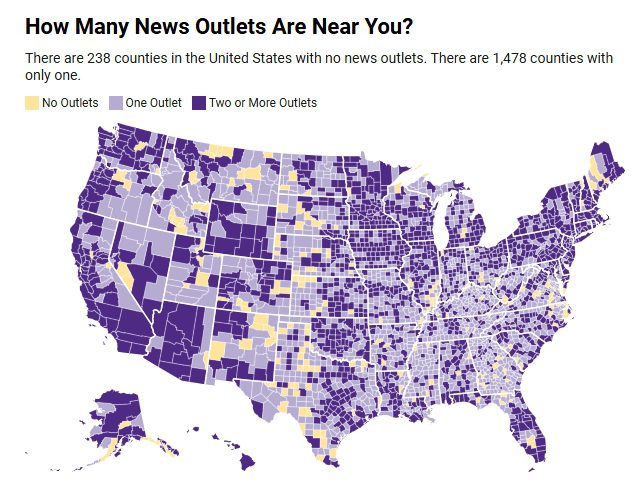
Since we just established that democracy depends on journalism, this is a wake-up call. The Medill Local News Initiative is out with its annual State of Local News report and it “paints a portrait of a local news ecosystem in a state of precarity” thanks to the steady, unrelenting decline of local newspapers. It highlights 26 new news deserts, especially in the Midwest. There are 238 counties in the United States with no news outlets and 1,478 counties with only one.
One organization fighting against climate news deserts is Grist, through is local news initiative, and the Grist newsroom just won a prestigious Edward R. Murrow Award.
Fox News isn’t ready to join the bipartisan backlash against data centers. “More than half of the references to data centers on Fox News over the last two years would have left viewers with a favorable impression, compared to less than 10% on CNN and 5% on MS NOW,” according to a new Semafor analysis of mentions of data centers on each network.
Gov. Newsom has another podcast, well not quite. “From the Source,” which is produced by the California Natural Resources Agency is hosted by Natural Resources Secretary Wade Crowfoot. POLITICO’s California Currents describes it as “where he sits down with leaders across the Newsom administration to talk about what they’ve accomplished and what’s coming next.” Episode One is with CAL Fire Director Joe Tyler.
EXTREME WEATHER
Tropical Storm Rachel led to waves that badly battered Long Beach’s iconic boardwalk and Newport Beach homes. Drone operators shared lots of footage. The action is likely to continue “again and again” for weeks.
Long Beach Mayor Rex Richardson said that the city was taking the situation “very seriously” and that it underscored “an importance to be incredibly serious in our region and in our state around climate resilience and coastal resiliency,” the LA Times reports.
Long Beach also warned EV owners in areas prone to coastal flooding that they should “proactively move their vehicles away from potential exposure areas before a storm hits,” to avoid the “potential safety concerns that can arise if an EV is exposed to saltwater.” People should not drive any type of EV through flooded saltwater areas.
Do berms and sand bags help? “If they’re built high enough,” USC’s Patrick Lynett told KCRW. “Eventually you run out of sand.” Sea walls take too long but some communities might turn to rock in these locations.
Climate Central says climate-warmed Gulf waters made Hurricane Isaias’s winds 7 mph stronger than they otherwise would have been.
New UCLA research shows that 2024 broke the record for extreme rainfall, thanks to climate change and El Niño, with 40% of that increase tied to global warming. “Conditions are ripe for a repeat.”
This year’s “super El Niño” has entered record-breaking territory. Could it also be the strongest El Niño in one thousand years? “Tree rings and corals both put the biggest modern El Niños at or near the top of the past millennium, and this year’s event is on track to land well above them,” Zeke Hausfather writes.
POLITICS
Dave Roberts at Volts has a “podcast that will please no one” about BAAJA, the permitting reform bill that is pleasing no one. “What I’m going to attempt to do is have a reasonable discussion of the contents and relative merits of the bill” he opens, with guest Daniel Palken, who runs infrastructure and energy permitting work at Arnold Ventures, a philanthropy devoted to sustainable energy systems.
One of the leading voices demanding that the permitting reform bill wait until after the 2026 midterm election is California Democrat Rep. Jared Huffman, who spoke with Jael Holzman for Heatmap News. “Huffman thinks it also gives too much benefit to oil and gas interests, and is an unnecessary capitulation to fossil-friendly Republicans who will likely lose power in this November’s midterm elections, anyway.”
Bill McKibben took to Substack to defend the integrity of Sen. Sheldon Whitehouse and his policy aides for negotiating the bill. McKibben adds that he has “grave reservations about this bill, grave enough that were I voting I wouldn’t support it.”
Jeremy Symons, a respected independent policy analyst took to X to argue that BAJAA Title IV’s project certainty provisions are “dangerously sloppy and an insane transfer of power to Trump and corporations” in ways that will advantage industry lawyers. “As currently written, it does for corporate dominance of US health & safety agencies what Citizen United did for corporate dominance of US politics.”
Voters have soured on Republicans’ handling of fuel prices and a POLITICO Poll finds most Americans see no clear way for the party to regain the advantage as the election reaches its final weeks.
Elon Musk has poured at least $276 million into the midterms since the summer, re-emerging as the top known donor to the Republican Party, CNN reports.
The Invest in Tomorrow Coalition, a clean energy super PAC, has announced that it’ll spend $15 million to defeat Republicans in seven U.S. House races: Reps. Lauren Boebert of Colorado, Scott Perry of Pennsylvania, and Victoria Spartz of Indiana who voted last year to end Biden-era renewable energy tax credits, along with Mike Beltran of Florida, Anthony Constantino of New York, Brandon Herrera of Texas, and David Flippo of Nevada.
David Gelles has a look at President Obama’s legacy as seen through the recently opened Obama Presidential Center in Chicago. “The closest the exhibits come to addressing the sweeping setbacks to Obama’s climate agenda is to note that ‘some in Congress and in the fossil fuel industry blocked comprehensive legislation.’ And that “as a result, many of President Obama’s climate actions were done by executive authority and could be overturned after he left office.”
LITIGATION
Brazilian prosecutors have filed an unprecedented lawsuit against oil giant Shell’s subsidiary in the country, demanding $108 million in compensation over deadly 2024 floods. Shell’s liability should match its contribution to global warming — estimated at two percent of historical global greenhouse gas emissions, the civil lawsuit states. AFP describes the litigation as a first of its kind.
The Standing Rock Sioux Tribe has filed a new lawsuit in the U.S. District Court for the District of Columbia to try to shut down the Dakota Access oil pipeline, continuing a decadelong battle over the project. The suit targets the U.S. Army Corps of Engineers, the U.S. Pipeline and Hazardous Materials Safety Administration and three federal officials of those agencies, the North Dakota Monitor reports.
The environmental group California Water Impact Network filed a major new lawsuit arguing the state of California is taking far too much water out of the Delta, harming native fish and the ecosystem, causing toxic algae blooms, and threatening local farms and communities. LAT’s Ian James quotes an expert who calls it one of the most ambitious water lawsuits he’s ever seen.
CALIFORNIA
New governor, new congress, new LA mayor? Join a wide range of UCLA experts — Alejandro Camacho, Marta Segura, Anthony Rendon, and Jon Christensen — for a post-election discussion on Nov. 9 about the local, state, and national implications for environmental policy and climate politics. RSVP here.
When PG&E wanted to replace Merrian Borgeson’s aging gas service line in Berkeley, California, she asked the company not to do it. But the utility dug up her yard anyway and swapped in a new pipe to send gas from the distribution main line to her home. “Soon, Californians will have the choice that Borgeson did not,” Alison Takemura reports for Canary Media on the Home Energy Choice Act (AB 2313).
The Climate Center is hosting an Oct. 21 webinar with climate advocates and Sacramento insiders to explore which proposed climate policies did (and didn’t) become law and what happens next for these new laws and those that got vetoed this go around.
Zuzana Burivalova, a tropical forest ecologist who uses sound to understand the health of forests globally, was just named a winner of the 2026 Pritzker Emerging Environmental Genius Award from UCLA’s Institute of the Environment and Sustainability.
METHANE
The US Environmental Protection Agency said last week that it would within “days not weeks” propose scrapping a Biden-era rule aimed at curbing large leaks of methane from oil and gas operations. The deregulatory move comes just weeks after Colorado became the first state in the nation to fully comply with the standards, Colorado Public Radio’s Ishan Thakore reports. The EPA proposal “will not affect Colorado’s recently updated rules, which are now part of state regulations” however it will affect “whether the EPA notifies Colorado oil and gas companies of massive methane leaks it detects.”
GAIA is organizing a “Global Week of Action to Stop Incineration” today through Oct. 16 with the goal to end waste disposal in dumps, landfills, and incinerators. GAIA published new research into 20 waste-to-energy incinerators in a report called “The Burn Book: Incinerators that Threaten the Climate, Public Health, and our Finances.”
DATA CENTERS + ENERGY
The data center industry is using a time-tested tool — land acquisitions — and it’s “inflaming political tensions and complicating communities’ efforts to set the rules at a moment when Americans are increasingly wary of the energy- and water-guzzling facilities,” POLITICO reports.
Even already-operating wind projects aren’t safe? As Maria Gallucci reports for Canary Media, Trump’s Interior Department now wants to reevaluate a key permit for Revolution Wind, which has been sending power to the grid for months now.
TotalEnergies plans to buy 700 MW worth of U.S. solar capacity, which is only surprising because the French energy company previously took one of the Trump administration’s payoffs to abandon its American offshore wind energy developments.
My UCLA Emmett Institute colleague Alex Wang was a guest on the Climate One podcast, talking about the ongoing global energy crisis and how China is affecting oil markets through two forces: short-term strategies to prioritize domestic energy consumption and the long-term strategy of electrification.
VP JD Vance, during a Texas campaign stop, announced plans this week to expand one of the nation’s smallest refineries using the Defense Production Act, part of a push to boost refining capacity amid high fuel prices.
CLIMATE INTERVENTIONS
Reporter Karl Mathiesen took a look inside “a war game” scenario designed to stress test the global response to advances in possible climate interventions and solar geoengineering technology, and wrote about it for WIRED. “Solar geoengineering could buy humanity time against climate change—or trigger a dangerous new arms race. A first-of-its-kind simulation offered a glimpse of what happens when geopolitics takes the wheel.
Bill Gates is talking about climate again and focusing on “persistent contrails” responsible for about half of the temperature increase caused by aviation. “If we were to get rid of them, we would eliminate up to two percent of all global warming,” he writes. “Doing this would cost less than ten dollars a ton of emissions avoided (probably around a dollar or two), compared with $130 or more per ton for SAF. That’s a mind-blowing impact for such a relatively cheap intervention.”



About Evan

Evan George is Director of Communications for the UCLA Emmett Institute, a leading environmental law center. He also writes The Drain, a weekly roundup of environmental a…
READ more
Reader Comments