















































I Skipped NY Climate Week and Read These Books Instead
The Drain is a roundup of environmental and climate news from Legal Planet.
Climate World descended on New York City this week for the annual mad dash of panel discussions, press briefings, newsmaker interviews, influencer gatherings, and sponsored parties that is NY Climate Week, but I stayed home and read books instead.
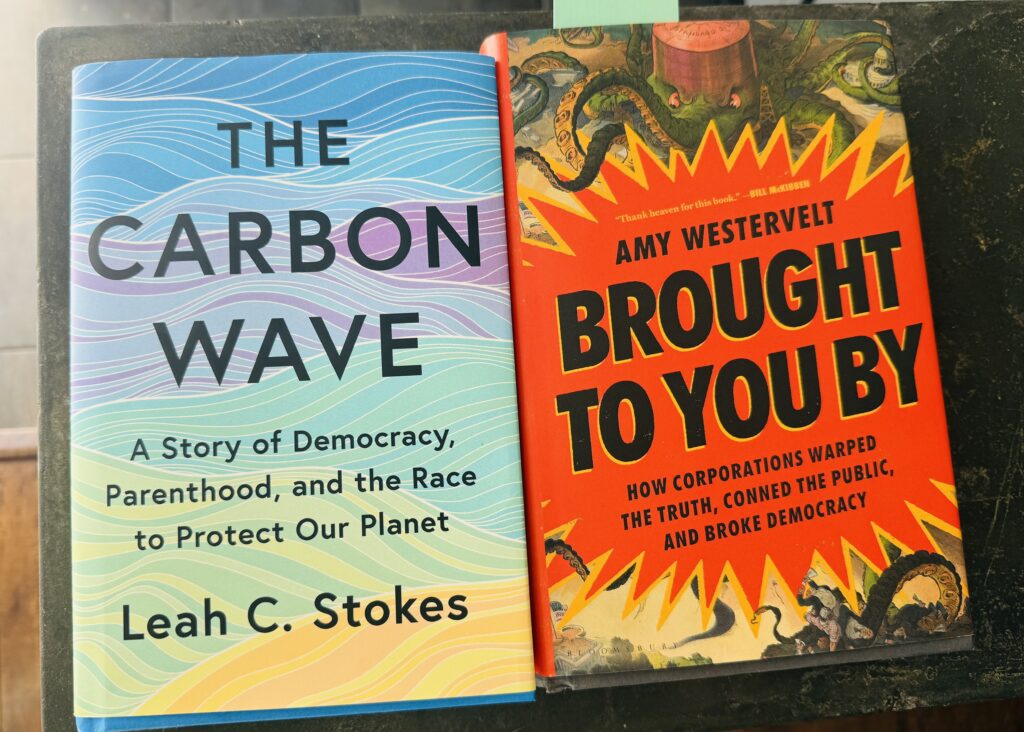
To be more specific, I went to my local bookstore (Village Well in Culver City!) and bought 4 new climate books that I’ve been excited to read:
“The Carbon Wave: A Story of Democracy, Parenthood, and the Race to Protect Our Planet,” by Leah C. Stokes.
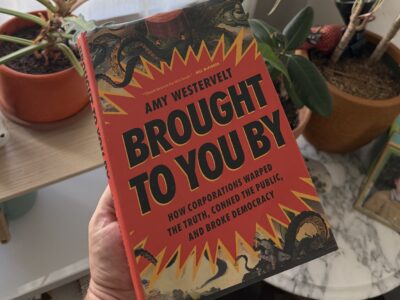
“Brought to You By: How Corporations Warped the Truth, Conned the Public, and Broke Democracy,” by Amy Westervelt.
“End Times Fascism and The Fight for the Living World,” by Naomi Klein and Astra Taylor.
“Building Post-Carbon Futures: Land, Justice, and Energy Transitions,” by Billy Flemming.
I started with “The Carbon Wave” so here are my thoughts. It has been years since I sat down and read a book from front to back, but I burned through it in less than 24 hours. Leah Stokes is a well-known climate advocate and a professor of environmental politics at UC Santa Barbara. This is not her first book about policymaking, but it is the most personal. “The Carbon Wave” weaves together the narratives of her and her family as well as a handful of fellow policymakers, political aids and researchers who together helped create what we now call the Inflation Reduction Act, aka the largest climate law ever passed in U.S. history. It’s a fascinating read.
“The Carbon Wave” manages to be lots of different things—a dramatic page-turner, an insider tell-all, a legislative history about a landmark bill, something of a memoir, and a blueprint (or a cautionary tale) for climate policymakers next time around.
As a Canadian American academic based in Santa Barbara, Stokes is not your typical Washington insider. She tells this story from her own perspective but also that of several of her policy partners: aides to then-Senate Majority Leader Chuck Schumer; climate advisors in the Biden White House; and activists at influential environmental groups. Key players include Adrian Deveny, Sonia Aggarwal, Brian Deese, Gina McCarthy, Sam Ricketts, Varshini Prakash, Ari Matusiak, and Stokes herself of course.
The narrative opens in October 2021 and bounces around the chronological timeline, but it essentially functions as a ticktock, behind-the-scenes look at this major legislative roller coaster ride to cut climate pollution. Not just the sausage-making but the idea-making. The spreadsheet making. The emissions tracker making. And the political dealmaking. Many later chapters, when the legislation is close to passing, provide valuable, and infuriating, political insights into the machinations of Joe Manchin, the former West Virginia senator who nearly tanked the bill multiple times. Even then, Stokes maintains an optimism for the democratic process.
Chance, preparation, luck, skill, and failure all play a role in staffers like Deveny and White House advisers like Aggarwal being in the right place at the right time. The COVID pandemic turned the world upside down for a couple years right when this cast of characters found themselves facing a very short window of opportunity to push a big climate energy bill, from the 2020 midterms to the early months of the Biden administration. The pandemic made it possible to influence policy via off-camera Zoom meetings on the other side of the country, yes, but it also interfered by sending crucial senators into isolation when they tested positive just as negotiations were happening.
Stokes is able to put this political page-turner into historical context. Sen. Ed Markey shows up several times as an elder statesman of the climate movement but also a warning of previous failures. The Waxman-Markey Bill on clean energy passed the House in 2009 and never made it to the Senate. “In the post-mortem of the Waxman-Markey failure, several political scientists had found that the lack of public mobilization for the bill was one cause of its failure,” Stokes writes. “I didn’t want us to make the same mistake twice.” That message looms large to the end.
My very first post for Legal Planet back in February 2023 was about President Biden’s reluctance, or inability, to sell some of the environmental features of the IRA. To my mind, Stokes’ telling provides insights into the questions of why this happened; why some voters never got excited about the climate law; how hyper-politics divided the climate movement on the IRA; why some features of the law were vulnerable to attack.
The memoir component is compelling too — and not just to add drama to what is otherwise a legislative thriller. It’s central to her point. If a cardinal sin of climate communications in the last few decades has been a failure to connect climate change to our everyday lives and our emotions, Stokes isn’t making that mistake. Her precarious pregnancy jockeys with the policy bill. One day, her family gets a clean bill of health, but the bill looks dead on arrival; the next day it’s the reverse. Most of the protagonists who are working tirelessly to help save the world in this story are either new parents or expecting parents motivated by their love. This portrayal is a powerful rebuttal of the idea that caring about climate change means you should forego raising children because of the carbon footprint. That’s an idea Stokes takes head-on, saying essentially, “What nonsense to blame an infant child for the carbon-intensive energy system they’ve just been born into — blame the adults who aren’t doing something, anything, to save them.”
From the outset, this book serves as a refutation of that old, industry-backed concept of the carbon footprint, aka that we should all focus on reducing our own personal emissions rather than systemic change. Hence the title. A carbon wave is a good, visual metaphor for the “two steps forward, one steps back” of climate policy, but it also acts as a call to action. “Let’s replace the carbon footprint with a new idea: the carbon wave,” she writes. “Working together, we can make waves.” Hers is the story of people who did it once — and might be called upon to do it again.
Next up: Amy Westervelt’s “Brought to You By.”
Welcome to The Drain, a weekly roundup of environmental and climate news. This week’s song is “Burning,” by the Yeah Yeah Yeahs, which is one of 500+ songs on my climate playlist (on Spotify and Apple Music).
NY CLIMATE WEEK
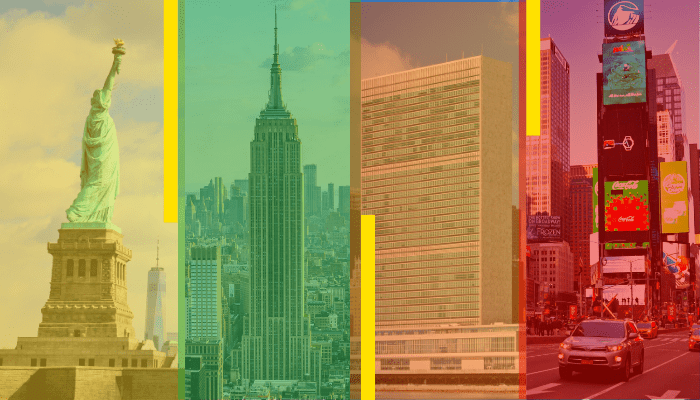
On Wednesday, UN Secretary-General António Guterres convened world leaders for a High-Level Event on Climate Action and the Just Transition. This is the final General Assembly session under Guterres. He gave an exit interview to David Gelles of the NYT and others. “It’s my duty to use that voice without any compromise, to tell the truth and to alert the international community to the dangers it faces,” Guterres told Fiona Harvey at the Guardian. Let’s hope the next Secretary-General raises their voice like he did.
Trump raised his voice at the UN to say artificial intelligence should be rebranded as “super intelligence” and then compared the risks of AI to climate change and falsely claimed that the latter has been a hoax that hasn’t lived up to warnings of its dangers, Scientific American writes.
Al Gore and others at NYCW tried to prevent AI data centers from hijacking the attention, noting that many other areas of the global economy are greater drivers of climate pollution. “The emissions from uncovered landfills around the world are a large multiple of the emissions from all of the AI data centers put together,” Gore said. Electricity for air conditioning is another.
Also in attendance at UNGA, French President Emmanuel Macron came asking the EU to delay its upcoming methane regulation for one year. Many researchers, scientists and advocates are answering why this is bad policy.
California Gov. Gavin Newsom is a frequent flyer at NY Climate Week and often makes news announcements timed to his appearance at the event. This year — his last as governor as he contemplates a presidential run — he announced that California continued to cut climate pollution, reducing statewide greenhouse gas emissions by 3.9% while growing the economy in 2024 — according to new data. Newsom also announced that California is moving forward with plans to link its signature climate program, cap-and-invest, to that of Washington state. “Talking about climate change may be out of style in U.S. politics, but it remains Gov. Gavin Newsom’s ticket to the world stage,” POLITICO’s California Currents newsletter says.
THE STATE OF CLIMATE COMMS
Amy Harder, climate and energy journalist for Axios, shared what she described as a “hot take” for NY Climate Week: that PR firms and climate communicators who share news items should practice more restraint during busy weeks like this and stop bugging the few reporters who remain on the beat. Weeks like these underline “the vast imbalance between the number of reporters and the number of people pitching us stories.” Take a hint if you don’t get a bite and stop texting reporters, she writes at LinkedIn. Can’t argue with that.
Journalist and meteorologist Chase Cain went further and said “do NOT launch your news during NY Climate Week *or* Earth Week.” If you have thoughts about this, leave ‘em in the comments.
Beyond timing, climate scientist Katherine Hayhoe and researcher Dana Fisher co-wrote an article for TIME that asks, “What’s working in climate communications?” and found an answer: Don’t talk about climate like it’s partisan. “The first and most important lesson is that talking about climate change means talking about everyday life. When we asked climate newsletter writers, podcast hosts, people who regularly post on social media, and those building climate content for non-profits, their response was clear. Their first priority is to connect the climate crisis to other concerns people face: our jobs, our health, the places we love.”
“The logic of the climate crisis is clear. What we’re missing is the magic,” writes Solitaire Townsend in another piece for TIME. Finding the magic is the role of storytellers connecting climate to emotions, Townsend writes.
POLITICO has an interview with Sen. Ed Markey, a co-author of the Green New Deal, about why affordability is a stronger talking point than climate change in the 2026 midterms. “The Big Tech and the fossil fuel agenda are one and the same,” Markey told POLITICO’s Surge. “They’re married the same way auto and oil used to be married. And you’re not going to hear a single word from the AI industry except some vague promise that they’ll solve the energy crisis 10 years from now.”
And here are the 100 top environmentalists and climate campaigners, according to the Independent. The list is published each year to coincide with NY Climate Week.
El NINO + DISASTERS
Scientists are forecasting more than 450,000 deaths from intense heat generated by El Niño, according to a new study from the Climate Impact Lab.
About 1,000 heat deaths are expected in California, Jack Dolan writes for the Essential California newsletter, while most are expected in Africa and Southeast Asia.
The “jaw-dropping” El Niño currently heating up the planet has burst through the highest temperature ever recorded for the phenomenon, several months before its expected peak, Damian Carrington reports for the Guardian. “The ‘Godzilla-level’ phenomenon is supercharging the climate crisis and will heavily impact communities across the world.”
Gov. Newsom proclaimed a state of emergency this week, mobilizing state resources ahead of potential winter storms and other impacts. He also asked state agencies to work with local governments to reduce flood risk and prep for a response to flooding, landslides or erosion.
In Long Beach, Mayor Tom Modica proclaimed a local emergency ahead of what is brewing. That emergency proclamation gives Long Beach greater flexibility to prepare and respond if conditions worsen, NBC4 reports.
In an age of serial disaster, rebuilding is no longer enough, even when it can be achieved. Resilience is demanded, as David Wallace-Wells reports for a New York Times Magazine cover story, the climate issue. One problem is that there is rarely someone truly in charge — no “recovery czar,” Juliette Kayyem tells him.
Less than half of blue-state major disaster declaration requests have been approved by Trump, Phillip Bump reports in a piece called “Trump is treating federal power like something he owns.”
LITIGATION
WATCH a webinar press briefing about the upcoming Suncor v. Boulder case featuring my UCLA Law colleague Alejandro Camacho along with Lesley Clark (POLITICO), Ishan Thakore (Colorado Public Radio), and Emily Sanders (Point Source News).
A federal judge this week dismissed rejected the first-of-its-kind complaint made by Michigan that claimed four of the largest fossil fuel producers and the American Petroleum Institute broke federal and state antitrust laws by acting as a “cartel” to boost prices and restrict development of renewable energy and electric vehicles, Lesley Clark reports for POLITICO.
The Trump administration illegally terminated the $7 billion Solar for All program intended to make solar power accessible to more than 900,000 lower-income Americans, a federal judge in Rhode Island ruled Friday. The AP reports that District Judge Mary McElroy “wrote in the ruling that Congress clearly intended the EPA to continue administering the Solar for All grants that were already obligated.”
California Attorney General Rob Bonta and the California Energy Commission filed a lawsuit Tuesday against the Trump administration and energy company Invenergy challenging their backroom payoff to scuttle a wind project set to be built off California’s Central Coast.
The Environmental Defense Center, Center for Biological Diversity, Sierra Club and several other organizations sued the Trump administration over the feds’ support for Sable Offshore Corp., POLITICO reports.
A $20 billion OpenAI data center campus announced in July in Georgia, is now facing its second lawsuit from Effingham County residents and environmental advocates. They cite concerns over public input, environmental impacts and electricity costs, Ryan Krugman reports for Inside Climate News.
LEGISLATION
Gov. Newsom on Friday vetoed SB 954, legislation that would have narrowed exemptions to CEQA for advanced manufacturing facilities amid pushback from business and industry groups. The bill’s numerous new siting, operational, and emissions requirements would have made the narrower exemption impractical for many of the projects it was intended to support, Newsom said.
AB 28, just signed by Newsom, will set up new protocols for managing temperature events at landfills following a high-profile situation at the closed Chiquita Canyon Landfill, writes Cole Rosengren for Waste Dive. That site has famously been experiencing elevated subsurface temperatures since 2022, leading to community and regulatory issues. It’s not the only one.
The governor also signed a package of bills to support the EV market, from commercial trucks to EV chargers which POLITICO outlines.
And last but not least, Newsom signed seven bills aimed at regulating the data center industry’s electricity costs and track water consumption. The LA Times reports that one of the bills “orders California Public Utilities Commission to create special requirements and rates for data centers’ use of electricity, including the costs for new power and for infrastructure upgrades.”
DATA CENTERS + ENERGY
The Trump administration is considering proposals for at least a dozen data centers and data center-related infrastructure projects to be built on federal public lands, the Washington Sun’s Mara Hoplamazian and Jade Lozada report. “Many of the projects under consideration haven’t been previously reported, and aren’t easily accessible on BLM’s website.”
The hosts of this year’s UN climate talks, COP31 Turkey, announced a new initiative on Monday to address data center’s rising energy consumption, called The Antalya Pledge on Artificial Intelligence, Matteo Civillini reports for Climate Home News. “Turkish minister Murat Kurum said AI companies should be transparent about their energy use and power their data centres with clean energy.” U.N. climate chief Simon Stiell said on the sidelines of Climate Week that “tech titans need to start showing why the benefits of AI outweigh its skyrocketing costs — for the many, not just the tiny few.”
Republican regulators last week rejected Duke Energy’s plan to power a $10 billion Amazon data center project in North Carolina — citing President Donald Trump’s Ratepayer Protection Pledge. POLITICO reports that commissioners on the five-member panel “said Duke did not adequately demonstrate how consumers would be shielded from paying for the peaker plant.”
The $6.2 billion Revolution Wind farm is complete. The project installed its 65th and final turbine, Dan McCarthy reports for Canary Media. “The project has been producing carbon-free power for Rhode Island and Connecticut since March, but at partial output” — until this week.
Vistra’s Moss Landing battery facility south of Santa Cruz caught on fire again. “Vistra has been working on demolishing the site, which entails laboriously removing the intact batteries still in the building, de-energizing them, and shipping them for recycling or disposal,” Canary’s Julian Spector reports. My UCLA colleague Denise Grab is quoted by CalMatters explaining that the design is not up to par with current safety designs.
Closer to home, a lithium-ion battery fire in La Verne spurred neighborhood and school evacuations this week.

About Evan

Evan George is Director of Communications for the UCLA Emmett Institute, a leading environmental law center. He also writes The Drain, a weekly roundup of environmental a…
READ more
Reader Comments