


















































Academia
We are Hitting a Major Methane Milestone

The Drain is a weekly roundup of environmental and climate news from Legal Planet.
This year, we celebrate 250 years since its discovery. No, I don’t mean America (though plans are underway to celebrate the semiquincentennial this July.) I’m talking about methane — that colorless, odorless, flammable and short-lived but super potent greenhouse gas that is helping heat the planet faster than carbon dioxide. It was 250 years ago …
Continue reading “We are Hitting a Major Methane Milestone”
CONTINUE READINGEarth is Getting Darker. Here’s Why That’s Alarming

Some climate scientists are calling attention to yet another alarming recent climate trend: Earth’s declining reflectivity and what it may mean for feedback effects on future warming.
Some recent Earth observations are spreading new alarm among climate scientists. The observations have been reported in many scientific and environmental outlets, and have provoked a fair amount of confusion and some misrepresentation. Some scientists have been informally calling these observations “the most important climate risk you’ve never heard of.” But they have not yet …
Continue reading “Earth is Getting Darker. Here’s Why That’s Alarming”
CONTINUE READINGPaul Ehrlich and The Bet

The real lesson everyone misses about Paul Ehrlich and his famous wager.
Paul Ehrlich died last weekend at the age of 93. Among scientists, he was celebrated for his work on population biology, integrating economics and ecology, and for his creation (with Peter Raven) of the field of co-evolution, the study of how species influence each other’s evolution. To the public, he was much better known as …
Continue reading “Paul Ehrlich and The Bet”
CONTINUE READINGAffordability Is Everywhere

How affordability concerns are informing recent developments in electricity, clean energy, and housing policy.
Affordability concerns are increasingly top-of-mind for advocates, academics, and public officials with regard to electricity generation and pricing, the transition away from fossil fuel extraction, and affordable housing. Public support for improving the grid, transitioning to a clean energy economy, and expanding the supply of housing depends on whether policymakers can ensure that the costs …
Continue reading “Affordability Is Everywhere”
CONTINUE READINGIs China a Climate Hero? It’s complicated
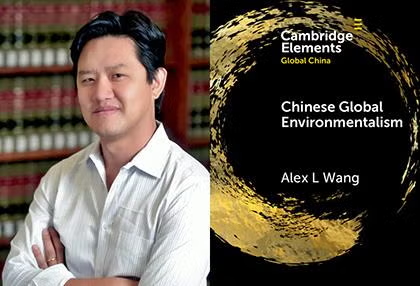
UCLA’s Alex Wang explains China’s climate strategies and contradictions in his new book, Chinese Global Environmentalism.
Though China was once viewed as a climate villain, the country now dominates the global supply chains of solar panels, batteries, and electric vehicles. Just this month, Chinese manufacturer BYD overtook Tesla as the world’s biggest maker of EVs. It’s the latest example of how China’s focus on clean technology is setting the pace for …
Continue reading “Is China a Climate Hero? It’s complicated”
CONTINUE READINGIn the Cross Hairs

The Right has taken umbrage at some of the important work of environmental law professors and centers.
The fossil fuel industry and its conservative allies seem to have taken notice of the important work done by environmental law centers. Their response is to try to repress this valuable work. This is a backhanded acknowledgement that law schools are making a difference.This campaign has targeted some of the law schools with the most prominent environmental law programs. Climate scientists have long been the target of harassment and public attack. It appears that people who work on climate policy are now also in the crosshairs. What we’re seeing lacks the drama of other attacks on free speech and academic freedom. But it is capable of being no less harmful. McCarthyism writ small is still McCarthyism.
CONTINUE READINGA Science-Policy Dialogue on SRM for Latin America

Key takeaways from the UCLA Emmett Institute’s convening on Solar Radiation Modification (SRM) in Santiago, Chile.
Though interventions like solar radiation modification (SRM) are increasingly breaking into mainstream conversations of climate change, the charged nature of this topic and political extremes that have characterized discussion around it make it difficult for policymakers and decision-makers to find neutral spaces to learn about existing research, ask questions, and brainstorm policy ideas with colleagues and trusted experts. Creating that neutral space was the goal of an Emmett …
Continue reading “A Science-Policy Dialogue on SRM for Latin America”
CONTINUE READINGDoes the Unitary Executive Theory Exist? Not really.

It’s just another ideological confection to impose right-wing policies: the Supreme Court’s argument last week shows it
At Legal Planet, we often bemoan and gnash our teeth at the Unitary Executive Theory, which supposedly holds that because “the Executive Power shall be vested in the President of the United States,” Congress can not circumscribe the President’s removal authority or even his ability to manage federal agencies in any way. But last week, …
Continue reading “Does the Unitary Executive Theory Exist? Not really.”
CONTINUE READINGAlejandro Camacho Joins UCLA Law Faculty

Camacho will be a core faculty member of the UCLA Emmett Institute and a contributor to Legal Planet.
At this critical moment in environmental law, the Emmett Institute at UCLA School of Law keeps growing stronger. We are pleased to welcome Alejandro Camacho, a renowned regulatory scholar, as a professor of law. Camacho will be a core faculty member of the Emmett Institute on Climate Change and the Environment and a faculty affiliate of …
Continue reading “Alejandro Camacho Joins UCLA Law Faculty”
CONTINUE READINGCrafting a Roadmap for Zonal Decarbonization in California

A new series of briefs from the UCLA Emmett Institute offers legal insights for the gas transition. First up: SB 1221.
California has a $43 billion problem: that is the estimated cost of maintaining the state’s gas network over the next twenty years. That is an astronomical amount to spend on what state policy dictates will eventually become stranded assets: California won’t be able to meet its ambitious climate goals unless it moves away from natural gas altogether, so retirement of these assets is …
Continue reading “Crafting a Roadmap for Zonal Decarbonization in California”
CONTINUE READINGJoin Our Mailing List
Climate policy is changing rapidly. Stay in the loop with expert analysis via email Monday - Friday.

The Drain is a roundup of climate and environmental news from Legal Planet delivered to your Inbox once a week.