


























































An “Unprecedented” Heat Wave is Just the Start
The Drain is a weekly roundup of environmental and climate news from Legal Planet.
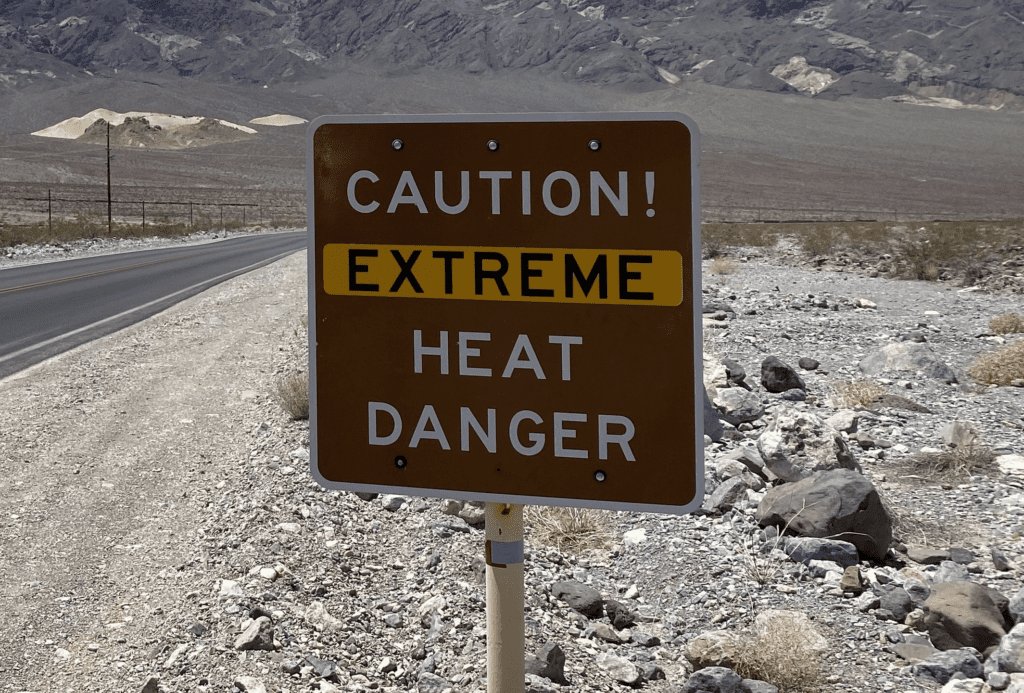
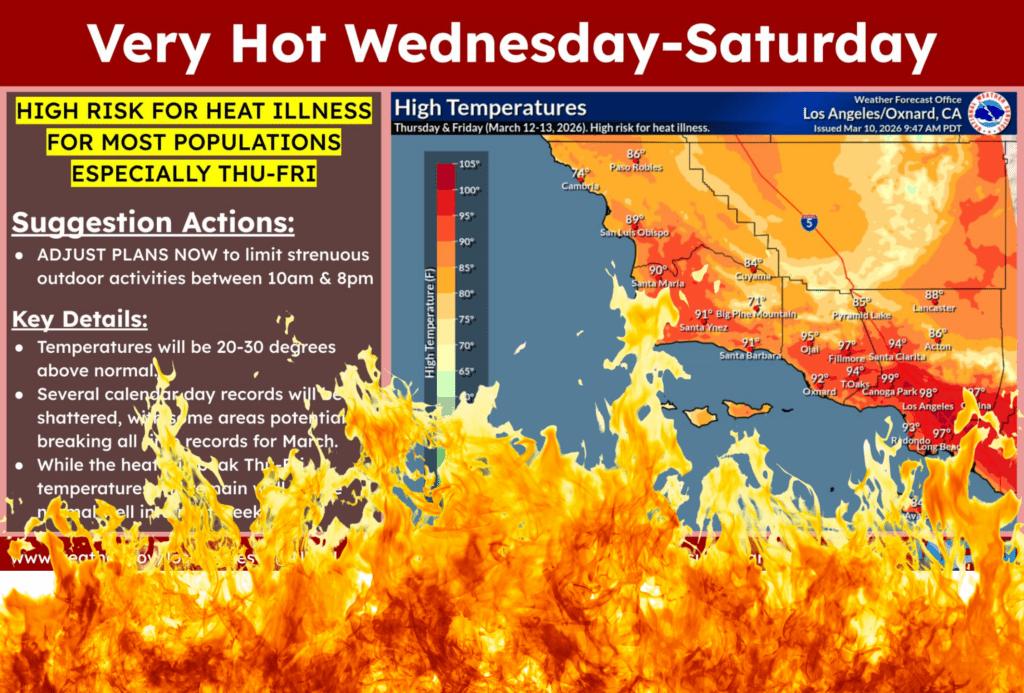
Dust off your fan or set the thermostat for your heat pump. A heat wave is in the forecast for the western U.S., bringing 90-plus degree heat to much of California and records are likely to fall. Temperatures that are 20-30 degrees above normal for this time of year are on tap starting today.
It’s not normal. The National Weather Service calls it “unprecedented.” Some parts of California and the American Southwest that have never before experienced triple-digit temperatures this early in the year are slated to see just that. It’s still early March, after all.
“I keep having to check the calendar every time I go outside in a T-shirt this winter and that’s been true wherever I’ve been in the American West,” University of California climate scientist Daniel Swain said yesterday in his latest office hours livestream. “Meteorological winter has ended and we did not get any of those severely colder periods that we would typically expect.” That’s bad news. “We are in a fairly serious situation across the interior West especially,” Swain said.
For all the focus on the snowstorm that affected much of the eastern U.S. in February, we actually saw a pretty poor winter for snowpack in the West and water in the Colorado River. NOAA confirms that winter 2025-26 was the warmest on record across a huge portion of the U.S. Sometimes we hear about a “Miracle March” in which we can have a single month of wet winter-like storms that catch us up on the backend. “This year that is not going to happen — there will be no Miracle March,” Swain said.
What there likely will be is El Niño. That means unusually warm waters along the equatorial tropical Pacific Ocean, and a series of shifts in winds and precipitation patterns in the atmosphere. Prepare for it to be wet and wild. Most projections from El Niño monitoring groups in the U.S. and Australia, among others, show an increasingly likelihood, CNN reports. “El Niño years also tend to boost global average surface temperatures, thereby acting in concert with human-caused global warming to set heat records.” The planet could even experience a “super El Niño” to rival the strongest ones in history, according to the European Center for Medium-Range Weather Forecasts. And that could push global temperatures to record levels, particularly in 2027.
For now, we’re just talking about a March heat wave. But even those are records we do not want to be breaking. I had multiple Zooms this week with folks in Vermont and New York who were enjoying the 70 to 80-degree weather, as they should. But there is something ominous in the coming weather too.
Welcome to The Drain, a weekly roundup of environmental and climate news from Legal Planet. Our song of the week is “Heat Waves” by Glass Animals.
War on Iran
This is becoming an environmental disaster and not an accidental one.
The Guardian reports that four oil depots and a petroleum logistics sites in and around Tehran were bombed by air strikes. “With the sun blotted out, disoriented people in Iran’s capital had to turn on their lights to see through the gloom.” Videos shared widely by citizen journalists showed massive flames over the Tehran sky overnight and smoke still billowing over the oil storage facilities.
Black poisonous rain fell from the sky. “There are all sorts of nasty, complex hydrocarbons in those black clouds of smoke,” John Balmes, professor emeritus of environmental health sciences at UC Berkeley told NYT’s David Gelles.
“This was in essence chemical warfare, even if the chemicals were the (easily anticipated) result of “normal” bombs,” Bill McKibben writes at The Crucial Years. “And it affected an almost entirely civilian population that will be paying the price for decades to come.” In a separate post, McKibben summed up the spike in oil and gas prices this way: “Sunlight travels 93 million miles to reach the earth. None of them through the Strait of Hormuz.”
The market is bananas. International crude oil prices spiked close to $120 per barrel over the weekend before coming back down.
American suppliers of LNG could be in for a windfall as desperate international buyers bid top dollar to secure what gas is available. “Trump has been pressuring allies from Japan to the EU to buy even more U.S. natural gas,” Dan McCarthy writes at Canary Media. “But the war only strengthens the case against a deeper dependence on LNG.”
And Iran’s control of the Strait of Hormuz means it is EXPORTING MORE OIL TODAY THAN BEFORE THE WAR, the WSJ Journal reports (emphasis my own.)
Trump administration
The EPA has hit a 40-year staffing low. An Inside Climate News analysis of just-released federal workforce data shows more than 4,000 employees departed between January 2025 and January 2026, including a majority of team leaders.
During the year she spent leading the U.S. Department of Homeland Security, Kristi Noem all but killed FEMA by freezing spending and slashing staff. Now that she’s been fired, will the agency recover? Jake Bittle examines that for Grist. NPR looks at the record of Sen. Markwayne Mullin, R-Okla., who has been tapped to be the next Secretary of Homeland Security, if confirmed.
FEMA suspended all of its training and education programs for emergency managers across the country — except for those “directly supporting the 2026 FIFA World Cup,” reports Jeva Lange for Heatmap News.
Trump issued an order last month compelling the production of glyphosate, the weedkiller you know as Roundup. It’s no coincidence, Hiroko Tabuchi reports for NYT, that glyphosate-maker Bayer is also the only company in the United States that manufactures a form of elemental phosphorus called white phosphorus, which it uses to make the weedkiller.
Last week, the Department of the Interior wrapped its first Alaskan oil and gas lease sale without a single bidder for more than a million acres of federal waters. “Like so many previous Trump ventures, this lease sale was a big, fat failure. Even oil and gas companies recognize that leasing in dangerous, undeveloped areas is all risk and little reward,” said Athan Manuel, director of Sierra Club’s Lands Protection Program.
Energy

Solar power installations sank in the U.S. last year, as the Trump administration sought to impede the growth of renewable energy, Ivan Penn reports for the New York Times.
Texas has passed California to become the leader in utility-scale solar. That’s according to data for 2025, released recently by the U.S. Energy Information Administration, Dan Gearino reports.
New Mexico could be on the verge of adding 14 million tons of CO2, erasing all of its climate gains in the last 20 years, by adding one OpenAI data center. NPR spoke with Michael Thomas, CEO of Cleanview, about his new report on tech companies’ plans to build their own off-grid power plants to provide energy for data centers.
In Arizona, the state’s utility regulator has repealed rules requiring electricity providers to generate at least 15% of their energy from renewables. The Arizona Corporation Commission said the cost to customers was no longer justifiable after “dramatic” changes to the renewable energy landscape, Utility Dive reports.
In Washington, negotiators from both parties in Congress are discussing restarting stalled talks on “permitting reform.”
Global lithium demand could exceed “13 million tonnes by 2050 under an accelerated energy transition, more than double base-case projections, with supply deficits emerging as early as 2028 unless the industry invests up to $276 billion in new capacity,” reports mining.com, based on a Wood Mackenzie projection.
Meanwhile, storm clouds over community solar here in California. “Over the last 11 years, New York, Maine, Minnesota, Massachusetts and other states have built thriving community solar programs. But California has built, at most, only 34 projects since 2015, and experts say that’s a generous accounting,” Blanca Begert reports for the LA Times.
Here in LA County, Monterey Park voters will decide in June whether to ban data centers citywide, setting up a potential legal battle with the developer behind a proposed project, Josie Huang reports at LAist.
More California
Chevron is going on the attack against… Cap-and-Invest.
In a letter to state leaders, Chevron warns that “proposed amendments to the Cap-and-Invest program could undermine the state’s economy and the nation’s energy security.” The company is sharing this WSJ editorial headlined “Gavin Newsom’s Climate Tax” alleging the policy will increase the state’s dependence on foreign oil. And they’re actively enlisting voters to speak out.
California and Washington took a first formal step to linking their carbon trading markets last week, publishing a draft agreement to add Washington’s market to the decade-old carbon market run jointly by California and Quebec, POLITICO reports.
The California First Appellate District Court of Appeal issued an opinion this week striking down a lawsuit by solar advocates against the CPUC challenging the third-generation net metering system, known as NEM 3.0. “Meaning nothing will change. Higher solar incentives aren’t coming back,” writes Sammy Roth.
The CPUC also announced that certain Californians whose homes were destroyed by wildfires and other natural disasters can apply for assistance under the Rebuilding Incentives for Sustainable Electric (RISE) Homes program.
The U.S. Department of Justice issued a sweeping 22-page legal “slip opinion” last week asserting that the Defense Production Act empowers Trump or his Secretary of Energy to approve Sable Offshore’s plans to restart offshore oil production in Santa Barbara County at what’s known as the Santa Ynez Unit, the Santa Barbara Independent’s Nick Welsh reports. The order looks to preempt “regulatory requirements imposed by numerous state agencies and a federal decree issued in 2020 giving the Office of the State Fire Marshal the last word when it comes to restarting Sable’s corrosion-prone pipeline.”
Alice Reynolds wrapped up her term at CPUC and gave an exit interview to Noah Baustin for the California Climate newsletter. “Cost containment is our reason for being here at the CPUC,” Reynolds said. “I don’t even know how to answer a question of, “Why did you approve a rate increase?” That’s not what we do.”
CARB has set an Aug. 10 deadline for some of the nation’s largest companies to disclose their greenhouse gas emissions, according to Sacramento Bee’s Chaewon Chung. That’s to implement SB 253 and SB 261 ahead of their first reporting requirements this year.
The Little Hoover Commission released a report urging policymakers to act fast on California’s fast-growing data-center industry – before soaring electricity demand from AI hits the bills of ratepayers. The bipartisan commission outlined more than a dozen recommendations.
California needs 1 million affordable homes, according to a new report by the National Low Income Housing Coalition. “California has just 25 available and affordable rental homes for every 100 households that are deemed “extremely low income” (meaning they make 30% or less of the area’s median income),” reports CalMatters.
Trump’s threatened hostile takeover of local permitting to supposedly speed rebuilding from the Eaton and Palisades fires is over. It failed to launch. POLITICO’s Liam Dillon reports that a self-imposed deadline to propose new regulations has come and gone.
Other States
Good Jobs First, a watchdog group that focuses on economic development incentives, says it is tracking at least 12 in-session states with filed data center moratorium bills this legislative cycle (in addition to other states considering executive action and many cities and counties considering local measures). Stateline has a rundown.
Rhode Island is joining the wave of states looking to recover rising insurance costs from Big Oil. State Rep. Terri-Denise Cortvriend introduced a bill that would encourage insurance companies to take Big Oil to court to recover climate change-driven losses, rather than passing those costs on to their policyholders through higher rates.
New York Gov. Kathy Hochul may slow implementation of that state’s ambitious climate law in the face of rising residential energy costs. Raga Justin reports for Bloomberg Law that it is “setting up an intraparty fight with Democrats ahead of her November reelection bid.”
Minnesota Democrats proposed a climate superfund last week in the Minnesota Senate. It would calculate damages caused by greenhouse gas emissions and send a bill to the world’s largest polluters for their share, Andrew Hazzard reports.
Media News

Chase Cain left his job as NBC’s climate reporter, he tells HEATED in an exclusive interview. “Last week, the veteran journalist resigned, citing burnout from near-constant internal fighting to get important climate stories on air—stories that he says were routinely deprioritized, buried late in newscasts, or cut entirely.”
Scott MacFarlane, who covered the DOJ and Congress for CBS, announced Monday he is leaving the network. “MacFarlane told colleagues in an email that the departure is his decision,” LAT reports.
Heatmap News is hosting a series of events for San Francisco Climate Week around Earth Day, including events about California’s clean energy transition, climate moonshots, and a house party.
There’s a free newsletter by the award-winning journalists and meteorologists of Yale Climate Connections, whose Editor-in-Chief Sara Peach will “catch you up on the latest climate news in five minutes or less every Tuesday and Friday morning. Plus, she’ll bring you the most inspiring solutions from all over the world.”
Climate-Colored Goggles, the newsletter by climate reporter Sammy Roth, is running a member pledge drive this week with stories every day.



About Evan

Evan George is Director of Communications for the UCLA Emmett Institute, a leading environmental law center. He also writes The Drain, a weekly roundup of environmental a…
READ more
Reader Comments