



























































Is Antitrust Unconstitutional?
It violates the “Major Questions Doctrine” — which reveals the doctrine’s bankruptcy
 Last week, I argued that the Unitary Executive Theory does not really exist: it is simply a way for the Supremes to impose their policy preferences, to be discarded if inconvenient.
In this week’s episode, we can look at the “Major Questions Doctrine,” which purportedly holds that agencies must point to “clear congressional authorization” for the power asserted in “extraordinary cases”. It was first explicitly enunciated in West Virginia v EPA, where the Court decided that it did not like the Biden Administration’s clean power plant rules, and so settled on the major questions doctrine as the reason to strike them down.
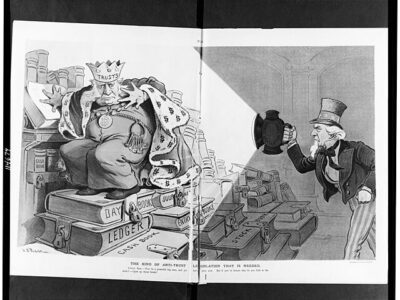
Now, let’s think of the Sherman Act, one of the touchstone statutes of American economic regulation, and the basis for US antitrust law. Here is the key language:
Section 1. Every contract, combination in the form of trust or other- wise, or conspiracy, in restraint of trade or commerce among the several States, or with foreign nations, is hereby declared to be illegal.
Section 2. Every person who shall monopolize, or attempt to monopolize, or combine or conspire with any other person or persons, to monopolize any part of the trade or commerce among the several States, or with foreign nations, shall be deemed guilty of a misdemeanor…
You might notice that the statute fails to define such critical terms as “trust,” “combination,” “conspiracy,” and “monopoly.” For this reason, it has been highly contentious, and court rulings on it have long been criticized as contradictory.
No matter, say conservative legal scholars, who argue that effectively the Sherman Act effectively represents a delegation to the judiciary to figure out the best rules for competition law. As the University of Michigan Law School’s Sanjukta Paul has noted, “[t]he widely held conventional wisdom is that the Sherman Act is the paradigmatic ‘common-law statute,’ entailing a delegation of lawmaking power by Congress to the courts that spans the field of antitrust.” (For the record, Sanjukta thinks that this conventional wisdom is quite wrong). As Judge Frank Easterbrook has observed, the Sherman Act “does not contain a program; it is instead a blank check”” to the judiciary.
You can see where this is going. Not only does the Act fail to define its key terms, it nowhere explicitly gives this blank check. This has been read into it by the very same federal courts who have then taken the power. That’s why it has encrusted into a “conventional wisdom” – you don’t need that if you have an explicit grant of authority.
Now, you might argue that the Sherman Act is different, because it represents a delegation to the judiciary, not the executive. But that has it exactly backwards.
Whatever else one might say about the Presidency, the President is – at least for now – an elected office. The federal judiciary is not. So the executive branch has at least some democratic accountability. And if one is interested in political accountability from Congress – which actually passed the statute – the executive is a much better target for oversight. Judges will not sit down in front of Congressional committees to be browbeaten about antitrust policy.
What’s more, there are more safeguards in, say, a delegation to an administrative agency like EPA, which until last year was staffed with scientific professionals (and hopefully will be again). That makes it a much better recipient of delegation than a non-expert judiciary, whose members have no particular expertise or knowledge of antitrust law or economics.
Maybe this is the whole point. Maybe the justices who decided to invent the major questions doctrine wanted to get rid of antitrust law: after all, a large chunk of what passes for contemporary Supreme Court jurisprudence represents an attempt to return the nation to the Gilded Age.
But I don’t think so. I think that they just want to destroy the administrative state and so will invent new doctrines to do it. When it is inconvenient, they will ignore it. As they will here. But no one should be fooled into thinking that it represents a “doctrine.” It is all ideology, all the way down.
Related Posts

About Jonathan

Jonathan Zasloff teaches Torts, Land Use, Environmental Law, Comparative Urban Planning Law, Legal History, and Public Policy Clinic – Land Use, the Environment and Loc…
READ more
Reader Comments