























































Policies on the Bus Go Round and Round
The Drain is a weekly roundup of environmental and climate news from Legal Planet.

A year ago, the transportation manager of Northshore School District, outside of Seattle, wrote to EPA Administrator Lee Zeldin pleading with him to release frozen funding she was owed for new school buses.
“We need your assistance to complete these projects and lift the financial burdens school districts are facing due to the delay in payments and potential pause in funding,” Sabrina Warren wrote in a letter dated Feb. 25. “The EPA School Bus Program has brought invaluable opportunities to school districts across the state of Washington to transition their fleets to newer, cleaner vehicles.”
Her email is one of a flurry of letters that EPA received last year from school districts, bus manufacturers and suppliers that show surprise and frustration at the freeze on payments already awarded by EPA. (I reviewed the emails from a public records request.) They concerned school districts from Georgia, Oklahoma, Michigan, Wisconsin, Colorado and others that had already placed bus orders. North Shore School District near Seattle was supposed to receive $600,000 for three electric school buses — part of the $24 million in federal funding headed to Washington state to replace diesel-powered buses with cleaner versions.
Last week, Trump’s EPA finally responded by announcing what it calls a “revamp” of that Clean Bus Program program, saying it wants to funnel federal funding away from electric buses and toward dirtier options like those fueled by fossil gas. EPA Administrator Lee Zeldin would rather school buses run on biogas or natural gas. (Maybe some coal-powered buses too for good measure?)
The Clean School Bus program is part of the 2021 Bipartisan Infrastructure Law passed by Congress. The program invested $5 billion in cleaning up school buses across the country and protecting communities from air and climate pollution while helping school districts overcome the cost hurdle. It has awarded funding for the replacement of 8,900 school buses in 1,300 school districts, 95 % of them zero-emission battery electric vehicles. There’s about $2.3 Billion left to spend, Marianne Lavelle reports at Inside Climate News.
Why electrify? Buses powered by electric batteries don’t have tailpipe emissions. They generate less than half the carbon emissions of natural gas buses. And anyone who has ever stood on the curb next to an idling diesel bus can understand the health benefits of not subjecting children to those fumes.
“It’s clear that EPA means to tilt the scales in favor of polluting school buses, and kill any interest in the Clean School Bus program by unexpectedly halting and starting funding for school districts and imposing labyrinth-like reporting requirements,” Adrian Martinez, Director of Earthjustice’s Right To Zero campaign, said in an email. “We’ve said all along that America’s kids deserve a clean ride to school, but this administration doesn’t seem to think so.”
The Trump administration has called the program a waste of taxpayer money and pointed to the example of Quebec’s Lion Electric, which filed for bankruptcy in 2024 after selling thousands of buses. But there are other manufacturers pumping out electric buses for school districts and local transit agencies that are in it for the long haul, if the buyers don’t disappear. Just to name a few, there’s Blue Bird Corporation, in Macon, Georgia; Thomas Built Buses, a subsidiary of Daimler Truck North America LLC, which builds vehicles in High Point, North Carolina; New Flyer, a subsidiary of NFI; and RIDE, a subsidiary of BYD, which operates a big factory in Lancaster, California about 70 miles from downtown Los Angeles.
There undoubtedly have been bumps in the road. When I checked in with Northshore SD near Seattle, the district did end up receiving three buses from one of the U.S. manufacturers (Blue Bird). But they have had to send the vehicles back to the dealer for repairs, which has made them unreliable. In the meantime, they are still waiting, one year later, for the EPA to send the $600,000 rebate to help pay for the buses, which could come as soon as this week. Not ideal.
Electric bus manufacturing is still advancing here and abroad. Until recently, the U.S. government was paving the way for this trend while creating jobs and boosting U.S. manufacturing muscle. Now we’ll have to wait and see what happens to the remaining $2.3 Billion.
EPA is opening a 45-day public comment period in order “to seek feedback from fleet operators, manufacturers, school officials, and energy producers.” Perhaps the agency also needs to hear from the parents, teachers, and students.
Welcome to The Drain, a weekly roundup of environmental and climate news from Legal Planet. Our song this week is the ode to bus rides, “America” by Simon and Garfunkel.
New State Legislation

A dozen state legislatures are pushing virtual power plants — in the form of measures to launch or expand programs that rely on customers’ thermostats, batteries, and EVs to relieve the grid, Jeff St. John reports at Canary Media. They include Michigan, Minnesota, New Jersey, and Pennsylvania. Similar bills passed in Illinois and Virginia in 2025 and in Maryland and Colorado in 2024.
Illinois Gov. JB Pritzker last Wednesday called for a two-year suspension of tax incentives offered to develop data centers amid growing scrutiny over their rapid expansion and impact on communities. Pritzker is calling for the state to build at least 2 GW of nuclear capacity, just a month after lifting the state’s longstanding moratorium on nuclear construction.
Maxine Joselow has a roundup in the New York Times of how states are trying to fill the gap in climate policies left by the federal government. She starts with Colorado, where legislators are planning to give drivers a $2,000 discount on new EVs, more than double the current amount offered by the state. Rebates explained here.
My UCLA Emmett Institute colleague Ann Carlson is quoted in a story at E&E about the impacts of the endangerment finding rescission on state legislation. It will end up in court and “states “will have the better argument,” Carlson said.
In Virginia, a solar energy bill known as Senate Bill 347 has passed the Virginia Senate. It would set up a framework for siting solar projects that localities could follow and that prohibits the premature rejection of solar infrastructure development.
Some states are going in the other direction.
A wave of new legislation in South Carolina and at least 16 other statehouses aims to shift power away from state agencies by subjecting to legislative scrutiny any regulation that would cost at least $1 million to implement. “South Carolina’s version would require, among other demands, that agencies eliminate two regulations for every one that they create,” writes NYT’s David W. Chen. The state’s environmental agency would bear the financial brunt of complying with such legislation.
My Emmett Institute colleague Cara Horowitz was quoted by the Associated Press in a story about states generally and the Alabama Legislature specifically approving legislation backed by business groups that would prevent state agencies from setting restrictions on pollutants and hazardous substances exceeding those set by the federal government.
So, what if you’re a local government, policymaker, or city attorney trying to craft resilient climate policies and you are worried about being preempted by state law? Columbia Law School’s Sabin Center for Climate Change Law just released a new report titled Navigating State Law in Local Climate Action that provides state-by-state information, resources, and analysis to unpack key state-local preemption issues in nineteen states.
California
AB 2313, dubbed the Home Energy Choice Act, by Assemblymember Marc Berman, would offer California homeowners the opportunity to electrify their home appliances when their utility is scheduled to replace the natural gas line connected to their homes. Sponsors, including Earthjustice and NRDC, say this proposed incentive program would help thousands bring modern, energy efficient appliances into their homes every year.
AB 2463, by Assemblymember Cottie Petrie-Norris, would force regulators to reevaluate how much energy companies are allowed to pay their shareholders as compensation for funding investments.
SB 982 by Scott Wiener seeks to make fossil fuel companies help cover soaring home insurance costs caused by wildfires and other climate disasters. “If your house is burning down and your insurance costs are quadrupling, or you no longer have insurance, your life is now more expensive and worse because of climate change,” Wiener said.
SB 1076, by state Sen. Sasha Renée Pérez would require insurers to offer and renew coverage for any home that meets wildfire-safety standards adopted by the insurance commissioner starting Jan. 1, 2028.
AB 2647, by Assemblymember Lisa Calderon would modify the state moratorium put in place in 1976, to allow for construction of modern nuclear reactors. The legislation would exempt all reactor designs certified by the Nuclear Regulatory Commission after January 1, 2005.
SB 1167, by Sen. Catherine Blakespear, seeks to create a clearer regulatory framework for vehicles marketed as e-bikes but capable of speeds and performance more akin to mopeds or lightweight motorcycles. It’s backed by bike safety groups.
And in job news, the California Public Utilities Commission is under new management after Gov. Newsom promoted Commissioner John Reynolds to president of the CPUC last week as part of what CalMatters called a “new phase” of Newsom’s effort to address sky-high power bills.
Meanwhile in Europe
The repeal of the endangerment finding strengthens the case for Europe to continue leading the charge, particularly with EU’s carbon pricing, Catherine Wolfram argues at Project Syndicate.
And yet there’s a European Commission proposal to allow exemptions to this new carbon tariff. The EU’s carbon border adjustment mechanism, or CBAM, requires importers to pay a fee based on the carbon dioxide emissions of the goods they bring in. The proposal to craft an exemption to help farmers is drawing ire, Alexander Kaufman reports.
Climate activists are pushing London to ban fossil fuel advertising. The city’s transport operator Transport for London has one of the largest advertising estates in the world. Isabella Kaminski at the BBC has a great roundup of all the city and state governments that have taken action against Big Oil advertising. the Netherlands in particular has become a hotspot for bans. Several UK cities have also introduced bans. “In Australia, 19 jurisdictions have already voted for or implemented some level of restriction on fossil fuel advertising, including Sydney, its largest city.”
China
China’s CO2 emissions fell by 1% at the end of 2025, amounting to a 0.3% drop for the full year, according to a new analysis by Carbon Brief.
Compared to 2024, China last year produced 43% more solar, 14% more wind, and 8% more nuclear energy, with coal power generation dropping by 2%, writes Katherine Hayhoe at Talking Climate.
Is China a climate hero? It’s complicated. My UCLA Emmett Institute colleague Alex Wang explains China’s climate strategies and contradictions in his new book, “Chinese Global Environmentalism.” He previews the book’s themes in a Q&A with me.
If Chinese Global Environmentalism is your jam, Wang is holding a book talk and reception at UCLA School of Law next Wednesday, March 4. RSVP here.
Trump Administration
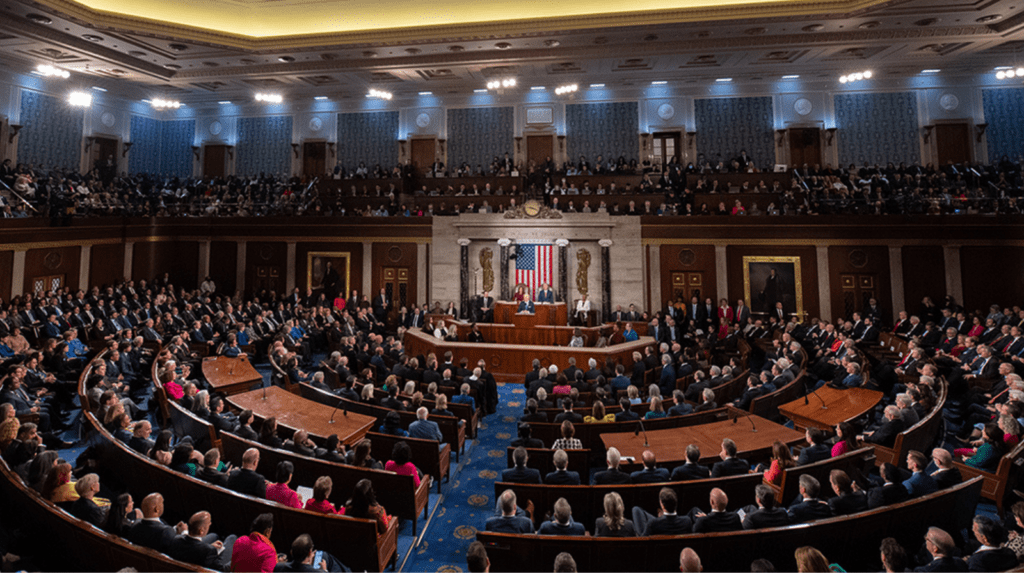
The State of the Union is… tired of high electricity bills.
As part of his long-ass State of the Union address, Trump promised to protect power customers’ wallets from data centers but this so-called “ratepayer protection pledge” covers only part of the costs of expanding AI, Zach Colman reports. Tech execs are coming to the White House next week to go through the motions of signing the pledge.
Even some Republicans who are concerned about data centers and electricity costs said they were still seeking details from the administration.
Here are three better ideas from Legal Planet about what the administration could do to stop making pledges and start writing checks.
Trump announced on Saturday he’s planning to hike the new global tariff rate to 15 percent, one day after the Supreme Court struck down his signature tariff policy. What it all means for clean energy industries has been a hot topic.
While RFK Jr is busy doing shirtless push-ups with Kid Rock while drinking milk in a hot tub, the health secretary is also pledging his support for Trump’s executive order that was supportive of glyphosate, the key ingredient in Roundup weedkiller, about which thousands of people have made cancer claims in court.
My UCLA Law colleague William Boyd has a fresh take on Trump’s new executive order mandating the production of glyphosate as a matter of national security.
The Trump administration also announced last week that it will roll back clean air regulations limiting mercury and hazardous toxins from power plants, which public health groups warn will harm America’s most vulnerable.
The Courts
The big news was that the Supreme Court justices decided to hear next term an appeal by Exxon and Suncor in an industry bid to stop Boulder Colorado and dozens of city and state lawsuits that blame oil companies for climate change. The justices had turned away similar industry appeals in recent years but will hear this Big Oil climate liability case next fall. The case is Suncor v. County Commissioners of Boulder County, 25-170. Climate Integrity has reaction and the background.
It’s fraught timing for climate regulations, as we know, so the Supreme Court review will test whether the Trump administration’s war on federal climate regulation also undercuts fossil fuel companies’ primary defense against climate-related lawsuits, Emily Pontecorvo reports for Heatmap News.
General consensus has been that the endangerment finding rescission strengthens state law claims and authorities. But there is at least one way in which the rescission could undermine, not strengthen, Boulder’s arguments. My colleague Cara Horowitz explains what’s giving her a headache about the case.
HEATED focused on the fact that Justice Samuel Alito has not recused himself from the case, despite having reported significant financial investments in the fossil fuel industry.”
Relatedly, Republican Representative Harriet Hageman announced last week that she is drafting legislation to block the growing wave of state and local climate-damage lawsuits against fossil fuel companies. It follows a letter last year from a group of attorneys general from red states urging the creation of a federal “liability shield” similar to the one Congress granted gunmakers in 2005.
California and 12 other states sued the Trump administration last Wednesday to challenge the Department of Energy’s termination of roughly $2.3 billion in federal funding for clean energy and infrastructure projects. “These aren’t optional programs — these are investments approved by bipartisan majorities in Congress,” California Attorney General Rob Bonta said. The suit challenges cancellation of $1.2 billion to California for development of clean hydrogen as an alternative to oil and gas for public transportation, heavy-duty trucking and seaport operations, Bob Ekelko notes.
A federal judge in Texas dismissed Exxon Mobil’s defamation lawsuit against enviro groups that it had accused of trying to sabotage its recycling business. Karen Zraick reports. That judge allowed a parallel case against California AG Rob Bonta to proceed.
Michigan’s new anti-trust climate lawsuit against Big Oil is risky and might run into challenges, but could potentially be a game changer if the state can overcome initial dismissal attempts by the industry defendants, Dana Drugmond reports at Inside Climate News.
French oil major TotalEnergies is facing trial in a landmark civil climate case that aims to compel the company to curb its oil and gas production and emissions in line with the global accord’s 1.5 degrees Celsius long-term temperature limit, Drugmond also writes.
Energy

It’s official: pollution from power plants is way up thanks to the Trump administration’s energy policies, including those favoring coal, the Wall Street Journal’s Kris Maher reports. “Levels of sulfur dioxide emitted from power-plant stacks were up about 18%, with nitrogen oxide up 7% and carbon dioxide up 4%, according to an analysis of publicly available Environmental Protection Agency data” reviewed by WSJ.
The Energy Department just closed the largest loan it has ever issued — a $26.5 billion loan package — to Georgia utility Southern Co. to pay for a suite of power projects, including new gas generation, in Georgia and Alabama.
Google announced that Pine Island, Minnesota will be the future home of its next massive data center. “In collaboration with the city and Xcel Energy, we’re committed to bringing high-quality jobs, economic growth and education initiatives to the community.” Heatmap News’ Katie Brigham described it as “what would be the largest battery in the world by energy capacity: an iron-air system capable of delivering 300 megawatts of power at once while storing 30 gigawatt-hours of energy, enabling continuous discharge for 100 hours straight.
MPR reports that there is substantial community opposition. The Minnesota Public Utility Commission will need to approve the data center’s electricity plan first. The project’s developer said it hopes to start construction this year.
How are tech companies proposing to supply power for data centers? Claire Brown has a roundup. “In recent weeks, Microsoft and Anthropic have both announced plans to ‘pay their way.’”
In North Carolina, about half a million Duke Energy customers have handed control of their smart thermostats over to that utility “in exchange for a financial incentive and a chance to help the grid,” writes Elizabeth Ouzts at Canary. “For my part, the savings have been meaningful.” It’s the kind of thing that could be expanded nationwide.
If New York City meets its future climate goals, or even comes close, it will completely disrupt the public gas utilities’ current business model, Lauren Dalban reports for Canary Media.
Who loves the sun? Trump votes. This poll shows three-quarters of U.S. voters who supported President Donald Trump in 2024 are in favor of solar power, according to Semafor.
Los Angeles

After the big Los Angeles Times investigation into the use of AI to generate public comments aimed at blocking SoCal air rules, advocates held a press conference to demand an investigation by the Los Angeles District Attorney and California Attorney General. They also unveiled a site where you can search if your name was used by the AI-powered campaign to submit a comment to SCAQMD.
LA officials plan to use our park system as infrastructure for events during this summer’s World Cup and the 2028 Olympics, but they’re not investing enough in the system. “This lack of support flies in the face of the city’s own park needs assessment,” writes Jon Christenson in an Op Ed.
What do Angelenos get from the corporate branding going on at LA parks? Alissa Walker at Torched examined recent brand pop-ups, like a New Balance event at Lafayette park. “Are we making money off this?” she asks. “And are they leaving anything behind? Here are all the local community programs the NBA is funding.”
At Boiling Point, Noah Hagerty tells a “tale of two fires in the Palisades” between government officials and affected residents, who place the blame on government failures. “This sort of dismissal has essentially forestalled any constructive discussions of climate change, the limits of the fire service and water systems and proposals like Zone Zero, since so many Palisadians now feel like any of that is just a fig leaf for the government’s agency and responsibility, and not a good faith discussion of how to solve the wildfire problem.
The LA County district attorney is investigating whether SoCal Edison should be criminally prosecuted for its actions in last year’s devastating Eaton wildfire, which killed 19 people.
Two California senators have asked for an investigation into the state insurance department’s handling of complaints filed by Los Angeles wildfire victims struggling to collect payouts from State Farm.
And in coastal restoration: work began Tuesday on a row of dunes at Santa Monica Beach that will stretch from the city’s famous Pier to the sands along the Venice border, Santa Monica Lookout reports.


About Evan

Evan George is Director of Communications for the UCLA Emmett Institute, a leading environmental law center. He also writes The Drain, a weekly roundup of environmental a…
READ more
Reader Comments