


























































Is Climate Journalism Up to the Task in 2026?
The Drain is a weekly roundup of environmental and climate news from Legal Planet.

We need strong climate journalism now more than ever and there’s some good news to report on that front. Important voices on the climate beat are cranking up the volume, especially via new digital platforms.
But first, the bad news. We now know that 2025 was Earth’s third warmest year on record — featuring firestorms in LA, a deadly heatwave in Europe, and catastrophic flooding in Southeast Asia. And yet, media coverage of climate change last year decreased by 14% compared to 2024. That’s according to a recent report from Colorado University Boulder’s Media and Climate Change Observatory (MeCCO). May Boycoff, who heads MeCCO, partly attributes that diminished coverage to newsroom consolidation, staff reductions, and political economic headwinds in the industry.
Just look at the Washington Post, where management handed pink slips last month to at least 14 journalists working on climate and the environment. Or look at CBS, where most of the five-person team supporting climate coverage on air and on digital platforms was laid off last October. Those cuts were part of a larger layoff of about 100 other CBS News staffers and around 1,000 staffers across its parent company Paramount Skydance.
Now worry about CNN. When news broke last week that Paramount had surprisingly won the bidding war to buy Warner Bros. over Netflix, Sammy Roth posed the question: What will this mean for CNN’s climate journalism? Because operating both CBS and CNN means a certain amount of overlap in news operations that profit-minded managers will be tempted to slash.
For every high-profile layoff, like those at CBS and the Washington Post, there are more newspaper jobs in rural parts of the U.S. that are slipping away with little fanfare. The journalism landscape is so bleak that New York Times Publisher A.G. Sulzberger has voiced a new audio advertisement that implores the listener to support any news organization devoted to original reporting. And the Associated Press is debating internally whether AP’s wire services should use AI to do the writing while reporters feed the bots some quotes from the field.
Even newsrooms doing award-winning work covering disasters often fail to draw the climate connection to extreme weather events. My report last year looked at fire coverage by the Los Angeles Times and found that only 14% of stories about the Eaton and Palisades fires mentioned the role of climate change in the first two months of coverage. When great journalists are assigned to cover all aspects of the fire’s causes and impacts but barely mention climate change, that’s a problem of editorial leadership.
Now the good news.
The Los Angeles Times just hired a veteran of the climate and environmental beat to be their new climate and energy reporter. Blanca Begert previously reported for Inside Climate News, Politico’s California Climate newsletter, and Grist. Begert has a master’s degree in environmental science from the Yale School of the Environment, where she studied forest management and conservation. That’s a big win for readers and a good sign that LAT continues to invest in the climate team even though they ended the Boiling Point podcast when Sammy Roth left the paper to start Climate-Colored Goggles.
For its part, POLITICO recently restructured its robust energy and environment reporting teams and put longtime editor Debra Kahn in charge to “to turbo-charge [our] reporting on the White House, Congress, federal agencies and state and regional energy power centers.” That elevates an editorial leader who is expert on environmental policy generally, and California especially, to lead national reporting efforts.
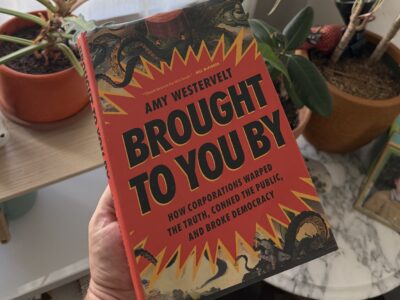
When it comes to audio, Drilled’s flagship podcast hosted by Amy Westervelt is about to get wider distribution by joining industry sweetheart Pushkin Industries, which puts out big pods like “Heavyweight” and “Revisionist History.” A new series of the award-winning Drilled is set for an April 21 release. Westervelt won Journalist of the Year from Covering Climate Now in 2023.
Speaking of awards, Covering Climate Now is accepting submissions for its annual journalism awards. The awards are free and open to all. They have grown to field more than 1,200 entries from dozens of countries each year. In addition to your typical beat-oriented categories, CCN honors work in a “Large Projects & Collaborations” category as well as “Emerging Journalists of the Year.” Covering Climate Now also offers all sorts of resources, webinars, and trainings, like tomorrow’s briefing on “The Iran War and the Climate Emergency.”
The HEATED newsletter has also expanded to include a video podcast. That’s great, because for almost seven years now, Emily Atkin’s HEATED has been a text-only operation but “most people don’t actually get their news by reading, they get it by consuming it via social media, mostly in video form,” Atkin writes in the announcement. Coming full circle, this video expansion is possible because Atkin has teamed up with Tracy Wholf, an experienced climate journalist who recently lost her job at (you guessed it) CBS. Or as Atkin writes, because a “centibillionaire’s son took control of a major news network and decided that climate change reporting was “no longer aligned with our evolving priorities.”
In the year ahead, talented climate journalists who are looking for new opportunities may be tempted to jump back into long-form writing by starting yet another Substack. Here’s a pitch to go beyond text: We need you engaging with people who don’t already subscribe to newspapers and newsletters and policy blogs. We need you in our feeds, talking to people who get their news from YouTube, and sharing short-form versions of your long-form, original reporting. But most of all we need you.
Welcome to The Drain, a weekly roundup of environmental and climate news. And your weekly check-up on the health of climate journalism. Our song of the week is “Nude as the News” by Cat Power.
Affordability and Energy
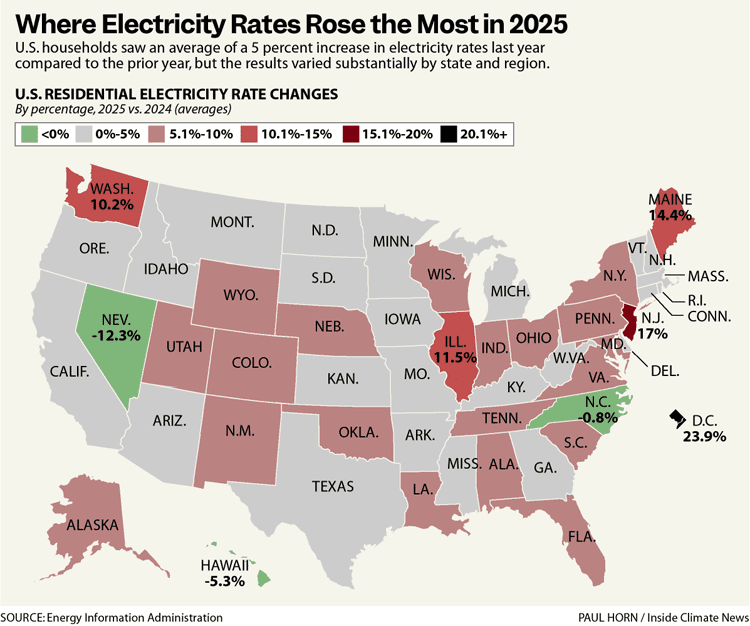
New data shows electricity rates rose 5% nationwide in 2025 and the figures were much higher in some states. At Inside Climate News, Dan Gearino and Marianne Lavelle analyze the increases. “States that voted for Trump in 2024 are sharing the pain of the power price shocks sweeping the country; 13 of the 24 states where prices rose in 2025 by more than the U.S. average of 5 percent voted for the Republican candidate.”
CalMatters spotlights what it calls California’s heat pump conundrum. “On the one hand, California has hyper ambitious goals to reduce greenhouse gas emissions” partly by electrifying buildings…On the other hand, California’s residential electricity prices are among the highest in the country — expensive even compared to its also pricey natural gas. That makes heat pumps a tough sell to many Californians.”
An energy-affordability bill approved recently by the Massachusetts House of Representatives could speed solar permitting, strengthen protections for many electricity consumers, and boost EV charging infrastructure, but it would also cut energy efficiency Sarah Shemkus reports for Canary Media.
Good podcast conversation here about the politics of affordability between Robinson Meyer and Jane Flegal, a senior fellow at the Searchlight Institute and the States Forum. Flegal was formerly the senior director for industrial emissions at the White House Office of Domestic Climate Policy. “Are there risks of talking about affordability so much?”
For the Guardian, Matthew Green spent some time in Benicia, near San Francisco, where for decades the Valero refinery shaped the local economy, politics and health. “Now the city has become a reluctant test case of whether an oil town can reinvent itself.” The Valero refinery is set to close in April.
As our growing fleet of EVs ages, new data pooled from tens of thousands of vehicles shows those batteries are lasting longer than previously expected, Camila Domonoske reports for NPR. “The initial drop-off is not as severe as some people had worried. And the sharp end-of-life decline is taking a long, long time to materialize.”
Investor-owned utilities are doing a delicate dance to carefully navigate the politics of higher rates, assuring people that they committed to affordability. “They need to boast about earnings growth to their shareholders while also convincing Wall Street that they can avoid becoming punching bags in state capitols,” writes Matthew Zeitlin at Heatmap.
Trump is scheduled to appear with Big Tech execs today (Wednesday) to promote the new, so-called “ratepayer protection pledge” on data center power. Details of the deal — you will be shocked to hear — have not been made public ahead of the scheduled signing event with tech giants Amazon, Google, Meta, Microsoft, and others, Charles Paullin writes.
War on Iran
The war launched by the United States and Israel on Iran last weekend is sending oil prices upward and the conflict could send prices per barrel as high as $100 or more, the consultancy Wood Mackenzie warned. The instability starts with the Strait of Hormuz, which has been basically closed. A big Saudi refinery has suffered damage.
Qatar’s state-owned energy company announced this week that its own LNG production and export operations were halting “due to military attacks” on their facilities.
The Trump administration has signaled that the world is so flush with oil and gas right now that it feels emboldened, the New York Times points out. “I think it gives President Trump more leverage in his geopolitical actions to not worry about a crazy spike in oil prices,” Chris Wright, the energy secretary, said on CNBC last month.
Several index funds that include shares of U.S. clean energy companies rose Monday, following the disruptions, E&E reports. But clean energy stocks are not winning. “First Solar: down over 1% on the day. Enphase: down over 3%. Sunrun: down almost 8%; Tesla: down around 2.5%” Heatmap reports, citing three main reasons why clean energy stocks are down anyway.
The Courts
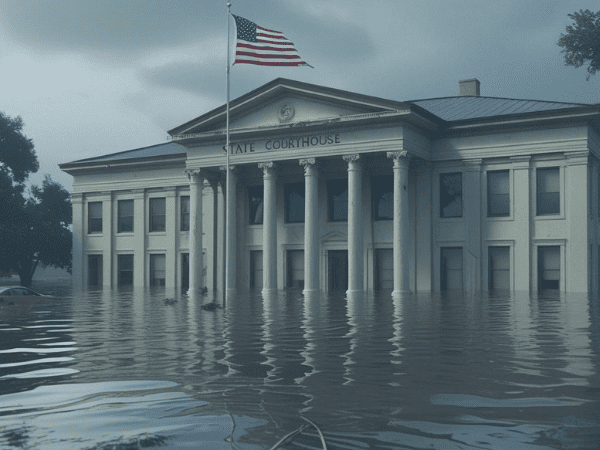
Later today, eight young people in Alaska will go before the Alaska Supreme Court in Sagoonick v. State of Alaska II, a youth-led constitutional climate case challenging that state’s support for the Alaska LNG Project. The hearing will be streamed and Our Children’s Trust is representing the plaintiffs.
Dozens of scientific contributors to the Reference Manual on Scientific Evidence — a judicial resource that has been published since 1994 by the Federal Judicial Center — are raising alarm bells about political interference after the deletion of a chapter on climate science, Liza Gross reports. “The political attack on the nonpartisan publication ‘should concern us all,’ its co-authors warn.”
New York’s successful congestion pricing policy gets the green light. A federal judge ruled that the Trump administration does not have the authority to terminate New York’s congestion pricing program, Streetsblog reports. The Department of Transportation’s legal authority over tolling programs “does not carry with it the inherent unilateral ability of whoever holds the office of Secretary of the Transportation at any particular moment to terminate a project whether established by himself or a predecessor,” Judge Lewis Liman wrote in an extensive ruling.
A judge in North Dakota finalized a $345 million judgement against Greenpeace USA last week. The damages stem from the American chapter of the activist group’s protests against the construction of the Dakota Access Pipeline. Greenpeace says: “We will request a new trial, and — if necessary — appeal the decision to the North Dakota Supreme Court. The law is firmly on our side, and we are confident in our strong arguments for an appeal.” Marco Simons, interim general counsel at Greenpeace USA and Greenpeace Fund, said: “Speaking out against corporations that cause environmental harm should never be deemed unlawful.
Groups supporting Vermont’s “climate superfund” law say in a new court filing that EPA’s endangerment rescission undercuts the Trump administration’s lawsuit against that state statute, Axios reports. EPA’s final rule “contradicts its litigating position in this case,” states Friday’s federal district court filing from the Conservation Law Foundation and the Northeast Organic Farming Association of Vermont.
A Santa Barbara Superior Court Judge denied Texas-based Sable Offshore Corp.’s motion to lift a preliminary injunction that limits the company’s ability to restart a problematic pipeline to carry crude from rigs off the Santa Barbara coast.
A federal district court judge in Oregon put parts of that state’s single-use plastic law on hold while he decides whether it violates antitrust and consumer protection laws. The Oregon law is similar to California’s own landmark, LAT’s Suzanne Rust reports. And the Oregon court found serious constitutional questions under the Dormant Commerce Clause and Due Process Clause, marking the first federal court intervention regarding an extended producer responsibility program on constitutional grounds.
Los Angeles, California
Mayoral candidate Nithya Raman spoke with POLITICO’s Alex Nieves about her vision for changing LA’s housing market, federal attacks on climate policy and the tension between electrification and affordability. On March 21, Raman and 2 other candidates will participate in an LA Mayoral Debate hosted by Streets for All.
UC Santa Barbara’s Paasha Mahdavi argues that adding more EVs, importing more gasoline, and rooting out hidden prices (not pumping more oil) is how to bring down gas prices here in California.
The CPUC adopted a new planning framework that requires the state to procure 6 gigawatts of new clean energy during a three-year period starting in 2030, Noah Baustin reports.
AB 2385 by Assemblymember Cottie Petrie-Norris is a new bill that would help local governments spring into action after disasters. My Emmett Institute colleague Julia Stein wrote about the problem this bill address.
OC residents concerned about the possible poisoning of Orange County waterways with herbicides have been making their voices heard on Instagram, Ian James reports for LAT. The county held a town hall in Dana Point on Monday night to provide information and hear from the public.

Register to attend “Can Abundance Be Sustainable?” the upcoming symposium from the UCLA Emmett Institute. It’s an all-day event devoted to panel discussions on the intersection of affordability and climate policy.
Read this new report from Climate Cabinet Education with 16 proposals for how to cut pollution by building more housing.
Stand up for science: There’s a day of national action on March 7 and if you’re in Los Angeles, the action is Noon-2pm at the Wilshire federal building.
Shake it off on April 25 at this Climate Solution Dance Party at the La Brea Tar Pits and Museum sponsored by marine biologist and climate expert Ayana Elizabeth Johnson
Reader Comments
2 Replies to “Is Climate Journalism Up to the Task in 2026?”
Comments are closed.
About Evan

Evan George is Director of Communications for the UCLA Emmett Institute, a leading environmental law center. He also writes The Drain, a weekly roundup of environmental a…
READ more
Yale climate connections does a really good job reporting on the climate.
https://yaleclimateconnections.org/ including their newsletter whatsnew@yaleclimateconnections.org
They also have wonderful Tom Toro cartoons at the end of the newsletter.
So … Climate Cabinet Ed … who is paying for all that? Do you know who is behind them?