

























































Trump and Xi Meet in Beijing
As the U.S. and China meet, climate change is NOT on the agenda.
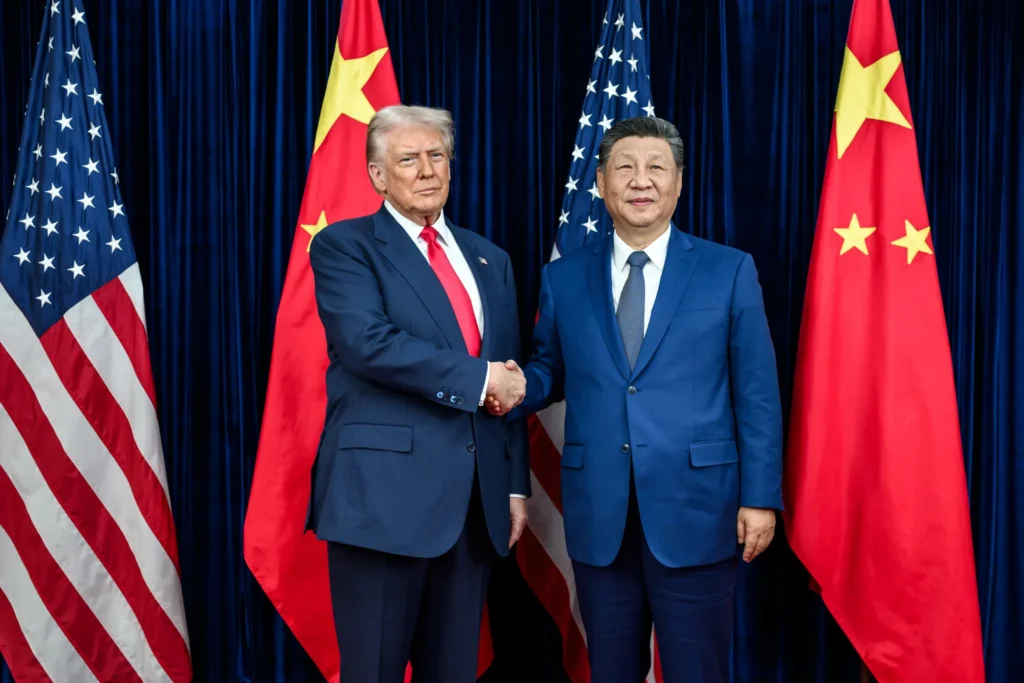
When Presidents Trump and Xi meet this week in Beijing, climate and environment will not be on the agenda. That absence is striking, because the U.S. and China are now moving in radically different directions on climate, energy, and environmental protection.
The US is in an extraordinarily anti-environmental moment. It has exited both the Paris Agreement and the UN Framework Convention on Climate Change. The Trump EPA now talks mostly about “deregulation” and has taken a litany of actions to weaken environmental rules, including issuing a rule to rescind the endangerment finding at the core of EPA‘s legal authority to regulate greenhouse gases under the Clean Air Act. Since the beginning of 2025, the Trump administration has taken a series of executive, regulatory, and budget actions to slow or constrain renewable energy development. Congress has nullified California’s “waiver” under the Clean Air Act that allowed it to adopt a 2035 100% EV care sales target, require growing shares of zero-emission truck sales, and limit NOx pollution from heavy-duty vehicles. The administration’s “energy dominance” strategy focuses almost entirely on fossil fuels. These are only a few examples from the most aggressively anti-environmental presidency in recent memory.
China, by contrast, remains formally committed to its Paris targets of peaking emissions before 2030 and carbon neutrality by 2060 – the “dual carbon” goals. In a relatively short span of time, it has become the global leader in clean-energy and electric-vehicle manufacturing and deployment. China accounted for more than half of the global increase in wind and solar generation in 2024, and clean generation met most of China’s electricity demand growth that year. Chinese firms produce the bulk of the world’s solar PV panels and a dominant share of wind-turbine components. In 2025, clean-energy installed capacity exceeded fossil-fuel power capacity for the first time. Chinese companies produce and sell well over half of the world’s electric passenger cars.
Of course, the countries start from very different baselines. The U.S. has made extraordinary progress on tackling many environmental issues over the last several decades, even if that progress is now under attack. China, meanwhile, remains the world’s largest emitter of greenhouse gases and many other pollutants. For those of us who believe the U.S. must still do far more on climate and the environment, this American turn against environmental policy is deeply troubling.
The sharp divergence in the two countries’ energy strategies has led some observers to characterize the U.S. as the world’s most powerful petrostate and China as its leading “electrostate.” The contrast is not just in rhetoric or industrial policy, but in the nuts and bolts of governance.
One recent development in China neatly illustrates how Beijing is trying to steer its bureaucracy toward emissions reductions and electrification. On Earth Day, as the Trump administration continued dismantling elements of the U.S. environmental regulatory regime, China’s top Party and state organs issued a new national framework for evaluating government officials on their progress toward the dual-carbon goals.
Officially titled the “Comprehensive Evaluation and Assessment Measures for Carbon Peaking and Carbon Neutrality,” these rules govern how provincial-level Party and government leaders are evaluated. In China’s centralized system, cadre evaluations are a primary way the Party steers the work of the provincial Party secretaries and governors. These are the KPIs that shape career prospects of subnational leaders.
I wrote one of the earliest academic articles about China’s turn to “hard” environmental targets in its 11th five-year plan (2006-10) and the introduction of binding energy- and pollution-control targets. Local regulators I interviewed at the time told me how they initially ignored these new targets because “environmental targets had never been important before.” That changed when senior officials in Beijing began to signal that missing them could damage local officials’ promotion prospects. In my research I documented how early implementation was flawed, culminating in a madcap rush to meet targets in 2010 that produced widespread cheating and “goal displacement.” Local governments shut off power to public services – my aunt received a text message in her southern city announcing that all elevator use below a certain floor would be suspended for several weeks – and firms turned to dirtier off-grid diesel generators to game the statistics. These are the kinds of behaviors one sees anytime there are hard targets, weak monitoring, and difficulty in meeting the goals – whether it be a mayor’s crime-reduction targets, test-score benchmakrs under the No Child Left Behind Act, or Chinese environmental indicators.
Over the last three Five-Year Plan cycles – a standard way to understand and organize Chinese governance – China has repeatedly expanded and refined its energy and environmental targets. Those targets have become more central to Beijing’s strategy to advance green industrial policy, shift China toward “higher-quality” growth, enhance energy security, reduce pollution, and burnish China’s global reputation. In addition to early pollution control and energy efficiency targets China has added targets for carbon intensity, share of non-fossil energy, and ecological conservation.
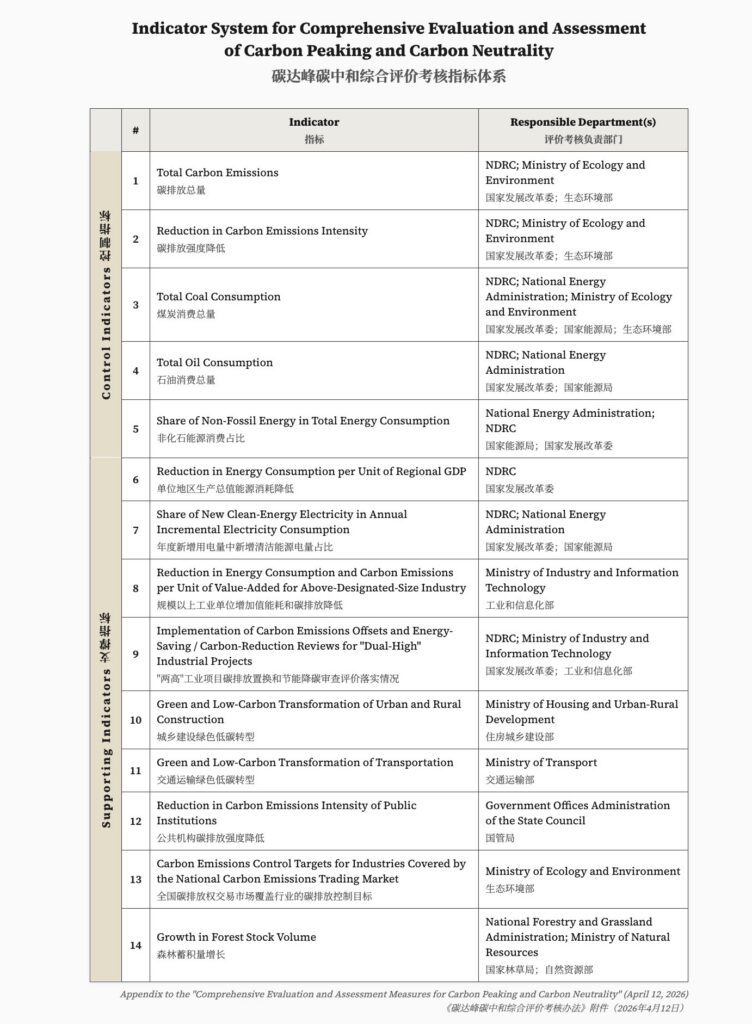
The new cadre evaluation system knits these pieces together into what officials describe as a “5+9” target framework (see chart below). There are five binding targets and nine supporting targets. A province will be rated “unqualifed” if it fails any one binding target or any three or more supporting targets.
The binding targets cover the major metrics of China’s energy and climate transition: total carbon emissions, carbon intensity, total coal consumption, total oil consumption, and the share of non-fossil energy in total energy consumption. The supporting targets include energy intensity, the share of clean energy electricity in incremental power consumption, sector-specific energy and carbon intensity indicators (for industry, buildings, transport, public institutions), performance under the national emissions trading system, and growth in forest stock.
A perennial question with targets is whether performance ends up being meaningful or merely symbolic. We will need to watch how this system is implemented and how strictly it is enforced. Analyst Lauri Myllyvirta has noted, for example, that China effectively “met” its 2020-25 carbon intensity target in party by revising how the indicator was calculated, rather than by delivering the level of emissions reductions implied by earlier data. That kind of methodological “fix” is a form of gaming we should be looking out for.
Going forward, we will need to hold two thoughts in our heads at once. While Trump and Xi are in Beijing not talking about climate change, Americans should recognize the growing divide between how our two national governments think about clean energy, transportation, and climate policy. The U.S.is currently pursuing a strategy that rejects most serious climate action. China, by contrast, is pursuing a low carbon strategy that is also paying dividends in economic development and in deepening its geopolitical ties across the globe. At the same time, we must continue to scrutinize how China is actually performing on climate action – for purposes of accountability, for understanding our shared progress on climate change, and for recognizing the ways in which targets and methodologies can both advance and obscure that progress.

About Alex

Alex Wang is Professor of Law at UCLA School of Law, and a Faculty Co-Director of the Emmett Institute on Climate Change and the Environment. He is a leading expert on en…
READ more
Reader Comments