




















































Can Sustainability Be Abundant, Safe, and Affordable?
Read and watch key takeaways from the UCLA Emmett Institute’s 2026 symposium on climate policy and affordability.

This month, the UCLA Emmett Institute explored the intersection of climate goals, affordability concerns, and environmental protections by hosting a symposium titled “Can Abundance Be Sustainable?” The all-day, public event at UCLA School of Law brought together academics, community advocates, policymakers, journalists, students and—not one but two—heads of utility regulatory bodies.
The goal was to think deeply about the path forward for ambitious climate policies at this critical time. While the symposium title used the so-called Abundance Agenda as a jumping-off point, several panelists observed that “abundance” as a rhetorical frame ignores other trade-offs that are often key to public policy.
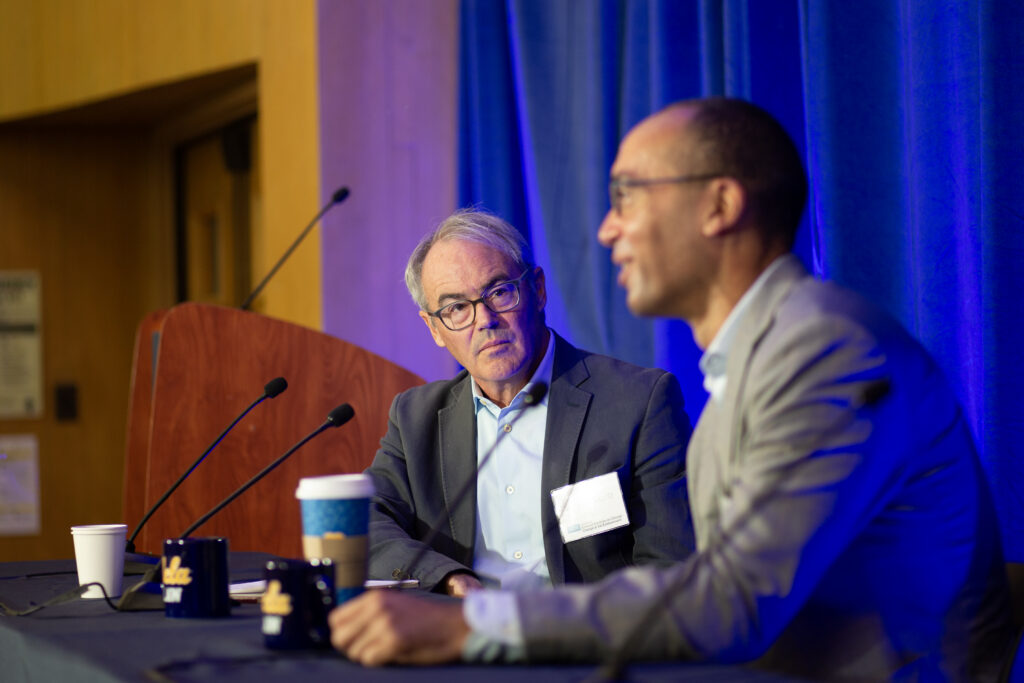
“In addition to affordability and climate policy, we are also responsible for reliability and safety of the systems we oversee,” California Public Utilities Commission President John Reynolds said during the keynote address. “We’ve got to do them all. It’s challenging to do them together because they impact each other—but that’s the work,” Reynolds said during a conversation with William Boyd, Michael J. Klein Chair and Professor of Law at UCLA. The pair broke down the contributing factors to the high cost of electricity and what the CPUC can do to address the costs.
Robinson Meyer, founding executive editor of Heatmap News who moderated the first panel, put it another way. “From California’s perspective, at least when I think about climate policy, the question is not ‘Can abundance be sustainable?’ but ‘Can sustainability be abundant?’ Because we know that costs are going up in California and New York,” Meyer said. “People are voting with their feet and moving to parts of the country that are far less sustainable.”
Throughout the day, panelists explored these tradeoffs as they relate to 1) electricity regulation and pricing; 2) the move away from fossil fuel extraction, infrastructure and dependence; and 3) how to build more housing without losing environmental protections.
Read on for summaries of each panel written by the UCLA Emmett Institute’s law fellows and to view full video recordings each discussion starting with the keynote.
Growing the Grid Without Breaking the Bank

Energy demand is growing for the first time in decades. How we meet that demand is still an open question, moderator Robinson Meyer, of Heatmap News, said. It remains to be seen whether sustainable sources of energy can be “abundant” and cost-effectively meet our energy needs. This is especially important as energy affordability is an increasingly salient concern for voters. That concern about cost has been around since at least 2020, according to Abre’ Conner, Director of the Center for Environmental and Climate Justice at NAACP. But in her experience politicians are only now waking up to the urgency of voters’ worries.
This places politicians and regulators in a difficult spot. Utilities want and need to invest in more infrastructure. Investments are needed to connect renewable generation assets to the grid, meet energy demand from data centers, and safeguard reliability as extreme weather events become more common. It will be difficult to design a cost recovery process that allows for these necessary investments without raising electricity rates, in William Boyd’s view. Yet “the investment challenge and the affordability challenge have to be solved at the same time” if we want to make electrification possible. Boyd noted that we are increasingly moving towards a zero-marginal-cost resource market: Renewables’ cost comes only from the upfront capital investments needed to build them, as opposed to the fuel-cost driven system we have today. In that world, a utility’s only major expense is capital expense. One way to keep costs in check, then, would be to lower capital costs for utilities. And since capital costs are a weighted average of debt and equity costs, regulators could do that by lowering the return on equity granted to utilities. “We’re in a different world, and we need to be thinking about different [funding] models,” Boyd said.
Tina Andolina, Chief of Staff to California Senator Ben Allen, was skeptical of that approach. Investments are happening, and we need our utilities to have strong access to capital markets to fund those investments. Lowering the rate of return on equity could endanger that access. Instead, Andolina suggests we focus on all the other costs that make up a utility bill and see where reductions could be possible. One big-ticket item is wildfire liability costs. The legislature, according to Andolina, is focused on figuring out what investments utilities can make to reduce wildfire risks and thereby cut wildfire liability costs while also increasing system reliability. That could be one way of lowering bills without reducing investment.
Costs are not the only challenge facing the grid. Another is community opposition, especially towards data centers and the grid buildout required to service them. Abre’ Conner, who has worked extensively with communities impacted by the power needs of data centers, raised community benefits agreements as one potential solution. These agreements can center community needs in the grid buildout conversation and can also provide “ratchets” to ensure enforceability.
Conner, of the NAACP, talked extensively about a controversial xAI data center that operates in Memphis, fueled by gas turbines. The NAACP is now suing Elon Musk’s xAI for installing the gas plant without obtaining the required air permits.
— Elias van Emmerick, Emmett/Frankel Fellow in Environmental Law and Policy
Affordability and the Transition Away from Fossil Fuels

Moderator Allan Marks, Lecturer at UCLA Law, kicked off the panel by recognizing that affordability concerns are often framed as justifications for lowering our ambitions to transition from fossil fuels to clean energy, or at least delaying the most transformative reforms. Marks posited that we are currently in an “energy expansion rather than an energy transition” because of rising demand for electricity that’s motivating investments in clean energy alongside natural gas in the U.S. and worldwide, and even coal in some foreign countries. Global markets are “doubling down on investments in clean energy, largely in solar power,” particularly in Asia, where there has been a rapid rise in energy demand for manufacturing, transportation, and buildings (i.e., air conditioning). Domestically, the Trump Administration’s support for fossil fuels and disdain for clean energy—wind energy in particular—have complicated, but not forestalled, the progress being made by Democratic-led states and localities seeking to shift toward renewables.
Katie Valenzuela, Policy Consultant at Everyday Impact Consulting, highlighted California’s recent backsliding on clean energy last year, when the Governor and Legislature passed laws to streamline oil and gas permitting in certain contexts and to remove legal and regulatory roadblocks to fossil fuel production, particularly in Kern County where Valenzuela grew up. Valenzuela described these laws, passed under the auspices of stabilizing gas prices, as deeply-concerning, especially in a blue state that has long professed its commitment to clean energy, and lambasted them as corporate welfare for fossil fuel companies that will “raise prices no matter what handouts are given to it by the state.” Drawing from her experience growing up next to fossil fuel drilling and refining sites, Valenzuela reminded the audience of the physical toll that polluting industries exact on frontline communities like her hometown of Oildale, whose residents are disproportionately low-income and of color. Valenzuela recognized that many frontline community members are both harmed and employed by the industry at the same time, and thus adopt the industry’s political positions out of a desire to defend their jobs. Valenzuela urged policymakers to engage with these complex dynamics in frontline communities and develop realistic plans to ensure a “just transition” as fossil fuels are replaced by renewable energy sources. Marks chimed in to call attention to the fact that class and racial inequities are also exemplified by the dearth of EV charging infrastructure in apartment buildings, particularly in low-income communities of color, and the financial inaccessibility of EVs for working- and even middle-class consumers despite the availability of government-funded subsidies.
Ryan Cummings, Chief of Staff at the Stanford Institute for Economic Policy Research, rebutted the commonly-held belief that boosting fossil fuel production in California would lower gas prices in the state. Cummings explained that gas prices are set by the price of the last, most-expensive barrel of oil needed to satisfy demand, known as the “marginal” barrel in economics parlance. In California, the marginal barrel is imported from overseas because California does not produce enough oil to meet its own demand, so gas prices in California are determined by the global commodity price of oil as long as there is sufficient import capacity (which there is in California). Half-jokingly, Valenzuela proposed that Cummings send his findings to her political contacts in Sacramento, because many legislators and advocates still believe that increasing oil drilling in California will reduce prices at the pump—uncritically parroting the talking points of industry lobbyists—despite ample economic evidence to the contrary.
David Spence, Professor of Law at the University of Texas School of Law, discussed the prevalence of mis- and disinformation about clean energy and fossil fuels, arguing that scientific realities have been obfuscated due to corporate lobbying and shifting political attitudes in the social media era. Spence attributed the increased politicization of pro-clean energy policies along party lines—with Democrats in support and Republicans in opposition—to the rise of “negative affective partisanship, ” a term-of-art in political science that refers to electoral choices being more motivated by negative attitudes toward the opposing political party than positive attitudes for one’s own party. Spence lamented the fact that partisan polarization in the U.S. has shifted the political calculus toward the extremes, such that politicians are incentivized to “toe the party line” because they are more concerned with a primary challenge than a general election challenge given that districts increasingly favor one party over the other to the extent of being non-competitive in general elections. These polarized political dynamics have foreclosed bipartisan efforts to create data-driven, scientifically-grounded climate solutions like pro-clean energy policies, which used to be less controversial. Spence shared polling data showing a sharp drop in support for the expansion of renewable energy among Republicans and voters who lean Republican—from 62% in 2019 to 33% in 2025—against a backdrop of continuously high support—hovering around 90%—for renewable energy among Democrats and voters who lean Democrat. Lastly, Spence encouraged policymakers to account for polling that sheds light on voters’ attitudes and motivations, which may be counterintuitive and driven more by emotion than fact. For example, Spence noted that voters almost always believe that energy prices are too high, are highly motivated by the fear of losing consumer choice (e.g., the ability to eat meat, drive gas-powered cars, and use gas stoves), and care much more about the immediate “sticker price” of an EV at the dealership than the lifecycle cost savings that an EV can provide due to lower energy costs over the EV’s lifetime.
— Brennon Mendez, Emmett/Frankel Fellow in Environmental Law and Policy
Housing Affordability and Environmental Protection
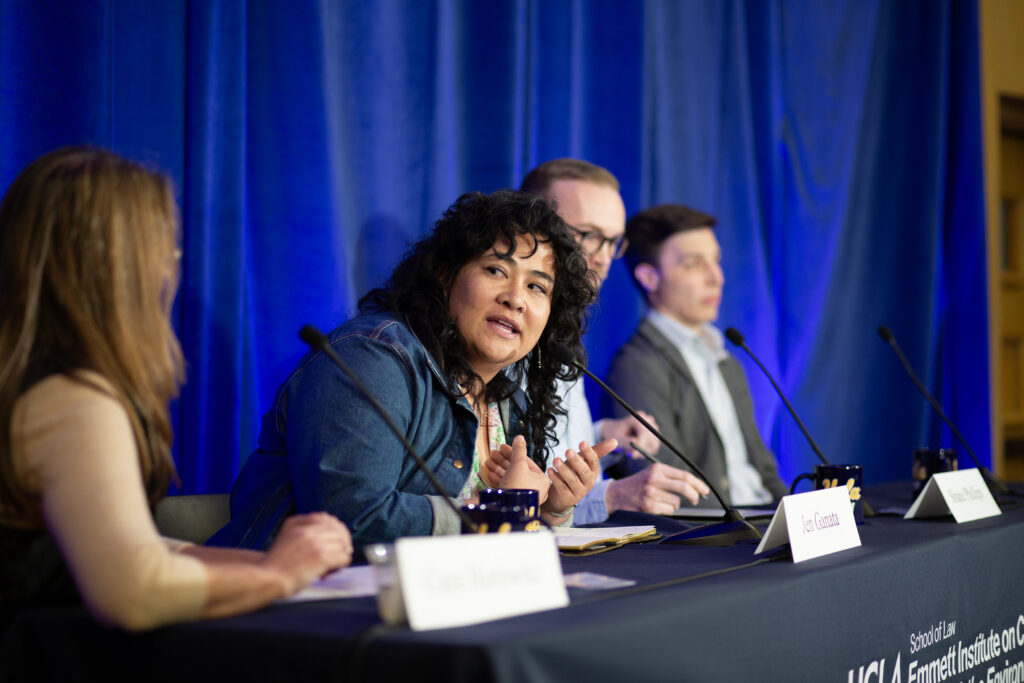
The third and final panel during the symposium confronted housing. The panel featured Jen Ganata, Legal Department Co-Director at Communities for a Better Environment, Shane Phillips, Housing Initiative Manager at the UCLA Lewis Center for Regional Policy Studies, and Liam Dillon, California Housing Reporter at Politico. Our own Cara Horowitz, Executive Director of the Emmett Institute, moderated the panel. Horowitz opened the discussion at “the heart of the matter”—the fact that California’s housing is too expensive to build, too expensive purchase, and too expensive to rent—and asked the panelists to speak about the relationship between housing affordability and requirements of the California Environmental Quality Act (“CEQA”).
Specifically, much of the discussion centered around the pros and cons of the recent CEQA streamlining efforts. In 2025, the California legislature passed two CEQA streamlining bills: AB 130 and SB 131. AB 130 established a new statutory CEQA exemption for infill housing projects that meet certain criteria, and SB 131 created a wide array of additional statutory CEQA exemptions, including a particularly controversial exemption for “Advanced Manufacturing” facilities on industrially zoned land. Ganata, who has over a decade of experience working in housing and environmental justice spaces, highlighted a few of the problems with these bills, including that they were passed as “budget trailer bills.” By virtue of being passed as part of the budget instead of through the standard legislative process, Ganata explained, conversations about the bills “happen[ed] behind closed doors” and thus took away any opportunity for environmental justice (“EJ”) communities to give their input. As a result, important equity considerations, like labor protections and affordability requirements, are absent from the new rules. As Ganata observed, this type of scenario therefore begs the question, “Who are we building for?”
Phillips, who was more supportive of the CEQA reforms, offered a somewhat contrasting view by emphasizing that, above all, “we have to make it feasible to build [new housing],” and “the more we ask [for] in terms of lower rents and higher wages, the less housing we’re going to get.” In his view, building more housing in dense urban areas—even if it is not strictly “affordable housing”—will be better for the environment, create more jobs, and help with California’s housing crisis. Phillips expressed his support for the “win-win” solution of building more dense housing around transit stations, noting that “we should make it easier to build the things people want, where they want them.”
The panelists also touched on building electrification and rebuilding after the 2025 Los Angeles wildfires. Dillon, of Politico, previewed some reporting that he was close to publishing on the challenges to rebuilding. “In terms of completions, we’re talking a few dozen across the Palisades and Altadena at this point,” he said. “That is decently behind —far behind —what happened in Santa Rosa after the 2017 Tubbs fire, where 15 months out they were at about 100 homes, and even behind what was being built in Paradise 15 months after the 2018 Camp fire, in which they had 50-some homes built.” (His story published soon after the panel.) To close out the panel, Horowitz asked the panelists to share their long-term visions for housing affordability and environmental protections. Rather than sharing his personal vision, however, Dillon shared his projections for “what he sees coming” in this area. While Dillon recognized that “abundance is certainly the flavor of the day in California,” he also highlighted the upcoming elections for California Governor and Los Angeles Mayor. In Dillon’s view, the “activist role” that the State has assumed in regard to housing development under Governor Newsom’s leadership is likely to be ratcheted back, although not entirely, under the next administration. Accordingly, we could see a notable decrease in the pace of CEQA reforms in the near future—whether this would help or worsen the housing affordability crisis remains to be determined.
— Tiffany Deguzman, Shapiro Fellow in Environmental Law and Policy



About Brennon

Brennon Mendez (he/him) is an Emmett/Frankel Fellow in Environmental Law and Policy at UCLA School of Law for 2024-2026, where his work will focus on environmental justic…
READ moreAbout Tiffany

Tiffany Deguzman (she/her) is the 2025-2027 Shapiro Fellow in Environmental Law and Policy at UCLA School of Law, where her work will focus on sustainable agriculture, wa…
READ more
Reader Comments