



















































Hate the Gas Tax? Get to Know the Road Usage Charge
The Drain is a weekly roundup of environmental and climate news from Legal Planet.
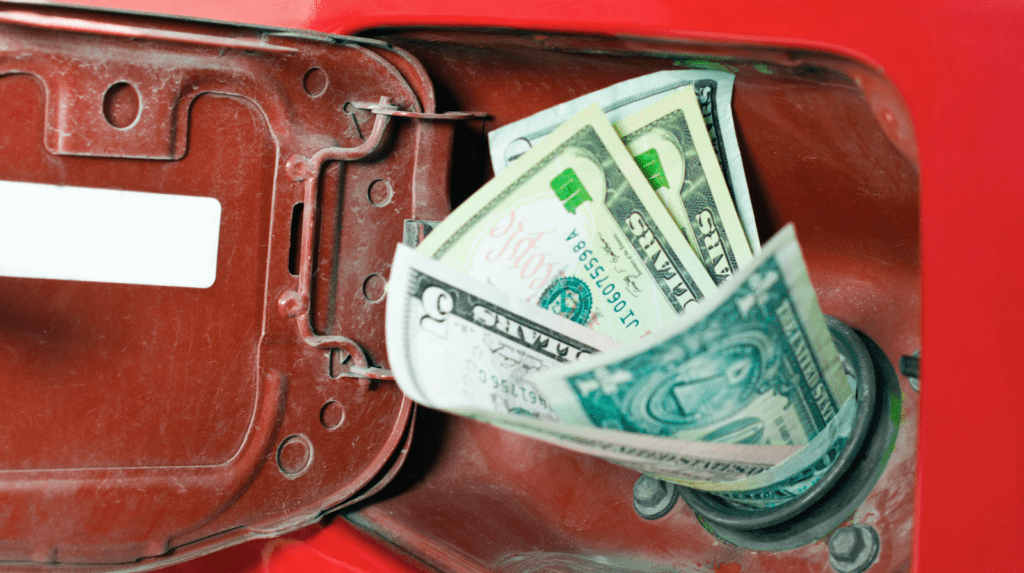
We Californians glide on a network of more than 394,000 miles of roadway, which includes 51,000 miles of state highways, and 25,737 bridges. Our state highway system is one of the largest in the country and requires serious maintenance. Whether you usually travel by gas-powered car, EV, public transit, bicycle or on a sidewalk, you benefit from the state’s transportation system, funded by federal, state, and local sources. We should all pay for this system. The only question is how.
Enter the federal gas tax: 18.4 cents a gallon and 24.4 cents for diesel. Historically, it’s been one important way to fund transportation — mostly our highway system but also public transit. The big problem is that it hasn’t gone up in 33 years, since Bill Clinton was president and I was wearing Reebok Pumps.
Transportation funding has decreased for three main reasons and in this order: Inflation, fuel efficiency improvements, and the rise of EVs. That’s according to Allan Jenn, Associate Professor at the UC Davis Institute of Transportation Studies, who told me by email that EVs are by far the smallest of the 3 factors but are a growing concern. EV drivers don’t pay a gas tax, so they don’t chip in for road maintenance. We’ll come back to that.
Transportation funding in California was estimated in a recent legislative analysis to total $44 billion in fiscal year 2022‑23 — one‑fifth of it coming from the federal government, mostly from the federal gas tax. That gas tax is in the news because Americans are paying more than normal at the pump right now. High gas prices caused by Trump’s war are disproportionately hurting low- and middle-class families; this surge is driving the cost of all other goods up; and people are understandably angry.
Republicans and Democrats in Congress have recently introduced several pieces of legislation to suspend the federal gas tax, which Trump said he favors. At least three red states (Georgia, Indiana, and Utah) have declared temporary gas-tax holidays and several more are discussing it (Alabama, Arizona, Connecticut, Florida, Maryland, New York, Pennsylvania, and South Carolina, according to Avalara).
But a nationwide gas-tax holiday that covers the 122-day summer driving season (as one bill in Congress proposes) would cost the Highway Trust Fund $11.5 billion in lost revenue without delivering significant relief to consumers, according to this nonpartisan analysis.
So, the gas tax is both insufficient and vulnerable to attack. What about a fee on EVs?
The Republican-controlled House Transportation and Infrastructure Committee this week unveiled its long-awaited transportation bill, or the highway bill, and it includes a fee on electric and hybrid vehicles. It would slap a $130 per year fee on drivers registering electric vehicles, with a $35 fee for plug-in hybrids. The measure also proposes to withhold federal funding from any state that fails to comply with the rule. If passed, the fees would take effect at the end of September 2027.
Some states already have EV registration fees or “alternative fuel fees” to supplement the gas tax. California has an annual “road improvement fee,” or RIF, for zero-emission vehicles. In theory, this means that EV drivers “pay their fair share” of road funding. But one complication, Jenn at UC Davis said, is that the gas tax is structured like a user fee so that someone who drives a gas-powered car 20,000 miles pays double what a driver doing 10,000 miles would pay. Meanwhile, an EV driver paying a registration fee pays the same amount no matter how much they drive. Seems less than ideal.
To be clear, an EV fee would be a drop in the bucket compared to the amount of money we’d lose from a holiday on the gas tax. And if you really want to fund transportation more fairly, you’d have both, Jenn said. “It seems abundantly clear that this is more motivated politically against EVs—if this was intended as a way to try and ‘balance’ the transportation budget, then you certainly wouldn’t suspend the federal gas tax at the same time.” Auto industry and environmental groups say the proposed EV fee is substantially higher than the average fuel taxes paid by owners of gasoline cars. So yes, EV drivers should pay, but fees should be fair and not penalize EV adoptions. A RIF shouldn’t be a rip off.
California has been looking into a different funding mechanism called a road usage charge, or RUC, that is mileage-based. Jenn and other researchers have written about how to design rate-setting, administrative costs estimates, and vehicle-miles travelled. They’ve looked at pilot and full-scale programs in other states, including Colorado, Hawaii, Minnesota, Oregon, Utah, Washington, and parts of the Northeast.
If only there was a way to put this research into practice. Oh, but there is!
Assembly Bill 1421 by Assembly Transportation Chair Lori Wilson seeks to move forward the state’s investigation into a mileage-based fee system that could eventually replace a gas tax. The bill directs the California Transportation Commission to assemble research and recommendations that consider lots of factors, including inequities related to low-income drivers who commute long distances; the impact of a weight-per-mile fee for commercial and electric vehicles on the motor vehicle industry; and how to charge out-of-state vehicles. UCLA Law students in the California Environmental Legislation & Policy Clinic contributed some research to AB 1421. They played with formulas and interviewed various stakeholders. Their research showed that an RUC could eventually replace the revenue shortfall of the gas tax and could be applied as multiple different formulas to different types of vehicles.
Following a largely partisan vote earlier this year to pass Wilson’s bill out of the Assembly, several Republican lawmakers lied online that the bill would impose a new tax on every mile a Californian drives, CalMatters reported. It remains to be seen what exactly will happen on the issue this legislative session, but we have a math problem that needs solving soon. And the fact that there’s a national debate right now over transportation funding underscores that.
Now, if the goal is simply to save drivers money at the pump without affecting transportation funding, there’s a bill for that too. The “Big Oil Windfall Profits Tax Act” is legislation introduced by U.S. Senator Sheldon Whitehouse of Rhode Island and two Democratic congressmen from that state. It would tax large companies that produce or import at least 300,000 barrels of oil per day and return it to consumers in the form of a rebate. In other words, it’s about relief at the pump without creating more pain for our roads.
Rising fuel prices are a real problem. They are as good a reason as any to rethink transportation. But they are not an excuse to shirk paying for something that we all use to varying degrees. Whether it’s a fee or a tax or a RIF or a toll or an RUC, we are chipping in for something that makes life a smoother ride.
Welcome to The Drain, a weekly roundup of environmental and climate news. Our song this week is Wilco’s “Bull Black Nova.” My Climate Playlist is now 218 songs and 15 hours of music (on Spotify and Apple Music).
Los Angeles
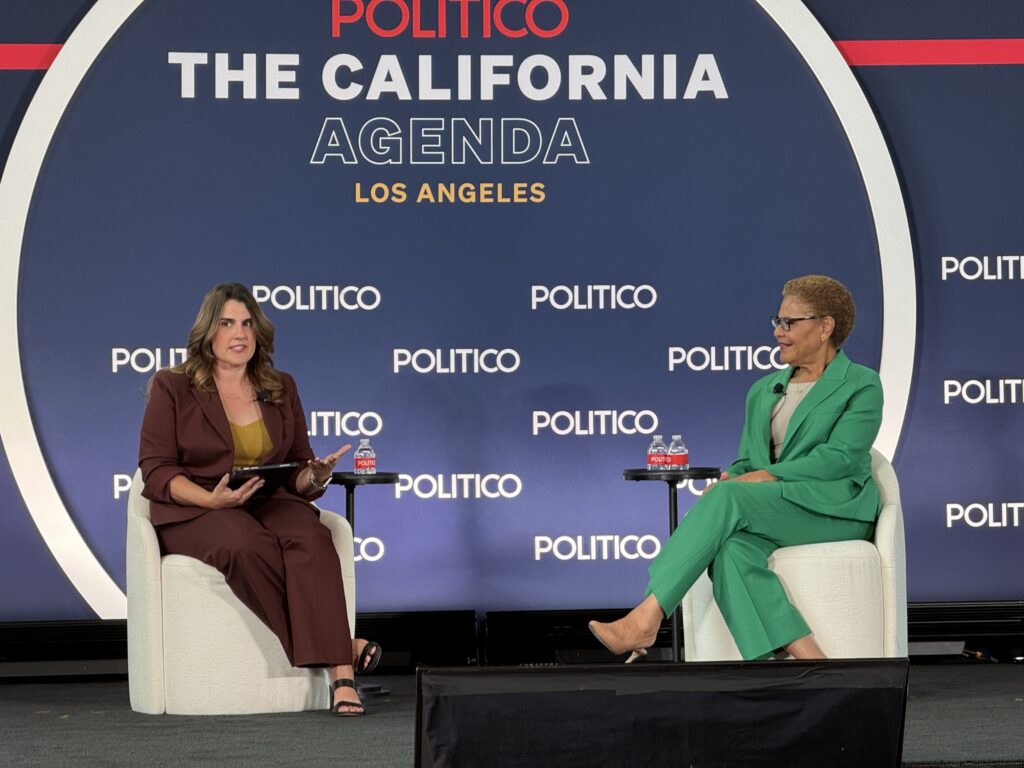
The Los Angeles mayor’s race is getting harsh. Trump basically endorsed Spencer Pratt in the mayoral race yesterday (an albatross in any LA election), but Mayor Karen Bass was more interested in taking down her fellow Democrat and former ally Nithya Raman at a POLITICO event held at Union Station. “I question her ability to lead the city when she struggles being a member of the city council,” Bass said. Oof.
POLITICO California housing reporter Liam Dillon said on stage yesterday that LA’s rebuilding from the 2025 fires remains way slower than what we saw from the Tubbs and Camp fires. We’ve seen just “39 homes complete in Altadena and 16 in Pacific Palisades.” By this point, the same number of days after the fire in Santa Rosa, three times that number of homes were completed. In Paradise, 87 homes were done, Dillon says.
A friendlier race: The results are in from the “D-Line Dash,” a race along the new Metro D Line hosted by Streetsblog LA. A transit rider, car driver, and bicyclist all raced from the new La Cienega/Wilshire stop to DTLA… the train won.
The LADWP recently released the LA100 Plan — that utility’s updated roadmap to achieving 100% carbon-free electricity by 2035. Now, UCLA researchers from The Luskin Center for Innovation and The California Center for Sustainable Communities are making the “LA RESET Tool” publicly available through a new interactive online platform. It maps how home electrification could change energy bills across Los Angeles.
Ahead of the 2028 Olympics, the City of Los Angeles, City of Long Beach, and the County of Los Angeles, in partnership with USGBC California, are seeking emerging low-carbon concrete solutions and information from manufacturers, ready-mix suppliers, precast producers, material innovators, and construction industry partners.
A smoke advisory was issued by AQMD on Tuesday as smoke from two wildfires drifted across parts of Southern California: the Sandy Fire in Ventura County and a wildfire burning on Santa Rosa Island in Channel Islands National Park.
Southern California was primed for the current wildfires when strong Santa Ana winds hit this week thanks to our long dry spell and warm weather — similar to the winds and conditions that sparked the Palisades and Eaton fires, says UCLA climate scientist Alex Hall. He says categorizing the severity of Santa Ana winds in a similar way as hurricanes could help for future prep.
World Cup
Speaking of big fires and mega-events, Alissa Walker notes that the two don’t go well together. “What’s the plan if we can’t, in fact, safely host the first U.S. match of the World Cup in 23 days?”
Eight games will be played in SoFi Stadium in Inglewood, beginning with the U.S. men’s national team’s opening match on June 12. The mega-event — held in 16 stadiums across Canada, the U.S. and Mexico — will be the most polluting games ever thanks to the sheer amount of travel and jet fuel, Blanca Begert reports for the LA Times.
A group of renowned scientists are warning FIFA that its current heat safety measures for the men’s 2026 World Cup are “inadequate” and could put players at risk of serious harm.
Activists against sportwashing are organizing a series of protests on June 21 to call attention to the World Cup’s fossil fuel sponsorships.
Reminder: When I published a report on sportswashing in Fall 2024 called “Foul Ball,” Major League Soccer teams had at least 9 sponsorships with oil and gas companies. For instance, LAFC had a sponsorship with Chevron.
California
The California Air Resources Board last month proposed major changes to the state’s cap-and-invest program, and the agency is set to vote on its new plan on May 28.
Jeff St. John at Canary Media reports that criticism is growing toward CARB’s plan “to grant a total of 118 million metric tons of extra emissions allowances to oil refineries and other industries, in exchange for a promise to invest in decarbonization projects in the future.”
That could reduce cap-and-invest’s revenue, according to an analysis from the Legislative Analyst’s Office. But the proposal still results in an 11% cap decline year over year through 2030, and 7% from 2031 to 2045, CARB told Hayley Smith.
More on gas: Is it time for a price-stabilizing gas tax here in the Golden State? “California could modify its gasoline excise tax to automatically adjust downward when the price of crude spikes, but also automatically adjust upward when the price of crude drops,” Severin Borenstein writes at the Haas Energy Institute blog.
Noah Baustin reported last Thursday that California Resources Corp., one of the state’s leading oil drillers, contributed $500,000 to an independent campaign committee supporting Xavier Becerra. That’s way more than the $39,200 Chevron gave directly to Becerra earlier in the campaign.
“I think Big Oil is choosing its governor,” RL MIller told Sammy Roth. “They are indicating very clearly which side they’re on.”
Baustin also had a Q&A with Linda Serizawa, director of the CPUC’s Public Advocates Office.
Newsom did his last budget. The plan does not include any big new spending on the environment. Sierra Club’s California Director Miguel Miguel said Newsom’s budget “fails to deliver the climate action California needs.”
The state’s Demand-Side Grid Management program, launched in 2022, has been a resounding success, with the enrolled households creating more than an entire gigawatt of power when the state needs it. That’s about as much as a nuclear power plant provides, or enough to power San Francisco at peak demand. But the program is in jeopardy as the program faces budget cuts for the third consecutive year, Blanca Begert reports for the LA Times.
Changes to the state’s Cap-and-invest program’s funding priorities and revenue threaten efforts to bring clean drinking water to schools, homes and communities across California, Rachel Becker reports for CalMatters.
The state Assembly and Senate Appropriations Committees killed dozens of bills — “including a plethora of closely watched climate policies” POLITICO reports. “The more that you can get bills to Buffy [Wicks] that are both good ideas, and also not absurdly expensive, the more lucky you’ll be,” Assemblymember Cottie Petrie-Norris said.
Looks like the California side of Lake Tahoe has to find a new source of electricity by May 2027, when its utility will no longer receive power from Nevada-based NV Energy. “Lake Tahoe doesn’t know where its power will come from after next ski season—and it’s a major problem for the 49,000 residents who call the region home,” Catherina Gioino reports for Fortune.
San Diego Gas & Electric is proposing a 140-mile, 500-kilovolt transmission line that would cut through the largest state park in California — Anza-Borrego Desert State Park. The Imperial Valley is a key interconnection point for regional solar, geothermal and battery storage projects, notes Hayley Smith for LAT.
Volvo agreed to pay nearly $197 million to resolve allegations from CARB that the company’s heavy-duty truck engines violated California emissions standards and certification requirements, Tony Briscoe reports.
Climate Politics
Democrats from across the country met this week at the Center for American Progress to talk affordability, accountability, and other party platform ideas. Did anyone monitor for how many times the words “climate change” were uttered?
Gov. Newsom sat with Neera Tanden and talked mostly about the Trump administration’s corruption, but climate did come up. “I’ll keep going to keep talking about it,” he said. “You can have a debate with the thermometer, I’m not going to. It’s financial risk — climate risk. You talk about housing, you need to talk about climate, they’re connected.”
Chris Rabb, a progressive state representative and climate champion, clinched the Democratic nomination on Tuesday for Pennsylvania’s 3rd District. Rabb previously introduced state legislation targeting greenwashing.
Vox’s Today Explained podcast had Matt Huber on to talk about his recent NYT Opinion essay about why Democrats should shut up about climate already.
Rebuttal: Rather than treating climate like a niche issue (which, to be clear, few major campaigns actually do) candidates “should offer concrete policies that assume global warming is the context in which all politics happens,” writes Kate Aronoff at Slate.
And Trump tried (and failed) to make fun of Texas U.S. senate candidate James Talarico for being “vey-gan” (his mispronounciation) because he ordered an egg, cheese, and potato breakfast taco on a campaign stop with President Obama. Texas loves migas; they’re not vegan; and although Talarico’s campaign is officially “no meat” for sustainability reasons, I don’t think that’s a criticism that will stick.
The States

Legislation in Illinois to open the door for small plug-in solar panels hit roadblocks, including safety concerns raised by the state’s electrical workers union
In Hawai’i, the governor signed into law SB 2471, a bill that AP says “uses a novel approach to reduce the influence of corporations and hard-to-track dark money groups that have been able to spend unlimited amounts on politics” ever since Citizens United.
In Iowa, Republican Gov. Kim Reynolds signed legislation to shield emitters from civil and criminal claims of climate-related harms tied to greenhouse gas emissions, E&E News reports. The legislation deals with farmers, ranchers, ethanol producers, petroleum manufacturing, storage and dispensing.
In Texas, solar is set to generate more electricity than coal in the ERCOT power market. No one in that state is building more coal but developers are adding more solar in the Lonestar State than anywhere else, Julian Spector reports for Canary Media.
In Utah, a coalition of big cities and small towns is charting a different path — one that will bring more renewable power to the electric grid. NPR says the effort could be a model for other U.S. cities to take climate action, even as the federal government pulls back on clean power. Utah Renewable Communities aims to generate enough clean electricity to offset the power used in their nearly 300,000 homes and businesses.
In New York, state officials are considering sending out $200 rebate checks to residents to help cover rising electricity prices.
A mega merger is on the horizon that would affect 10 million customers in Florida, Virginia, North Carolina, and South Carolina. Dominion Energy and NextEra Energy announced they will merge to form the world’s largest regulated utility. “Dominion is the utility that powers the world’s largest data center market in northern Virginia” while “NextEra is the largest utility in the S&P 500 by market value,” according to CNBC.
Trump Administration
Emails obtained by House Democrats and viewed by Heatmap News raise questions about the Trump administration’s claims about how it reached that ridiculous $1 billion settlement payout to TotalEnergies to not build offshore wind energy. Both parties signed a deal on March 23 that “justifies the decision by citing a series of events that it portrays as taking place after officials learned of the DOD’s national security concerns.”
The Trump administration told Colorado River states that it’s drawing up a 10-year plan for dealing with water shortages on the Colorado River, Ian James reports.
Trump’s EPA announced a plan to kill Biden-era drinking water limits on four Pfas “forever chemicals”, and to delay the implementation of standards for two other compounds, the Guardian reports.
The Interior Department intends to keep blocking wind and solar energy permitting even though they are losing in court. Interior Secretary Doug Burgum testified to Congress last week that his agency would appeal a recent district court ruling blocking it from enforcing these policies.
In one particularly glaring answer, Burgum seemed to not understand how batteries work. When the sun goes down, you can still use renewable energy, Mr. Secretary.
The Trump administration last Friday defended its legal authority to order coal plants to stay open. Lawyers argued before a panel of federal judges “that it alone has the power to decide whether an energy emergency exists,” Marianne Lavelle reports for Inside Climate News.
The Trump administration has quietly approved reuse of so-called cyanide bombs to control predator populations on public lands managed by the Bureau of Land Management. The controversial tactic was banned in 2023, Gizmodo reports. “An April memorandum signed by the BLM and the Agriculture Department’s Wildlife Services program, published by advocacy group Predator Defense, shows that the BLM has effectively repealed the ban on the deployment of M-44s—spring-loaded poison traps that spray sodium cyanide powder when triggered”.
More EVs
If you combine the sales of electric and plug-in hybrids the total is expected to grow to 23 million in 2026, representing about 28% of total sales worldwide, according to the IEA.
The Beijing Auto Show has become the world’s largest auto show and the Shiftkey podcast talked about what the newest models tell us about where the industry is headed.
U.S. automakers are worried that they could be forced to ramp up EV production in the near future because “the Trump administration has unwittingly placed a ticking time bomb inside its sweeping push to roll back fuel efficiency standards,” Jean Chemnick reports for E&E News. “At issue is a little-noticed change made by the Energy Department this February to a formula used to determine compliance with what is known as corporate average fuel economy (CAFE) standards.”
After 12 years of covering the EV transition, before most people had seized on the transition, David Ferris is moving on from E&E News and Politico.
Climate Projections and Interventions
An expert science panel is “dialing back their worst-case scenario” for global warming.
There’s been a lot of debate over the implications of the formal retirement of what’s called the RCP8.5/SSP5-8.5 scenario, that high-emissions scenario. Trump even commented on Truth Social about it. Does the change mean that we’ve made enough climate progress to retire this high-emission scenario or was it always implausible? “It turns out that two things can be true at the same time,” write Zeke Hausfather, Glen Peters, and Piers Forster.
Stardust Solutions, the secretive startup, has released information on the proprietary particle it wants to spray in the atmosphere. Eric Niiler reports for the NYT. A team of 25 researchers have developed two kinds of particles. “The first is made of amorphous silica and coated in a material to prevent it from interacting with atmospheric gases. The second particle is a shell of amorphous silica around an inner core of calcium carbonate.”
Companies are launching more satellites into space than ever before, and a study published May 14 in the journal Earth’s Future, suggests they could be messing with the climate, too. Gizmodo quotes Project lead Eloise Marais as comparing space-industry pollution to an “untested geoengineering experiment with many unintended consequences.”
Reader Comments
3 Replies to “Hate the Gas Tax? Get to Know the Road Usage Charge”
Comments are closed.


About Evan

Evan George is Director of Communications for the UCLA Emmett Institute, a leading environmental law center. He also writes The Drain, a weekly roundup of environmental a…
READ more
The gas tax is, as you state, a user fee – it varies based on amount somebody uses the road, and crudely accounts for the road wear (and resulting maintenance need) caused by size and weight through the effect of fuel economy.
EV fees, otoh, are essentially access fees, essentially an annual toll for using roads, regardless of amount of usage and potential road wear. One could make the same argument for bicycle or skateboard or even pedestrian annual road- and sidewalk-access fees as for EVs, which would be obviously abusive.
EV road taxes need to reflect in some way their effect on road wear based on usage and vehicle weight. They should not be fines for not using oil.
A possibly useful side effect of collecting usage data through periodic odometer checks might be to add annual (not biennial) safety checks including odometer recording. Keep the smog check part of it, for vehicles that burn something (do CNG/propane vehicles pay gas tax?) biennial if you want to. Adding a rudimentary safety check, which we currently do NOT have, might also limit the number of clearly defective vehicles on the road.
Perhaps we need some extra charge for all these delivery trucks, as I assume they damage the roads disproportionally more than cars. People who stay home but order gobs of deliveries are still using the roads.
I’m not a fan of measures to reduce driving. I would rather focus on how we can get all of us into greener vehicles. It’s unAmerican to be told to stay home. I don’t think people will accept it. And everyone who doesn’t live under a rock has already reduced their driving anyway.
Restrictive measures remind me of the doctor copays – I think there is like one person out there who goes to the doctor for fun. But all of us get punished.
Speaking of roads, why are ours so bad?
I don’t just mean in LA. Last time I drove out to AZ, I was shocked by the state of the 91. Wtf? Real question.