


















































America the Beautiful — Not Beautification Projects
The Drain is a weekly roundup of environmental and climate news from Legal Planet.

If you braved one of America’s most iconic national parks this weekend, you may have a new appreciation for the meaning of Jean-Paul Sartre’s famous line that “hell is other people.” At Yosemite, visitors reported waiting up to two hours just to enter the park and once they made it through, they were greeted by congestion on roads, shuttle buses, and all the popular trails. Crowds have been flooding Yosemite ever since the federal government did away with the reservation system. Weekends are bad, summer will be worse.
All told, California’s nine national parks drew a record 12 million visitors in 2025, up more than 800,000 from the previous record set in 2019. Yosemite accounted for more than a quarter of those visits, the Los Angeles Times recently reported. I visited Yosemite last October during the government shutdown and found it open for business but also threatened by the Trump Administration’s policies. Staff stretched thin and maintenance deferred.
My apologies if you were waiting in line at Yosemite or any park this past weekend, but now I add insult to injury: Your entrance fee may end up paying for some of Trump’s ridiculous beautification projects back in Washington D.C.
A New York Times analysis of federal records by Maxine Joselow and Andrea Fuller found that nearly $60 million in fees paid by visitors to national parks across the country is funding repairs to nine of the capital’s ornamental fountains. “The government is putting another $7 million worth of entrance fees toward the renovation of the Lincoln Memorial Reflecting Pool, which costs $13.1 million overall, according to an internal Park Service document reviewed by The Times.” That’s right, while our public lands and parks continue to go underfunded and understaffed, the Department of the Interior is diverting millions of dollars to paint the reflecting pool electric blue ahead of America’s Semiquincentennial. This is America the Beautification Project not America the Beautiful.
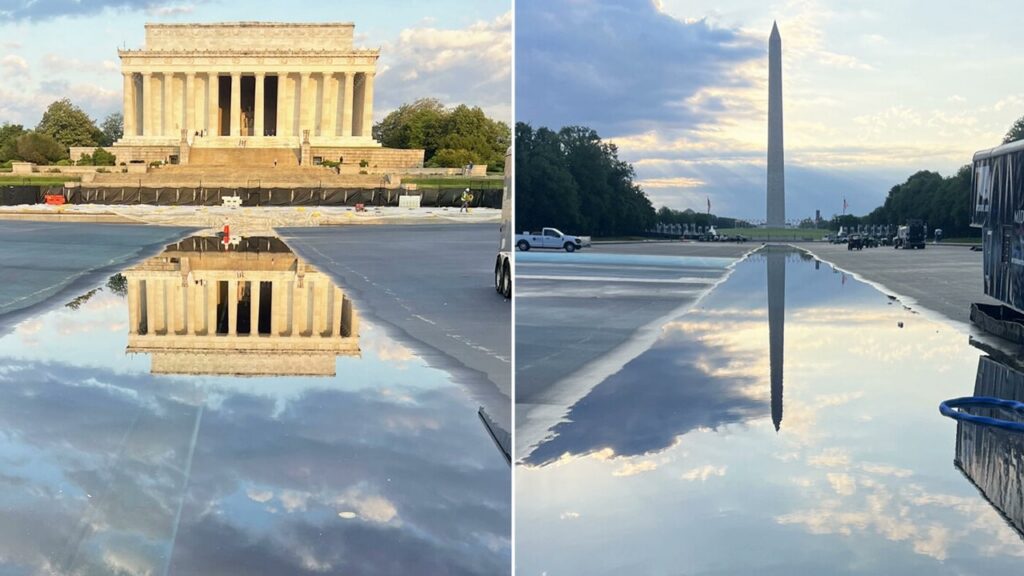
If that doesn’t get you in the mood to celebrate the nation’s 250th birthday consider that construction crews are also currently erecting a fugly octagonal ring outside the White House for UFC fighters to spar on Flag Day, aka Trump’s birthday bash. Oh, and Transportation Secretary Sean Duffy took his family on a monthslong, all-expenses-paid reality show road trip covered by Boeing and Toyota, while we the taxpayers were paying him to drive around for the cameras. What a time to be an American!
The only salvation this summer is to escape outdoors where you can commune with nature and with other people who are not hell. Now, I would never tell anyone to skip the wonder that is the Yosemite Valley, but if you’re looking for other parks and less-crowded public lands to visit, here are some recommendations gathered by my colleagues at the UCLA Emmett Institute.
Underrated Public Lands

Asilomar State Beach: I love that California had the foresight to set up robust legal structures—through the Coastal Act and the Coastal Commission— to protect its incredible coastline for the benefit of generations to come. Places like this are living testament to the power of law to do good. — Cara Horowitz
Channel Island National Park: Six of the eight Channel Islands off the coast of California are the only home to the adorable island fox (one of the smallest fox species in the world), and Santa Rosa Island is one of only two locations in the world where you can see a Torrey pine — the rarest native pine in the U.S. and, possibly, the rarest pine in the world! — Tiffany Deguzman
Point Reyes National Seashore: Point Reyes National Seashore is a magic place. Windswept, fog-swept, plunging cliffs and rocky beaches, tide pools each holding a surprise one after the other. —Jim Salzman
James Peak and Indian Peaks Wilderness areas: Both just outside of Boulder Colorado — the James Peak and Indian Peaks Wilderness areas are places where it’s still possible to find solitude and practice soul craft — even in a broken world. — William Boyd
Acadia National Park: It’s far away from LA, but I have a special fondness for Acadia National Park in Maine. Beautiful forests and rocky coastline, with a huge network (more than 50 miles) of fully separated trails for hiking and biking that crisscross the island – originally built as carriage roads by John D. Rockefeller, as part of his quest to keep automobiles off his summer-vacation island. — Edward Parson
Antelope Canyon: It’s not only the federal government that has gorgeous public lands, but the Navajo Nation does too. Antelope Canyon, near Page Arizona, is a stunning geographic formation and Horseshoe Bend is breathtaking. — Ann Carlson
Limekiln State Park: Hands down, my favorite park for camping and hiking is Limekiln State Park in southern Monterey County. It’s built around Limekiln Creek, which empties into a secluded beach (complete with sea otters) and which you can hike upstream to see the abandoned iron kilns where lime was extracted in the early 20th century. — Peter L. Reich
Sequoia National Park and Grand Teton National Park: Sequoia National Park is my first and go-to public land. It’s not the most secluded, but Moro Rock, Crystal Cave, Tokopah Falls, ladybug trail, and of course the colossal sequoia trees fundamentally shaped my relationship with nature. Meanwhile, Grand Teton National Park is just jaw-dropping. Bald eagles, grizzlies, moose, massive pronghorn and bison herds; not to mention awe-inducing vistas of glaciers and lakes while hiking or white-water rafting. —Alejandro Camacho
Need one more from a true expert? Mikah Meyer is the self-described “first person to have visited all 419 National Park Service Sites.” And unlike Secretary Duffy, he’s not just mugging for the camera in a car. He’s hiked and camped all over the country and he’s #1 pick is the Dinosaur National Monument, which straddles Utah and Colorado and boasts a wide variety of mountains, desert, rivers, and fossils. In fact, if it were simply renamed a “National Park” it would see four times more traffic, he told Vox’s Today Explained podcast.

As for me, my absolute favorite place on Earth is the Fiscalini Ranch Preserve in the small coastal town of Cambria, California. It’s a stretch of sweeping ocean cliffs and forest trails that used to be a working ranch that locals once had to trespass to experience. When developers bought it and closed the gates, the residents organized and bought the land as an organized trust that now is open to the public to wander. I suggest you cruise the Central Coast and take one of the most beautiful walks in these United States. Happy trails!
Welcome to The Drain, a weekly roundup of environmental and climate news. Our song of the week is “Color Song” by Maggie Rogers” which is the perfect campfire listen. My Climate Playlist is now 235 songs and 17 hours of music with an environmental message. (Available on Spotify and Apple Music)
Climate Politics

Last year’s opinion by the world’s top court that countries have a legal obligation to tackle climate change achieved a big political win at the UN General Assembly last week. A resolution by the island nation of Vanuatu to put it into practice was backed by a strong majority of countries, Sebastian Rodriguez reports for Climate Home News.
New York is doing something no climate-leading state has done, even in the Trump era: weaken its landmark climate law. The worst part about it is using “affordability” for cover in delaying implementation, Vanessa Fajans-Turner and Ayana Elizabeth Johnson write for TIME magazine.
The New York legislature released the text of the deal it reached with Governor Kathy Hochul to reform the state’s climate law on Tuesday.
One aspect of the climate law that made it ambitious was the way it required New York to account for methane. “The budget deal will eliminate this edge,” Emily Pontecorvo writes at Heatmap News.
Democrats won big in last year’s election for the public service commission, or PSC. This year, they’re aiming to win a majority on the commission and the election is a referendum on energy prices, Emily Jones reports for Grist.
Climate Storytelling
The Sustainable Entertainment Alliance has launched a “Green Title Database,” a first-of-its-kind public collection of over 350 TV episodes, series, and feature films from 2018–present that feature climate and environmental themes. Ali Weinstein at SEA says the effort, which reminds me of IMDb but for climate storytelling, has taken much of the year to assemble.
NPR is shrinking its newsroom through layoffs and buyouts, and the changes include reducing staff dedicated to covering climate. “The climate desk no longer exists separately but has been folded into the National Desk,” writes Neela Banerjee, who headed the climate desk for the last 3 years. “It was a grand run. Today, I was laid off by NPR,” she posts at LinkedIn. This comes a few days after the network’s “Climate Solutions Week.” Several energy and environment journalists remain despite the restructuring. I don’t think it means a major retrenchment from climate reporting, but it will inevitably mean fewer stories on the subject at a time when local stations are also downsizing due to the loss of federal funding. Science Correspondent Nell Greenfieldboyce, who has been reporting for NPR since 2005, was also laid off.
Stanford climate scientist Rob Jackson published a new book, Into the Clear Blue Sky that the NY Review of Books describes as “a sustained rallying cry” and accounts of scientists and start-ups working on different kinds of atmospheric restoration, with a focus on methane. “If we want to reduce greenhouse gas warming over the next decade or two,” he writes, “reducing atmospheric methane concentrations through emissions reductions and atmospheric removal is the best—and perhaps only—lever we have to shave peak temperatures and reduce dangerous weather disasters and heat waves.”
My UCLA Emmett Institute colleague Ann Carlson was a guest on Shift Key with Robinson Meyer talking about Smog and Sunshine which Heatmap News recommended as the perfect beach read for the summer. And she joined Ethan Elkind on “Your Call” to tell the story.
“On the Media” is doing a series called “American Emergency: The Movement to Kill FEMA.” Episode 3 is about Hurricane Helene: a storm that brought unprecedented destruction to Western North Carolina, and put the agency squarely in MAGA’s crosshairs.
Good Housekeeping, not usually a hotbed of radical ideas, has tips for how parents can talk about climate change and climate anxiety, including how to talk to young athletes about the dangers of extreme heat.
And across the pond, news outlets are covering an unusual, earlier-then-ever heat wave that’s hitting the UK and other parts of Western Europe. But many are covering this extreme heat — which is shattering records and killing people — using photos of fun in the sun. That’s not how you do it. Covering Climate Now has tips for how to tell stories about extreme heat without images of people in bikinis and kids splashing in fountains.
Los Angeles
The unofficial start of summer brought multiple environmental emergencies to Southern California: an oil spill in East LA and a chemical hazard.
The oil spill sent at least 2,400 gallons of crude oil in East Los Angeles, where a construction crew laying out a fiber optic line ruptured an underground pipeline. The Line 63 pipeline operated by Plains All American runs beneath the street and transports crude oil from Kern County to the Port of Los Angeles. Petroleum products entered storm drains and into the LA River, officials said.
In Orange County, emergency crews faced five full days of trying to secure a bulging pressurized tank loaded with 7,000 gallons of methyl methacrylate, to prevent an explosion while thousands were evacuated. GKN, the facility operator, is known for producing parts for the Lockheed Martin F-35 fighter jet.
Industrial risks are rising in California thanks to three factors: global warming, aging infrastructure, and the push to build housing in industrial areas, Seth Shonkoff tells the LA Times. “When you increase the population density around these types of facilities, you are increasing the hazard that if something goes mechanically wrong, more people are going to be at risk.”
The UCLA Luskin Center for Innovation is holding a June 11 webinar to explore strategies to reduce program participation barriers and expand home electrification across California. The event draws on findings from their recent report Streamlining Home Electrification in the Gateway Cities on a promising pilot program in the L.A. region.
The Port of Long Beach is pushing ahead with a $4.7-billion project to support wind power despite Trump’s war on wind. Hayley Smith reported on the 2026 Pacific Offshore Wind Summit in Long Beach.
California

Meanwhile, California as a whole remains committed to deploying 25 GW of offshore wind capacity by 2045, according to state officials who attended the same summit. The industry is clearly determined to stay the course.
“Throughout the two days of the summit, speakers affirmed that message and urged the industry to go on offense, supported by the knowledge that the law and public opinion was on its side,” Justin Gerdes writes at Quitting Carbon.
Why is PG&E throwing millions of dollars at a committee that’s attacking Tom Steyer, while propping up Xavier Becerra in the race for governor. Dakota Smith reports that Pacific Gas & Electric has plowed at least $13.5 million into efforts to oppose Steyer and other major utilities in the state have also donated to another committee backing the anti-Steyer effort.
The California Air Resources Board is scheduled to vote today to approve significant changes to the state’s cap-and-invest program, including amendments that would provide relief to in-state oil refineries. CARB chair Lauren Sanchez told POLITICO “I don’t see it as pulling back… The federal headwinds are unprecedented, and it is even more important now that California moves forward, to continue to show the world that we can balance our climate ambitions and these affordability concerns.”
As diesel prices in California rise to $7.30 to $7.50 a gallon, San Joaquin Valley farmers are seeing their operating costs swell amid concerns that prices for consumers also will continue to rise, The Fresno Bee reports.
That despite the fact that California oil permitting surged in the first quarter of 2026 with 154 of 190 permits to drill new wells authorizing dangerous oil extraction techniques known as “Enhanced Oil Recovery,” according to analysis from Consumer Watchdog and FracTracker Alliance. No new permits for new EOR wells were approved in 2025 by comparison.
California’s first carbon capture project, called Carbon TerraVault I, has begun storing carbon dioxide underground in a pair of depleted petroleum wells in western Kern County. John Cox in Bakersfield calls it “a milestone for the local region and California as a whole.”
This year has been so warm that cherry trees in SoCal’s Leona Valley produced no fruit. Orchards that usually attract hundreds of visitors on weekends now sit empty, Ian James reports. If you’ve read California’s lawsuit against the oil majors for climate deception you may recall that the complaint lists the damage to the state’s orchards for cherries and other stone fruits. “Virtually no areas in California will remain suitable by 2041–2060 under any emissions scenario for these types of fruit crops.”
Energy
A big methane deal: Canada struck an agreement to export liquefied natural gas to Germany, beating out the U.S., the New York Times reports. “Canada will commit to exporting up to one million metric tons of liquefied natural gas a year from a terminal on its Pacific Coast in British Columbia to Germany, starting in the early 2030s, for a two-decade horizon.” The CBC notes that the Ksi Lisims LNG facility is among the major projects that Prime Minister Mark Carney said would be reviewed for fast-track permitting and approval.
April 2026 was the first month when wind and solar combined to produce more electricity than natural gas did, per new global data from energy think tank Ember. “Coal should watch its back: It’s only a matter of time before wind and solar come for its crown, too,” Dan McCarthy writes at Canary.
A growing number of companies — dozens of start-ups like Vema Hydrogen — are trying to find large reservoirs of natural hydrogen thought to exist underground, Brad Plumer reports for NYT. That’s on top of the growing number of geothermal startups that the media has stayed focused on since Fervo’s IPO.
These are the 10 most influential companies in energy, according to TIME’s new ranking: Schneider Electric, Chevron, Vestas, Redwood Materials, Saudi Aramco, NextEra Energy, Holtec International, Emerald AI, Fervo Energy, Base Power.
It’s going to be a hot summer, but the U.S. grid should be able to handle the heat thanks to new solar and storage and a handful of new gas plants, Jeff St. John reports for Canary Media. That’s according to a new summer reliability assessment from the North American Electric Reliability Corp. “The report contradicts the Trump administration’s claims that aging fossil-fueled plants are needed in order to prevent blackouts.”
In Pennsylvania, Gov. Josh Shapiro issued new standards for data centers, including requiring developers to generate their own electricity.
In New Jersey, Gov. Mikie Sherrill released guidelines for data center companies, including requiring public reporting of water and electricity usage and plans.
Pope Leo took aim at artificial intelligence in his first major encyclical “Magnifica Humanitis” and touched on the climate toll of the tech. “Current AI systems require enormous amounts of energy and water, significantly influencing carbon dioxide emissions, and place heavy demands on natural resources.”
The SunZia wind farm in New Mexico — a wind project billed as the largest clean energy installation in the U.S. — is due to come online next month.
On June 10, POLITICO will host an Energy Summit to talk about the Iran war, affordability, data centers, and permitting reform from diverse viewpoints. Speakers include Senators Sheldon Whitehouse and Dave McCormick, Rep. Brett Guthrie, FERC Chair Laura Swett and the Energy Dominance Council’s Jarrod Agen — and EPW Chair Shelley Moore Capito.
Reader Comments
One Reply to “America the Beautiful — Not Beautification Projects”
Comments are closed.
About Evan

Evan George is Director of Communications for the UCLA Emmett Institute, a leading environmental law center. He also writes The Drain, a weekly roundup of environmental a…
READ more
I bet someone here can answer: Why are the numbers different, btw the purple air map pg versus the air quality number on my iphone?
Which is more reliable? Are they using totally different sources? The numbers were v, v different.
I only just started looking at these – and i havent researched it at all, so, just if you already know … i’d be interested.
Also, it is my impression that housing is next to industry allllll over LA – and while i am fervently anti-yimby, i sort of doubt that this is getting any worse. Maybe it cant!