



















































L.A. Says “Oil Drilling Has No Place Where We’re Living”
The Drain is a roundup of environmental and climate news from Legal Planet.
After more than a decade of activism by Angelenos and a years-long legal battle followed by new state legislation, the Los Angeles City Council has approved a plan to end oil drilling within city limits once and for all — making LA the largest city in the nation to do so.
The City Council voted unanimously yesterday on the ordinance, which bans new drilling and phases out existing production over 20 years, covering some 600 active and 1,200 idle oil wells by defining oil and gas activities as a nonconforming use. “Oil drilling, we know, has no place in the city of Los Angeles,” Councilmember Katy Yaroslavsky said yesterday. Now it heads to Mayor Karen Bass’ desk, and her office told LA Times reporter Hayley Smith that she intends to sign the ordinance ASAP. (Signing it before election day would be a sign of good will given recent news.)
If this feels like déjà vu, that’s because LA passed a ban back in 2022. Oil companies sued. And the issue was argued over in California courts. Several years ago, students in our UCLA environmental law clinic actually provided legal analysis underscoring the legal basis for LA County to also phase out oil and gas operations. But the legal landscape shifted when the California Supreme Court handed down a 2023 decision in Chevron U.S.A. v. County of Monterey that held a local ordinance phasing out wastewater injection wells and new well drilling in Monterey County was preempted by state oil and gas regulations because it regulated “methods and practices” of oil drilling. In 2024, an LA Superior Court judge held that the city of LA’s ordinance was preempted by state law as well. Then in September 2025, Gov. Newsom signed AB 3233, which clarifies and confirms local government authority to regulate, and even prohibit outright, oil and gas operations. UCLA Law students in our environmental clinic again advised Los Angeles community advocates this past spring on strategies around this readoption. So here we are, with a new victory to celebrate.
Oil and gas drilling is linked to significant public health issues, including increased rates of respiratory problems and cancer, and neighborhood drilling disproportionately affects low-income Black and Latino communities, who often live closer to these sites and face higher exposure to harmful pollutants.
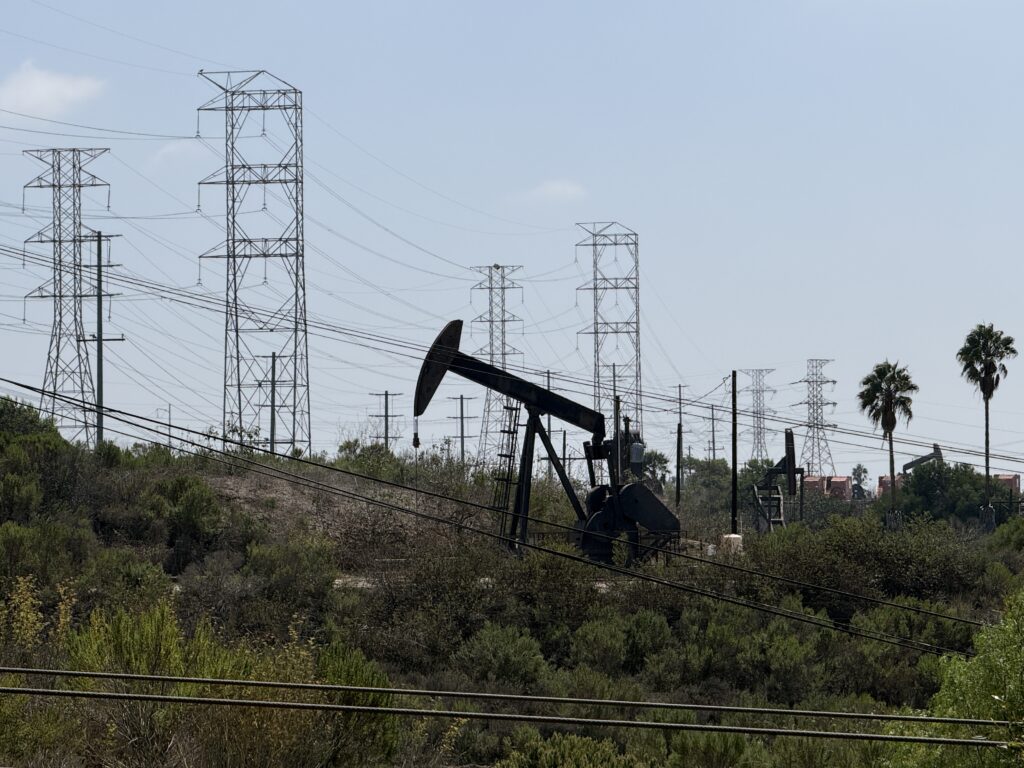
I live about a mile from the Inglewood Oil Field — still the largest active, urban oil field in the country. It’s a bizarre scene of tall pumpjacks bobbing up and down behind barbed wire fence on barren patches of land surrounded by native plants and palms. I walk by them when I take my dogs to the nearby park, and I drive through the field anytime I take my son for pancakes at our beloved Pann’s diner. Maybe you’ve driven through it via La Cienega Blvd. on your way to LAX and thought “WTF is this?” I for one look forward to when that land becomes an expansion of Kenneth Hanh Park and new, much-needed housing.
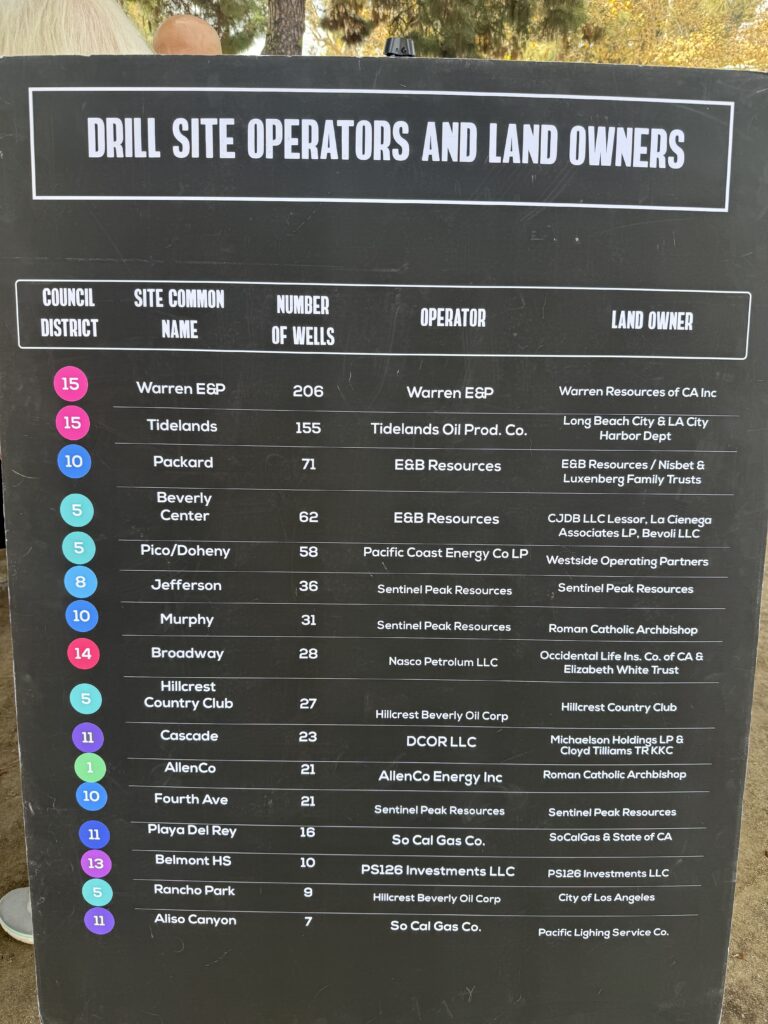
My neighbors and I have lots of folks to thank, but none more than STAND-L.A., a coalition of local environmental justice groups and affected community members who have spent many years advocating for this ban and then its readoption (see all of the orgs listed here). STAND-L.A. members attended the City Council hearing on Wednesday, but they weren’t there just to celebrate. The coalition is actively pushing for the city to quickly shutter two specific drilling sites in Los Angeles. Thanks to their work, the city’s zoning administrator is now weighing whether to revoke the operator’s permit for 32 closely-packed oil and gas wells at the Murphy drill site on West Adams Boulevard — also not far from my house.
Organizers like Wilmington resident Wendy Miranda told LAist’s Kevin Tidmarsh that they’re looking to the future of what these sites could be once they’re shut down and cleaned up. “Maybe these could be parks that our communities desperately need… I’m just really excited for Wilmington, for South L.A., for other communities that have oil drilling near them to see that this will no longer be in our neighborhoods.”
This week, national headlines have been filled with news about radical deregulation and blatant giveaways to toxic polluters (just keep reading), but don’t let it overshadow local victories that put the health of communities ahead of fossil fuel companies.
Welcome to The Drain, a roundup of environmental and climate news. Our song this week is Ministry’s “Just Stop Oil,” one of 600+ songs on my Climate Playlist (on Spotify and Apple Music).
METHANE
Three years ago, then-Vice President Kamala Harris took the world stage at COP28, the UN climate talks in Dubai, and announced an important new rule to reduce super-polluting methane from the oil and natural gas industry to promote public health benefits and ultimately economic savings. This week, Donald Trump took the stage in Lubbock, Texas to riff about the ass of a Republican senate candidate and then brag that he was “officially terminating” the Biden-era methane rules. Fittingly, a methane plume was even detected by satellite not far from where Trump’s rally took place, POLITICO reports.
This rollback should scare us all this Halloween, my UCLA Emmett Institute colleague Alejandro Camacho writes. “By scrapping the Methane Super Emitter Program, it would leave no one to call when the ghost appears,” he says, invoking the ghost busters.
Methane is responsible for about a third of planet-warming greenhouse gas emissions so reducing methane is a powerful climate solution — and when it comes to the oil & gas industry, preventing leaks also means saving money. That’s why satellite technology that spots methane plumes has become so important.
Researchers analyzed satellite observations of controlled methane releases in a yearlong experiment led by Stanford scientists. The results can inform efforts to identify major methane sources, eliminate leaks, and reduce emissions of the potent greenhouse gas. On clear days, dedicated methane sensors detected 92-100% of test plumes. Using Tanager-1 observations, Carbon Mapper detected 100% of cloud-free releases and reported no false plumes.
A video from Solutions Insights Lab shows how “Mexico City’s food banks and compost plant show how rescuing food and turning organic waste into a resource can cut methane and feed people in need.”
The Massachusetts-based startup Emvolon builds modular systems that convert methane captured from landfills and other sources into energy-dense liquid methanol on-site, making it easier to transport to customers. On Tuesday, the company announced $22 million in new funding.
POLLUTERS

At the outset of Trump 2.0, the Trump administration gave corporate polluters the opportunity to send an email to essentially request a free pass to pollute. At the time it was clear how uniquely brazen this was — but it also opened the door to journalists requesting those emails via public records requests.
This week, the New York Times published an important story showing Trump exempted 202 facilities in 39 states and Puerto Rico from clean-air regulations that were going into effect — the “biggest presidential intervention in enforcement of the Clean Air Act” since the law was passed. The facilities are among the country’s worst industrial polluters, including chemical manufacturers, copper smelters and coal-burning power plants. Some are near schools and sports fields. “About 3.3 million people live within three miles of at least one affected facility,” write Eric Lipton and Maxine Joselow.
Much has been made out of how the combination of corruption and affordable concerns is resonating powerfully with voters in these midterm elections. I would submit that the combination of corruption and pollution concerns can be equally powerful for climate messages in political campaigns.
Elsewhere… This one oil company called “Citation” of all things is linked to 1,000 pollution incidents and other violations, why has Oklahoma never punished it? “Citation Oil & Gas is named more than any other company in an Oklahoma database of pollution reports and other rule violations — over 1,000 times in the past decade,” Nick Bowlin reports for The Frontier and ProPublica. “Regulatory agency staff repeatedly recommended the state punish Citation. Instead, agency bosses allowed the company to restart operations without consequence.”
POLITICS
We’re less than one week away from a midterm election dominated by affordability and AI concerns.
On a new episode of Shift Key, Caroline Spears of Climate Cabinet discusses which state races will matter the most, and which races to watch to see where climate policy might go in 2027 and beyond. They are: Georgia Public Utility Commission, Arizona Corporation Commission, Eileen Hartnett Albillar in Pennsylvania Senate District 6, Trevor Jung, from Wisconsin Senate District 21, and Aaron Lieberman in Arizona Senate District 4.
In Brazil, President Luiz Inácio Lula da Silva surged to a remarkable re-election on Sunday with a margin of victory – 4.4 million votes, according to official preliminary results – much larger than the last time the vote was contested. That’s good news for the work of preventing deforestation in the Amazon.
How would Steve Hilton or (much more likely) Xavier Becerra handle the cap-and-invest program or California’s broader climate ambitions? Good question! Emma Foehringer Merchant asked for CalMatters. “The Becerra campaign did not respond to multiple emailed requests for comment and Hilton told CalMatters he would move to suspend the carbon market — which he called “a disaster of a program” — entirely.”
BAAJA + PERMITTING REFORM
Former Biden climate advisor John Podesta says the current bill “hands Trump a loaded Howitzer,” and that Democrats shouldn’t pass the bill unless they revise or remove the ‘permitting certainty’ provisions, according to Heatmap News. It’s an opinion shared by Abbie Dillen, president of Earthjustice.
Former Biden Energy Secretary Jennifer Granholm meanwhile is urging Democrats to pass the permitting bill, while also warning President Trump that his attacks on wind energy could derail the deal, Axios reports. Progressive climate activist and former California gubernatorial candidate Tom Steyer also endorsed the bill, arguing it is much preferred to the status quo.
Some are more cautious in weighing the good and the bad: At Climate Colored Goggles, Sammy Roth almost but not quite endorses BAAJA, noting that it gives clean energy a chance to compete against fossil fuels. “I don’t want to tell you whether to support this bill — partly because I’m not sure how many of you would listen to me, and partly because I’m still not 100% sold myself.”
Resources for the Future has released its analysis of the permitting bill, with a focus on how aspects of such a broad permitting and energy infrastructure package could drive change in the power sector.
My UCLA colleague Alejandro Camacho co-wrote an Op-Ed about BAAJA in the Revelator that gives a hard ‘no’ to the bill, warning that it will fast-track environmental destruction.
LITIGATION
On Tuesday, California Attorney General Rob Bonta sued the owners and operators of a Los Angeles County landfill known as Chiquita Canyon over pollution that’s harmed residents and the surrounding environment, Riley Ramirez reports.
On Monday, a constitutional challenge brought by 15 young Canadians, began in Federal Court in Vancouver, marking the first federal youth-led climate trial in Canadian history. The plaintiffs in La Rose v. His Majesty the King are supported by Our Children’s Trust.
Incessant public requests are part of an expanding effort by fossil fuel allies to discredit findings in the burgeoning field of climate attribution science at a time when attribution science’s role in lawsuits against major industrial emitters is growing. That’s according to a new article at Nature by James Dinneen who cites the experience of a UC researcher and dozens of others.
The NY state attorney general’s office is appealing two recent federal court decisions that struck down New York’s Climate Change Superfund Act and determined the statute, which seeks to punish companies deemed responsible for greenhouse gas emissions, is preempted by federal law, reports the Times Union.
ENERGY + AI
On Nov. 4, the Bay Area Air District will vote on whether to keep moving forward with Rule 9-6, which implements a zero-NOx standard and applies only to new equipment or existing equipment that needs to be replaced. As I wrote last month, a San Francisco Chronicle article focused on whether district officials have switched their own appliances, a faulty premise even if affordability concerns are legit.
KQED reporter Azul Dahlstrom-Eckman visited an electric pizza kitchen in the Bay Area to “help us understand the benefits of electrification and what’s preventing more kitchens from making the switch.”
“Outrageous” and “extremely crazy” are some of the ways LA ratepayers have been describing big bills during this summer’s climate-fueled record heat. There continues to be a lot of interest in understanding utility rates after big electric bills went viral. My UCLA Emmett Institute colleague Denise Grab has talked about her analysis comparing public and private utilities (DWP vs. Edison) with NBC4, KTLA, and the LA Times. Also, if you’re using 4,000-5,000 kWh what are you doing?!
On Dec. 1, the Trump administration plans to auction oil and gas drilling rights on 43 parcels, about 35,000 acres of California’s public lands across Kern, Kings, Fresno, and San Luis Obispo counties. “It is the largest federal oil and gas lease sale in California since 2009,” according to the Last Chance Alliance, which has organized comments against the plan.
Trump last week declared imports of wind turbines and their components a “threat to national security,” but stopped short of imposing new tariffs on the sector, according to Reuters.
Half of Americans surveyed say they are likely to oppose a data center proposed within 3 miles of their home, and they are more likely to support candidates who oppose the building of data centers, according to a POLITICO Poll.
Anthropic’s IPO filing released this week details the AI company’s increased reliance on gas power along with its fears about public resistance to data centers and its ability to secure enough energy for the computing facilities, Heatmap News reports. “Anthropic mentions the word “energy” at least 14 times in the section of the document outlining the risks to its business,” Alexander Kaufman writes. “Climate” and “climate change” are mentioned just four times.
MEDIA + COMMUNICATIONS
The National Academies of Sciences, Engineering, and Medicine announced this year’s recipients of the Eric and Wendy Schmidt Awards for Excellence in Science Communications, given to science journalists, research scientists, and science communicators who have developed creative, original work to communicate issues and advances in science, engineering, and medicine to the general public. Among them is UC climate scientist Daniel Swain.
Prove it! New research finds audiences had an increased level of trust for videos by news influencers and other content creators who identified their sources, such as government documents and interviews.
New details about the forthcoming book “The Golden Empire.” From journalist Jake Bittle comes “the unforgettable story of a community of oil men and farm workers struggling with an epic drought, a rapid green energy transition, and the great questions of the 21st century.”
COASTS + OCEANS
Newport Beach is underwater from record high tides and it’s going to be even worse in November and December. Video of the destruction of Long Beach’s Alamitos Peninsula is “so ubiquitous online that the peninsula has become a global symbol of our collective struggles against the rising sea,” LAT’s Jack Dolan writes.
The Trump administration says it will strip California of its long-recognized authority to protect its coastline unless state regulators agreed to more than a dozen “corrective actions” that would benefit close allies of the White House, Rosanna Xia reports for the LA Times. The draft findings of a controversial federal review claims California has demonstrated “unjustified hostility and political bias against offshore drilling opportunities, oil and gas projects broadly, and SpaceX’s launch activities.” California agencies have until Nov. 16 to respond.
Almost all of the world’s beautiful, shallow-water coral reefs have now been classified as critically endangered by experts who assess ecosystem collapse, Caitrin Einhorn reports. “Heat stress because of climate change is the overwhelming reason for the finding.”
For you pescatarians… I recently mentioned some crabbers who are pissed at Big Oil for lying about climate change and its effect on ocean water temperature. The NY Times has a good feature on the climate-fueled gentrification of seafood, or how the “pattern of disruption from droughts, heat domes, marine heat waves, sea ice anomalies, ocean acidification, atmospheric rivers and toxic algae blooms has upended the rhythms of most commercial seafood species in the Pacific Northwest.”



About Evan

Evan George is Director of Communications for the UCLA Emmett Institute, a leading environmental law center. He also writes The Drain, a weekly roundup of environmental a…
READ more
Reader Comments