




























































Crafting a Roadmap for Zonal Decarbonization in California
A new series of briefs from the UCLA Emmett Institute offers legal insights for the gas transition. First up: SB 1221.

California has a $43 billion problem: that is the estimated cost of maintaining the state’s gas network over the next twenty years. That is an astronomical amount to spend on what state policy dictates will eventually become stranded assets: California won’t be able to meet its ambitious climate goals unless it moves away from natural gas altogether, so retirement of these assets is a matter of time.
In order to avoid saddling ratepayers with these expenditures, California has been drafting various policies to accelerate its transition away from gas. We at the UCLA Emmett Institute have been closely following the progress of one such initiative: SB 1221, the zonal decarbonization bill passed in California last year. This bill created a pilot program for the CPUC to designate up to 30 neighborhood decarbonization zone projects, wherein utilities can work together with communities to transition entire areas away from gas service at once.
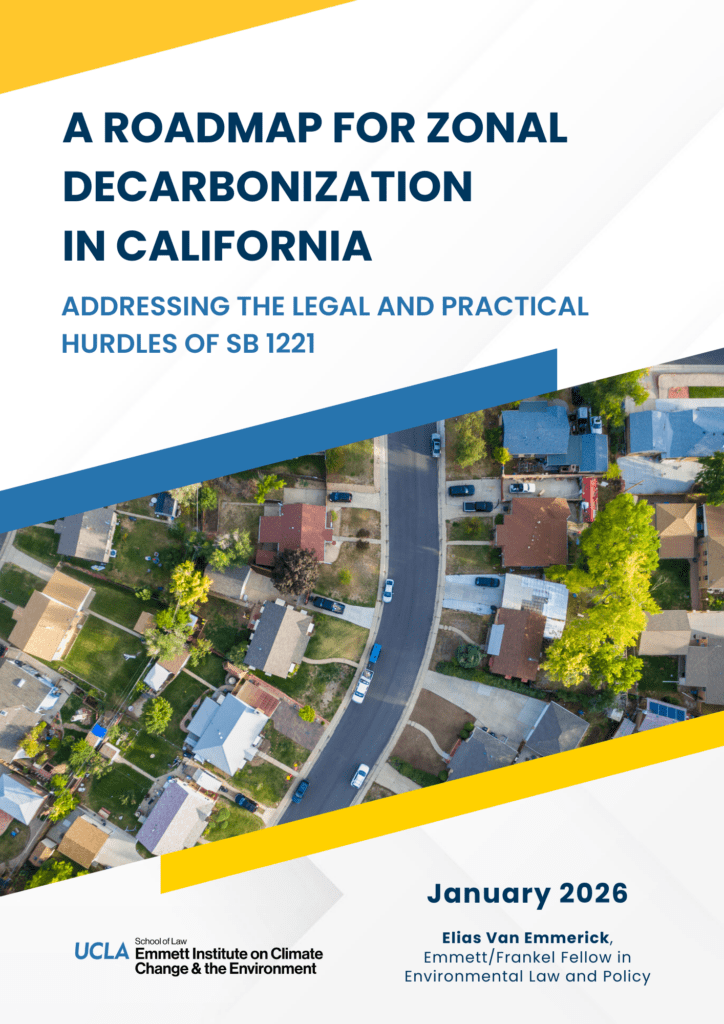
In a new paper, I seek to address the legal and practical hurdles that SB 1221 will likely face. The brief, A Roadmap for Zonal Decarbonization in California, is the first in a series from the Emmett Institute on legal insights for the gas transition. In it, I discuss the promise of SB 1221, its potential pitfalls, and issue recommendations for utilities and policymakers to make the most of the lessons learned during this pilot program, as the utilities begin the crucial work of engaging with communities in these zones. The brief tackles questions around cost recovery, which have stalled prior decarbonization projects, the legal “obligation to serve,” and offers recommendations for the CPUC. It stresses the need for proactive, community-centered outreach to ensure participation, broad definitions of possible benefits in the cost-benefit analyses underlying electrification viability, and expansive reporting requirements to ensure that lessons learned from this program can assist larger-scale decarbonization efforts down the road. The brief recommends the CPUC:
- Engage trusted messengers with established links to target communities to conduct proactive outreach and generate community buy-in
- Define a consistent method of conducting cost-benefit analyses that does not overestimate the cost of electrification or underestimate the costs of gas projects
- Examine the differing incentives faced by single-fuel gas utilities versus dual-fuel utilities, and design a compensation mechanism that aligns utility incentives with those of California ratepayers.
SB 1221 is a big step towards California’s decarbonization goals, but how it is implemented will determine whether the program lives up to its potential. With this brief, I hope to lay out some steps to maximize the value this pilot program can bring to the longer-term project of switching California away from gas altogether.
Reader Comments
4 Replies to “Crafting a Roadmap for Zonal Decarbonization in California”
Comments are closed.



About Elias

Elias van Emmerick(he/him) is the 2025-2027 Emmett Frankel Fellow in Environmental Law and Policy at UCLA School of Law, where his work will focus on energy law and polic…
READ more
Your analysis of implementation challenges for SB 1221 is thoughtful and persuasive, but I’m troubled by your advocacy of “cost-benefit analyses that [do] not overestimate the cost of electrification or underestimate the costs of gas projects.” It sounds as if you want to load the dice in favor of electrification, contrary to the legislative intent. I would prefer that cost benefit analyses strive to estimate both classes of costs accurately.
Hi Martin,
I appreciate that feedback! My intent was not so much to load the dice in favor of electrification as it was to be realistic about the incentives utilities will face when implementing this program. Utilities (and especially single-fuel gas utilities) may like to paint a rosy picture of the costs of gas infrastructure maintenance, and have an incentive to overestimate costs of electrification. I think it’s up to the CPUC to ensure that a comprehensive, reliable estimate of costs ends up driving the decision rather than one that is the product of biased incentives. Absolutely agree that the goal should be to have both classes of costs be estimated accurately. Research by NRDC in Colorado shows that electrification usually comes out ahead when fairly compared, but it remains to be seen what that looks like in California.
What’s the plan for low income and fixed income folks and their homes?
These programs fully-fund the upgrades, and _should_ leave homes with lower ongoing operating costs (compared to if they’d not upgraded). Sounds like a great plan for fixed income folks!