















































A Tour of BYD’s Factory in Lancaster, California
The Drain is a weekly roundup of environmental and climate news from Legal Planet.

Next time you travel to Mexico, look out for seals, dolphins, and sharks. Not at the beach —when you’re driving. Those are names of a few of the EV models made by China’s BYD that are quickly proliferating in Mexico. The dolphin is a hatchback mini. The seal is a 4-door that looks a little like a Tesla. And the Shark is a plug-in hybrid truck that the company advertises as una estación de carga eléctrica en cualquier lugar a cualquier hora (an electric charging station anywhere, anytime) for a superior camping experience.
Cars and trucks made by the Chinese automaker BYD (Build Your Dreams) are becoming hugely popular in Latin America and throughout the world. I saw BYD vehicles on the streets in São Paulo last spring when I visited Brazil, which boasts a BYD factory.
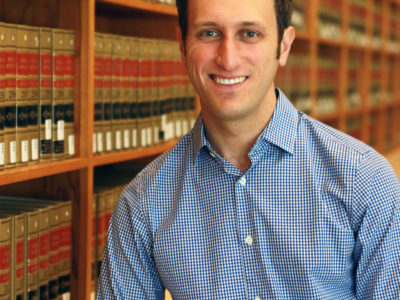
You probably know already that BYD does not sell these consumer vehicles in the United States thanks to rules and tariffs. But did you know that BYD does manufacture a wide range of electric buses and big-rig trucks in the U.S. and that their factory is right here in Los Angeles County? My UCLA colleague Alex Wang recently took his law students on a factory tour and I got to tag along.
The Lancaster factory is massive. It opened in 2013 and has expanded over the years to occupy 550,000 square feet. It’s the size of several football fields, with employees working on different stations devoted to trucks, transit buses, and school buses. We saw no robots and the facility in fact uses very little automation. We saw lots of banners with slogans like “Do it right the first time.”
The company recently rebranded in the U.S. as RIDE (“real innovation delivered with excellence”), but the spinoff is a subsidiary of BYD. When I wrote recently about the Trump administration trying to slow the trend toward of school districts turning to electric school buses, I was interested in how that market is changing because the RIDE factory in Lancaster makes lots of them.

In 2021, the same year that Congress passed the funding for the Clean Bus Program, BYD started making battery-electric school buses. It now offers three sizes and styles of zero-emission school buses. The vehicles are more expensive than gas-powered buses, but I’m told they typically pay for themselves in gas savings after 7 to 8 years. That’s not counting the public health benefits and savings, which are harder to quantify but nonetheless very meaningful for low-income communities that rely more on bus transportation.
The RIDE facility in Lancaster is also interesting because it signals BYD’s commitment to maintaining a foothold in the U.S. even though it doesn’t sell cars to Americans. Their buses are built by members of the SMART Union Local 105. The company sponsors local events like parades. And they supply the local transit agency: the Antelope Valley Transit Authority is the first and largest all-electric fleet in the country thanks to BYD buses. Their school buses are used in school districts in California and Oregon among other states. In California, Assembly Bill 597 passed in 2023 requires new school buses bought or contracted by California local education agencies to be zero-emission, where feasible, starting in 2035. With the federal government trying to move away from EV buses, it will be interesting to see if the RIDE factory pivots more to delivery trucks.
At the start of this year, BYD overtook Tesla as the largest purveyor of electric vehicles — one more example of how China is leaving us in their dust when it comes to green tech. My colleague Alex Wang explores the seeds of China’s decades of green development strategy in his new book “Chinese Global Environmentalism.”
“We’re at a very puzzling and remarkable moment right now” Wang said in an interview last week with Air Talk on LAist. Wang was explaining the climate contradictions in China now being the largest emitter of greenhouse gases and the global leader of EV technology. “There are now many EV brands that Americans have never heard of that are being sold around the world,” Wang said. Decades ago, China saw it couldn’t compete with the U.S. and Japan on making gas cars but saw a clean slate in EVs and other tech like solar panels. The results are now in the headlines each week.
BYD made news when it revealed its second-generation Blade battery with ultra-fast charging speeds.” The second-generation Blade battery can charge from 10-70% in just about five minutes and from 10-97% in under 10 minutes,” according to Inside EVs. Hopefully, U.S. automakers realize the strategic benefit of not ceding this market to China. Americans’ appetite for EVs is not going away: Though new EV sales in the U.S. dipped 27% in February compared to a year earlier, used EV sales rose 29%, Cox Automotive reports.
Meanwhile, what is the U.S. doing? The Trump administration just upped its battle with California over our state’s nation-leading vehicle-emission standards, by suing air regulators over rules aimed at curbing pollution from cars. Speaking to the New York Times, a spokesperson for Gov. Newsom brought it back to China: “While the Trump administration surrenders the future of the auto industry to China, California will continue competing globally to win the clean vehicle market.”
But wait there’s more. By waging a trade war of tariffs targeted neighbors like Canada, the U.S. is driving other countries into the arms of Chinese automakers. Canada’s Prime Minister recently reversed years of Canadian industrial policy and slashed tariffs to allow in a limited number of Chinese EVs. About 50,000 vehicles can be imported each year at a tariff rate of 6 percent to start but over five years, imports could grow to 70,000 vehicles annually, David Ferris reports for Politico. Canada turning to Chinese companies like BYD is a BFD. “It’s a situation that the U.S. and Canada sought to avoid for years, worried that the introduction of China’s low-cost, high-tech EVs would undermine domestic automakers and lead to Chinese surveillance,” Ferris writes.
Pretty soon, you won’t have to visit Mexico to see those seals, dolphins, sharks, and other EVs with the BYD logo. Americans driving around Michigan and New York may spot their northern neighbors cruising in Chinese EVs when they come across the border.
Welcome to The Drain, a weekly roundup of environmental and climate news. Our song of the week is “Cars” by Gary Numan as covered by Nine Inch Nails.
Affordability and Energy

Will I see you on April 3 at UCLA for the Emmett Institute symposium “Can Abundance Be Sustainable?” It’s free and open to the public but you must reserve a spot here. Three expert panels will explore how affordability concerns intersect with growing the grid; the transition away from fossil fuels; and building affordable housing.
The Senate overwhelmingly approved the 21st Century ROAD to Housing Act, which Sen. Elizabeth Warren has described it as a “meatball” because it has so many different ingredients. Pundits across the ideological spectrum described the bill as the most significant housing package in decades.
If there may be one silver lining in Trump’s deranged war on Iran it’s that it will likely speed up the renewable-energy transition, Ryan Cooper writes at American Prospect, looking at the energy security argument as prices for fossil fuels surge. The sun and wind are looking better and better.
It’s not just China either: Pakistan, Nepal, and other countries are seeking the relative security in solar, EVs, and batteries during these tumultuous times for fossil fuel markets, Julia Simon reports for NPR.
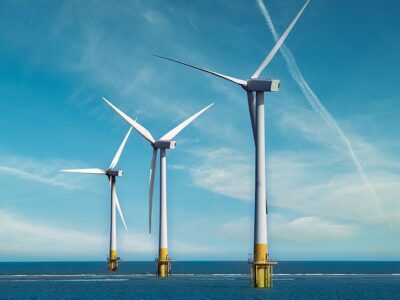
And look! All five offshore wind farms under construction in the U.S. are on track to hit major milestones this month. Revolution Wind turned on last Friday. The 704-megawatt offshore wind farm started pumping electricity onto New England’s grid from off the coast of Rhode Island.
Massachusetts’ Vineyard Wind is also complete but hasn’t fully come on line, Maria Gallucci reports for Canary Media.
And yet the administration is drafting settlement agreements that would pay $1 billion to TotalEnergies, the French energy company, to let it kill two wind farms off New York State and North Carolina, according to reporting by Maxine Joselow at The New York Times. Paying companies to NOT build renewable energy is a new level of bananas. Like catch-and-kill but for wind energy.
Washington state outsmarted Trump. Governor Bob Ferguson is expected to sign a bill on Wednesday that accomplishes one very narrow goal: It taxes the hell out of any electricity generated by the TransAlta Centralia coal plant, effectively pricing it out of the market. Emily Pontecorvo writes that the legislation is “a middle finger to Trump’s coal agenda.”
The New Jersey Board of Public Utilities last week approved three major measures to boost clean energy provision and address energy affordability, which the state’s new governor, Mikie Sherrill, has made a priority early in her tenure.
The AI power boom has the Natural Resources Defense Council cautiously supporting nuclear. NRDC filed comments in support of an early step toward restarting an Iowa plant Google is planning to use for a data center. “This is unprecedented for us because it marks the first time in our history that we have taken action in support of an individual nuclear power plant,” Manish Bapna told Axios.
California has the power to cap oil refinery profits and curb gas prices. So why isn’t it using those powers? Alejandro Lazo asks for CalMatters.
More California

Oil is now flowing through that problematic pipeline near Santa Barbara for the first time in more than a decade after the Trump administration ordered offshore production to resume there despite strong objections from California officials. As Nick Welsh reports for the Santa Barbara Independent, Trump intervened on Sable Offshore’s behalf, delegating his Secretary of Energy to invoke the Defense Production Act to “compel” Sable to resume production. According to a press release issued by Sable Monday morning, the company began production on Saturday. But Attorney General Rob Bonta filed an emergency motion in U.S. District Court for the Central District asking a judge to stop Sable from operating its pipeline system.
The administration is taking executive power into “uncharted territory by asserting it can override state law to restart a California oil pipeline, but such an expansion of presidential authority over energy infrastructure may invite skepticism from courts,” Keith Goldberg writes for Law360.
Experts tell Blanca Begert at the LAT that the unique geology of California’s fields, and the nature of its heavy crude, make it hard for companies to rush drilling here, even as gas prices spike.
AG Bonta also submitted comment letters opposing two Draft Supplemental EISs issued by the U.S. Bureau of Land Management that insufficiently evaluate the environmental harms of oil and gas development on federal lands across 20 counties in central and coastal California.
Cap-and-invest is moving forward in California: Public comments from state lawmakers, oil interests, environmental advocates and consumers flooded into CARB in advance of this week’s deadline, and the agency will have until May to revise the plan and put it to a final vote.
Jennifer Gollan reports for the San Francisco Chronicle that an AI-powered platform seemingly sent comments to the Bay Area Air Quality Management District on behalf of people without their consent as part of a campaign pollution rules. This is the second story of its kind, so air regulators have taken note about the new technology.
Gubernatorial candidate Tom Steyer sat for an interview with Emily Atkin for HEATED’s new video podcast format. She asks “can a billionaire really fix California’s problems” including the climate crisis? Bonus moment when Steyer realizes they’d met on his plane during a trip to the XL Keystone Pipeline protests.
Sammy Roth covered “one of the biggest climate stories nobody is following”: the recent resignation of the Los Angeles Department of Water and Power’s CEO. “LA is striving for 100% clean energy by 2035, an extremely big deal. Whoever replaces Janisse Quiñones has huge shoes to fill,” he writes.
Ariane Lange at the Sac Bee told the story of one dangerous road, and many like it, that have been the casualties of California’s meager investments in infrastructure for people (including kids) walking or biking. “Active transportation wasn’t a high priority: The state axed $400 million of a $1 billion increase from Newsom in 2022. The money has not been restored.”
The Dodgers have sold the naming rights to the field at Dodger Stadium to Japanese fashion giant Uniqlo, The Athletic reports. No word on whether it could affect the 76 gas logo that has been sitting atop the outfield signs for decades.
The Nation’s Alexandra Tey took a look at why climate activists are increasingly protesting teams like the Dodgers for their oil and gas sponsorships. I spoke to Tey for the story, sharing insights from previous research on oil and gas sponsorships.
And if you’re interested in learning more about how activists can leverage strategic communications in campaigns like that, activist/organizer Zan Dubin will speak with award-winning journalist and media strategist Tracy Wholf for this LA Climate Week event devoted to that topic.
Extreme Weather
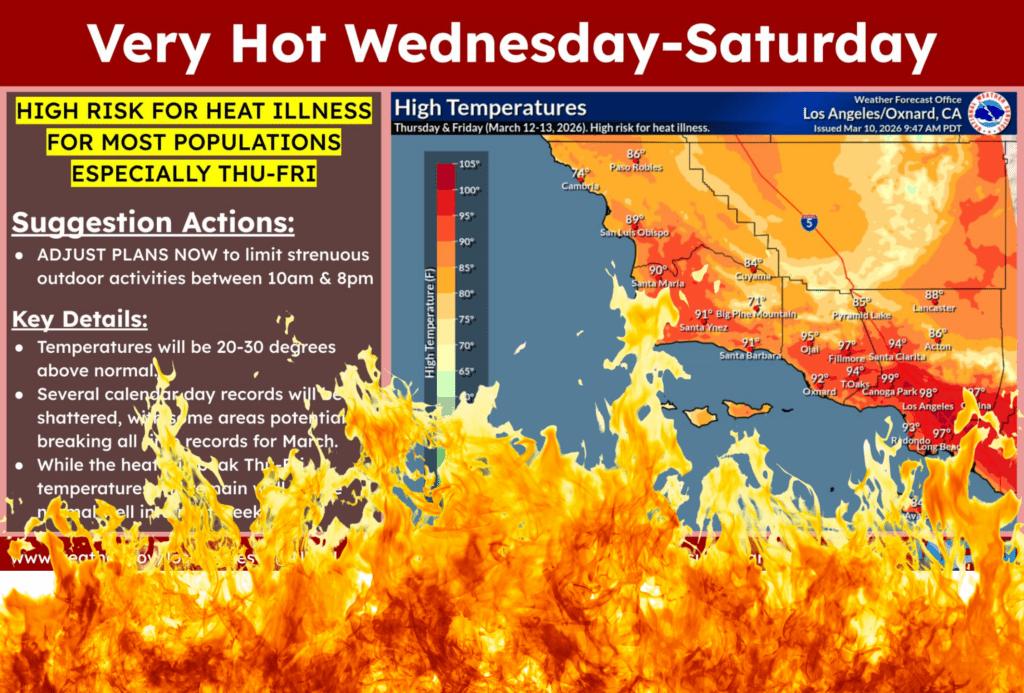
It’s way hotter than usual here in LA. As I wrote last week, it’s foreshadowing weird weather to come in 2026.
Triple-digit temperatures as high as 100+ degrees Fahrenheit have led to an extreme heat warning from Tuesday to Friday. LA officials held a press conference about protecting residents from extreme heat. If only someone had a plan for how to make LA safer? Wait, we do!
The UCLA Emmett Institute recently published a policy brief looking at ways for the City and County of L.A. to reimagine and remake the outdoor urban environment to reduce risks to vulnerable communities ahead of the World Cup and 2028 Olympics. This analysis, from the end of 2025, explores opportunities to develop and implement solutions that rely on the built environment, with an emphasis on street-level shade structures.
As LAist notes, by the time the World Cup arrives in Los Angeles this summer, it could be really hot and LA Metro is planning to use the World Cup as a test for the 2028 Olympics.
Alissa Walker, who’s covered this extensively for Torched, asks “Maybe we should be using this week to test those tools before the World Cup?”
The warm winter had already left very little snow in California’s Sierra Nevada, Ian James reports for the LA Times. The Sierra snowpack measures 45% of average for this time of year, according to state data, down from 73% of average in late February.
A mega storm is pummeling the Midwest with a blizzard and the Northeast with torrential rain. Forecasters said mid-Atlantic states and Washington, D.C., were at greatest risk for high winds and even tornadoes.
Trump administration and its war
On Tuesday, a tanker off the coast of the UAE near the Strait of Hormuz was hit by a projectile, just the latest attack on oil and gas infrastructure there. Leaders in some countries are asking residents to cut back their energy use — not yet here.
My Legal Planet colleagues on the environmental impacts of the war on Iran: UC Berkeley’s Shruti Sarode wrote about the juxtaposition of clean air in the Bay Area and the black poisonous rain hanging over Tehran. Ethan Elkind hosted a live call-in show on KALW discussing the environmental and public health impacts of the US–Israeli war on Iran.
A small cadre of political lawyers are driving the administration’s campaign to sue states to stop them from acting on climate change. Pamela King profiles the group of new DOJ lawyers for Greenwire.
The EPA on Friday proposed rolling back limits on emissions of ethylene oxide, a carcinogenic chemical used in the sterilization of medical devices, because of course.
And the brave EPA employees who publicly dissented from the Trump administration’s environmental rollbacks — who were then reprimanded by the agency — did NOT run afoul of the agency’s own ethics rules, Kevin Bogardus reports for E&E. “For months, many of us understood that we had followed the rules,” scientist Allison West wrote on LinkedIn. “Federal employees are trained extensively on ethics and the Hatch Act. We know where the lines are, and the letter respected them.”
About Evan

Evan George is Director of Communications for the UCLA Emmett Institute, a leading environmental law center. He also writes The Drain, a weekly roundup of environmental a…
READ more
Reader Comments