























































California Has a Neighborhood Decarbonization Law. How Does It Work?
New FAQ from UCLA outlines what we know (and don’t know) about the implementation of SB 1221, California’s landmark neighborhood decarbonization law.
By Sooji Yang, Lauren Dunlap, Elias van Emmerick, and Gregory Pierce
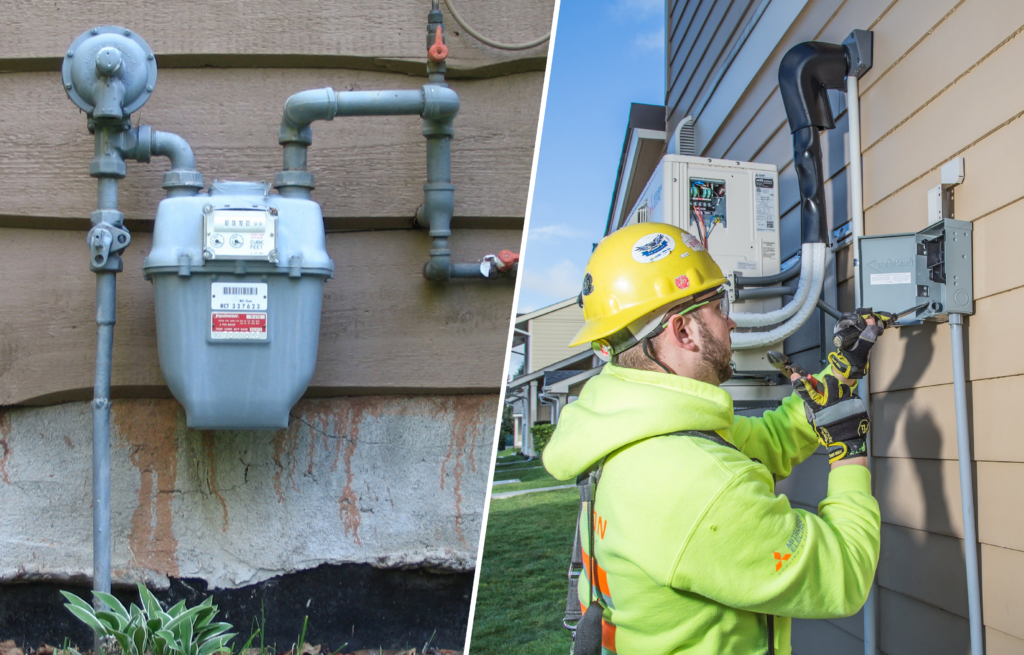
The California Public Utilities Commission (CPUC) is currently navigating a wide array of questions from stakeholders as it designs a first-of-its-kind program to transition entire blocks of buildings from natural gas to zero-emission alternatives. Guidelines for the pilot program—a central component of Senate Bill (SB) 1221—must be finalized by this July. But its mandate is unprecedented. While building decarbonization has historically relied on piecemeal, appliance-by-appliance electrification, SB 1221 shifts the focus to neighborhood-scale transitions and the strategic removal of natural gas infrastructure. With no obvious models to follow or learn from, residents, utilities, advocates, and researchers alike are raising critical questions about what the program will look like in practice.
Neighborhood decarbonization is an emerging yet promising climate strategy that transitions clusters of buildings from gas to all-electric service, helping the state drastically reduce the greenhouse gas emissions that stem from gas use in buildings. By decarbonizing at scale, the state can retire aging gas pipelines entirely, redirecting the saved costs of gas pipeline repair and maintenance toward zero-emission alternatives. SB 1221 offers Californians an initial opportunity to decarbonize their homes and neighborhoods while accessing benefits like cleaner indoor air quality, improved health, and potential bill savings.
While the rollout of this novel policy has sparked public interest, it has also raised important questions around how it is being designed and implemented. These include questions about state definitions as well as logistical questions about how residents can navigate the process. Building on CPUC’s FAQ that helps answer several fundamental questions, the UCLA Luskin Center for Innovation recently published an FAQ that explores additional questions and provides Luskin Center for Innovation’s independent analysis on where things stand with SB 1221. Read the full FAQ here.
Below, we highlight four of the main themes that arise from the many open questions and discussion points facing the CPUC:
Community Decision-making: SB 1221’s biggest strength may be its focus on community-wide decarbonization. Rather than pursuing piecemeal projects customer-by-customer, neighborhood decarbonization allows a utility to end gas service to an entire project area if a supermajority (67% or more) of customers in that area agree to it. Exactly how agreement or voting will work, however, remains unclear. The bill does not prescribe a specific voting mechanism, so utilities and the CPUC will have to jointly design a community decision-making process.
Cost: Who pays for neighborhood decarbonization remains a large open question. No explicit funding support has been defined by the CPUC as of yet. Utilities may be asked to fund these projects with the cost savings they receive from not replacing gas assets. SB 1221 requires that projects be “cost-effective,” meaning the zero-emission alternatives must cost less than repairing or replacing gas infrastructure within the target community. Utilities (and therefore ratepayers) should, in theory,save money overall even if asked to fund electrification. Placing the onus on utilities to cover these costs instead of ratepayers would also align with SB 1221’s intentional focus on disadvantaged communities.
Consumer choice: SB 1221 only requires 67% of customers in a targeted area to consent to decarbonization, meaning up to 33% of affected customers involuntarily losing gas service. While SB 1221 aims to facilitate neighborhood decarbonization at scale with a lowered consent threshold from 100% to 67%, this mechanism has led to some public frustration with the possibility of gas service ceasing without their approval, citing worries about property values decreasing and their preference for gas appliances. It is important to keep in mind that California’s policy goals and the broader climate imperative require homes to decarbonize sooner or later—SB 1221 provides a pathway for households that wish to do so sooner.
Transparency: One of the hallmarks of SB 1221 is its effort to improve data transparency. The law requires utilities to publish maps of upcoming gas pipeline replacement projects, which is critical for understanding which neighborhoods are good candidates for SB 1221 pilot projects. Yet utilities are temporarily permitted to keep specific locations of pipeline replacement projects confidential. While interested parties can theoretically request this confidential information if they sign a nondisclosure agreements, such legally binding agreements can restrict meaningful community and stakeholder engagement—and webinar commenters shared that utilities did not respond to requests for the information. The CPUC has yet to make a final decision on whether to require utilities to release the full, street-level pipeline replacement information publicly, and several advocacy groups have filed letters and public comments asking the agency to do so.
With its focus on not only electrifying homes, but avoiding investments in new fossil fuel infrastructure, SB 1221 pioneers critical “exnovation” policy—so it’s not surprising that there are many questions about how to implement it. While not all of the questions we discuss above have a clear-cut solution or answer, we expect that some of them will be addressed in the program guidelines that CPUC must complete by July 1, 2026. For readers who are interested in weighing in on these guidelines, our FAQ outlines some of the options for how to share your opinions—as does this past Legal Planet post, which calls for more climate-focused Californians to join CPUC public forums. Stay tuned for updates and feel free to submit public comments in the meantime.
This post is co-written by Sooji Yang, Graduate Student Researcher at the UCLA Luskin Center for Innovation; Lauren Dunlap, Project Manager at the UCLA Luskin Center for Innovation; Elias van Emmerick, Emmett/Frankel Fellow in Environmental Law & Policy at the UCLA Emmett Institute; and Gregory Pierce, Senior Director of the UCLA Luskin Center for Innovation.


About Guest

Legal Planet welcomes contributions from policy partners and professors from other environmental law programs.…
READ moreAbout Elias

Elias van Emmerick(he/him) is the 2025-2027 Emmett Frankel Fellow in Environmental Law and Policy at UCLA School of Law, where his work will focus on energy law and polic…
READ more
Reader Comments